Samsung Galaxy Watch 8 Review 2026: Still Worth It?
The Samsung Galaxy Watch 8 arrived in July 2025 with a bold new look and a pile of health features. Now it is late 2026, the Galaxy Watch 9 sits on store shelves, and prices on the Watch 8 have fallen hard.
That changes the whole conversation. A watch that felt expensive at launch suddenly looks like one of the smartest buys on Android.
I wore this watch daily for months. I slept in it, ran with it, swam with it, and got genuinely annoyed by parts of it. This review covers the good, the bad, and the things Samsung quietly hopes you will not notice. If you want a straight answer about whether the Galaxy Watch 8 still earns a spot on your wrist in 2026, keep reading.
In a Nutshell:
- The design is the real upgrade. Samsung swapped the old circular case for a cushion shape borrowed from the Watch Ultra. It sits flatter, weighs just 30g in the 40mm size, and is the most comfortable Galaxy Watch ever made. I forget I am wearing it, even in bed.
- Battery life improved but still needs a nightly charge. The 40mm model packs 325mAh and the 44mm model holds 435mAh. Expect roughly 28 to 34 hours with the always on display active. Heavy workout users will land closer to a single day.
- Gemini on the wrist actually works. Voice replies, reminders, texts, and quick searches happen fast. It is the biggest software leap Samsung has shipped in years, though it needs your phone nearby.
- New health metrics are interesting but not medical. Antioxidant Index and Vascular Load give you trends, not diagnoses. Treat them as nudges toward better habits rather than clinical readings.
- The raised glass is a durability risk. Sapphire crystal helps, but the display stands proud of the case. A screen protector is close to mandatory.
- Price is the headline in 2026. Launch prices sat at $349 and $379. Street prices now dip far below that, which makes this the best value smartwatch for Galaxy phone owners right now.
What Is the Samsung Galaxy Watch 8?

Last update on 2026-11-12 / Affiliate links / Images from Amazon Product Advertising API
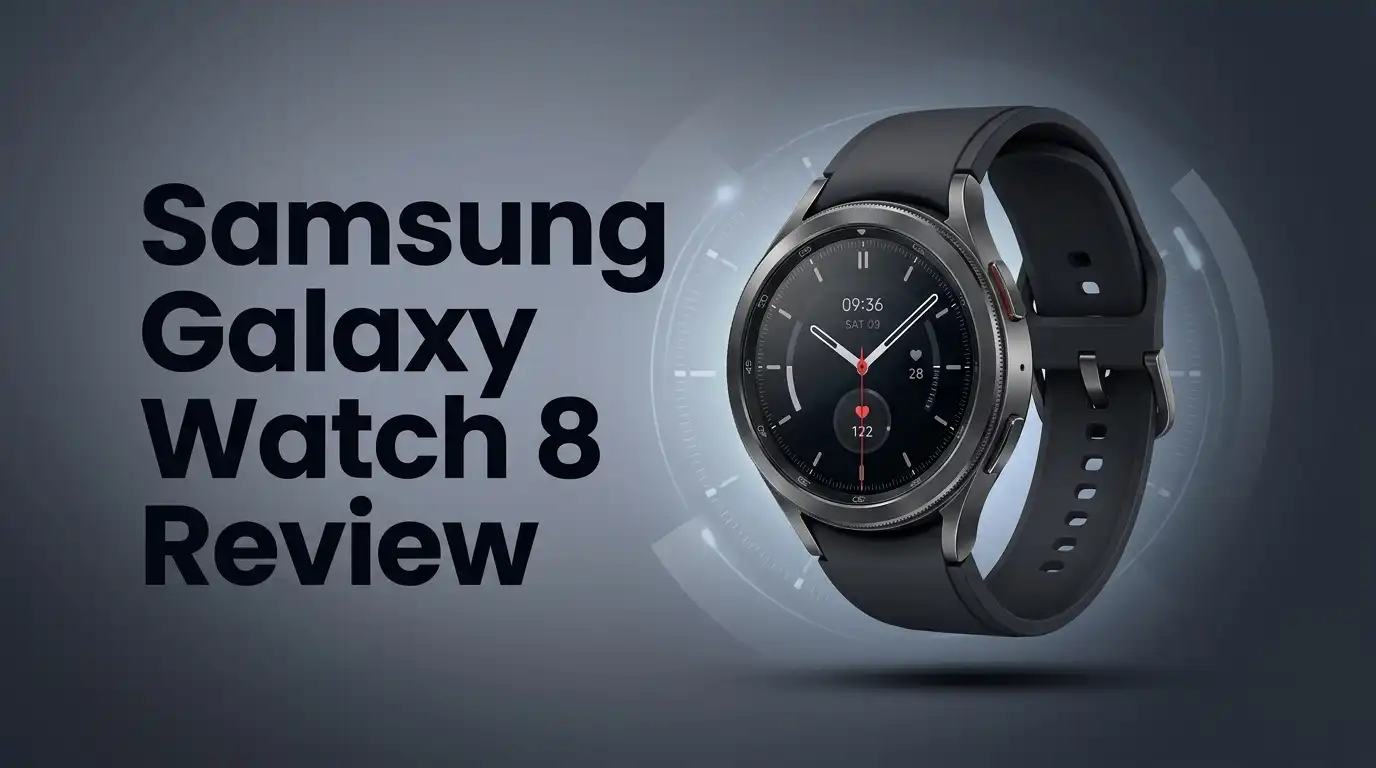
The Galaxy Watch 8 is Samsung’s mainstream smartwatch for Galaxy phone users. It runs Wear OS 6 with the One UI 8 Watch skin on top. Inside sits the Exynos W1000 chip, a 3nm five core processor paired with 2GB of RAM and 32GB of storage.
You get two sizes. The 40mm model carries a 1.34 inch Super AMOLED screen. The 44mm model steps up to 1.47 inches. Both hit 3,000 nits of peak brightness, which is genuinely bright.
The case is armor aluminum with sapphire crystal glass. Water resistance covers 5ATM plus an IP68 rating, so swimming and showering are fine. This is a full smartwatch, not a fitness band. It handles calls, payments, apps, and maps.
Unboxing Experience: What Actually Arrives
Samsung keeps the box small and plain. Mine was a slim white card box with a photo of the watch on the lid. No plastic wrap, no foam blocks, just recycled paper trays.
Lift the lid and the watch sits face up in a molded tray. Underneath you find the magnetic charging puck with a short USB C cable, a spare band strap in a second size, and a thin paper quick start guide. There is no wall plug in the box. If you do not own a USB C charger already, buy one.
The watch ships with a plastic film over the screen. Peel it slowly. The sport band feels soft and grippy straight out of the box, with no rubber smell. First boot took about four minutes and pairing over the Galaxy Wearable app took another five.
Design and Build Quality
The cushion design is the reason people notice this watch. Samsung set a round display inside a squarish aluminum body. The band flows into the case instead of hanging off metal prongs. It looks more like jewelry than gadgetry.
Weight matters here. At 30g for the 40mm and 34g for the 44mm, this is featherlight. I wore it for six straight nights and never felt pressure on my wrist bone.
The underside sensor hump is much flatter than on the Watch 7. That single change fixed my biggest complaint about the old model.
The downside is that raised glass. It sticks up about two millimeters above the case. I clipped mine on a door frame within the first week. The sapphire survived, but I would not push my luck twice.
Display and Daily Readability
The Super AMOLED panel is excellent. Blacks are deep, colors pop, and the 438 by 438 resolution on the 40mm looks sharp at arm’s length. Peak brightness of 3,000 nits means you can read it in direct summer sun without shading your wrist.
The always on display now feels usable. On the Watch 7 I switched it off to save power. On the Watch 8 I leave it on and still finish the day with charge left.
Touch response is quick. The bezel swipe gesture works better too, because the raised glass gives your finger somewhere to travel without covering text.
One small gripe. Auto brightness sometimes overshoots indoors at night. It flashes bright for a second before settling. A minor annoyance, but a real one.
Top 3 Alternative for Samsung Galaxy Watch 8

Last update on 2026-11-12 / Affiliate links / Images from Amazon Product Advertising API
Google Pixel Watch 4

Last update on 2026-11-12 / Affiliate links / Images from Amazon Product Advertising API
Apple Watch Series 11

Last update on 2026-11-12 / Affiliate links / Images from Amazon Product Advertising API
Samsung Galaxy Watch Ultra (2025)
Performance and One UI 8 Watch Software
The Exynos W1000 is the same chip as the Watch 7, and that is fine. Nothing stutters. Apps open instantly, watch faces animate smoothly, and swiping through tiles feels frictionless.
One UI 8 Watch brings a redesigned tile system. Tiles now group into Health, Fitness, and Basic categories. Each card shows useful data at a glance. Tap it and the full app opens. You can rearrange everything from your phone in seconds.
The Now Bar sits at the bottom of the screen and shows live activity, like a running timer or music playback. It borrows directly from Samsung’s phone software and it works well.
Notifications arrive fast. My honest complaint is that they are too gentle. The haptic buzz is soft, and I missed several messages while walking outdoors.
Gemini and Smart Features
Gemini replaces Google Assistant, and the difference is large. Ask a question and you get a spoken answer plus text on screen within two seconds. It handles chained requests well, like looking up a restaurant address and texting it to a contact.
I used it for reminders, timers, calendar entries, and quick facts. It rarely failed. The main limits are practical rather than technical. Gemini needs your phone nearby and a data connection to do anything clever.
Two weak spots stood out. Gemini does not always launch turn by turn directions on the watch itself, pushing you to your phone instead. It also stops listening after replying, so every follow up needs a fresh tap.
Samsung Pay, Google Maps, Spotify offline playback, and call handling all work exactly as expected.
Health Tracking: Antioxidant Index, Vascular Load, and Sleep
Samsung added two new metrics. Antioxidant Index reads carotenoid levels in your skin. You remove the watch, press your thumb to the sensor for five seconds, and get a score. Most people land in the low band. Raising it takes weeks of eating more colorful fruit and vegetables, not days.
Vascular Load measures strain on your circulatory system overnight. It needs three nights to build a baseline, then reports whether your load is higher, lower, or steady.
Sleep tracking remains a strength. You get stage breakdowns, a sleep score, a sleep animal type, and Bedtime Guidance that suggests a consistent schedule. Sleep apnea detection is available in supported regions.
Treat all of this as wellness data. It spots trends. It does not replace a doctor.
Fitness Tracking and the AI Running Coach
The Running Coach is the standout fitness feature. It starts with a 12 minute assessment run and scores you from level 1 to 10. You then get a four week plan with four workouts per week, aimed at a 5K, 10K, half marathon, or full marathon.
During runs the coach speaks up every minute with pace feedback and encouragement. It is pushy. It also works. I ran farther than I would have on my own.
GPS lock takes about eight seconds outdoors. Distance tracking matched my phone within two percent across ten runs. Heart rate holds steady during steady state cardio but lags during sharp interval spikes, which is normal for wrist optical sensors.
Auto workout detection for walks and cycling is fast and accurate. Strength training rep counting remains hit or miss.
Battery Life Tested in Real Use
Here are honest numbers from my testing. On the 40mm model with the always on display enabled, moderate notifications, one 30 minute GPS run, and sleep tracking, I averaged about 30 hours before hitting 10 percent.
The 44mm model with its 435mAh cell stretched closer to 38 hours under the same routine. Turning off the always on display added roughly eight hours to either size.
Heavy days drain it fast. A 90 minute GPS workout plus frequent Gemini use dropped me to 20 percent by early evening.
Charging takes about 75 minutes from empty to full on the included puck. A 30 minute top up gets you to roughly 45 percent.
Realistic expectation: charge it every night while you shower, then wear it to bed.
What the Galaxy Watch 8 Does Not Do Well
Authentic reviews name the flaws, so here they are.
Battery life is still only average. Garmin and Amazfit rivals last five days or more. Samsung gives you one to one and a half.
It is nearly useless with an iPhone. Pairing is not supported. Buy it only if you own an Android phone, and ideally a Galaxy.
The raised display invites damage. Sapphire resists scratches, not impacts. Corner strikes are a genuine risk.
Some health features are region locked. ECG and blood pressure monitoring require a Samsung phone and regulatory approval where you live.
Third party app selection remains thin compared with the Apple Watch ecosystem.
Finally, the upgrade over the Watch 7 is modest if you already own one. Same chip, same sensors, new shell and software.
Galaxy Watch 8 vs Galaxy Watch 8 Classic

Last update on 2026-11-12 / Affiliate links / Images from Amazon Product Advertising API
The Classic exists for people who want a real watch feel. It uses a stainless steel case, weighs 63.5g, and brings back the physical rotating bezel. Spinning that bezel to scroll menus is satisfying in a way touchscreens never match.
It comes in one 46mm size with a 1.34 inch display and a larger 445mAh battery. Storage doubles to 64GB. There is also a new Quick Button you can map to a workout or app.
The bezel protects the glass, which solves the durability worry on the standard model.
The trade offs are weight and price. The Classic is twice as heavy and launched at $499. If you sleep in your watch or have slim wrists, the standard Watch 8 is the better daily companion.
Price in 2026 and Where the Value Sits
Launch pricing was $349 for the 40mm, $379 for the 44mm, and $499 for the Classic. Those numbers felt steep against the Watch 7.
Everything changed once the Galaxy Watch 9 launched in July 2026. The Watch 8 was discontinued, and retailers began clearing stock. Discounts of $50 to $120 became routine, with the 44mm regularly dipping near the $300 mark and lower during sale events.
At that price the value equation flips completely. You get a 3nm chip, sapphire glass, Gemini, and a current software platform for less than many midrange trackers.
Check the listing carefully. Some sellers offer international versions with different warranty coverage. Buy the model sold for your region.
Pros and Cons
Pros
- Outstanding comfort. The 30g frame and flat sensor puck make all day and all night wear effortless.
- Brilliant 3,000 nit display that stays readable in direct sunlight.
- Gemini integration is genuinely fast and handles real tasks, not just trivia.
- Improved battery over the Watch 7, enough to keep the always on display enabled.
- Sapphire crystal and 5ATM water resistance for solid everyday protection.
- Running Coach delivers structured plans that beginners will actually follow.
- Strong 2026 pricing after the Watch 9 launch.
Cons
- Only about one day of battery life, which lags far behind Garmin rivals.
- Raised glass sticks out and is exposed to knocks.
- Android only. No iPhone support at all.
- Notification haptics are too soft and easy to miss.
- Antioxidant Index feels like a novelty for most users.
- Minor hardware upgrade over the Galaxy Watch 7.
- No charging brick included in the box.
Who Should Buy the Galaxy Watch 8?
Buy it if you own a Galaxy phone and want the smoothest possible pairing. Samsung Health, Samsung Pay, camera control, and ECG all work best inside that ecosystem.
It suits casual runners, walkers, and sleep trackers who want guidance without a subscription fee. Everything here is free after purchase, which is not true of Fitbit Premium.
It also fits people with smaller wrists. The 40mm model is one of very few full smartwatches that does not look oversized.
Skip it if you need multi day battery life. Trail runners, hikers, and travelers should look at the Watch Ultra or a Garmin instead.
Skip it too if you already own a Galaxy Watch 7 and are happy with it. The jump is not worth full price.
Final Verdict: Is the Galaxy Watch 8 Worth Buying in 2026?
Yes, for the right person. The Galaxy Watch 8 is the most comfortable and most polished smartwatch Samsung has built. The cushion design fixed the fit problem. Wear OS 6 and Gemini fixed the software sluggishness. The bigger battery made the always on display practical.
It is not perfect. One day of battery life is the ceiling, the exposed glass makes me nervous, and a few health metrics feel more like science experiments than tools.
But value carries the day. Now that the Galaxy Watch 9 has replaced it, the Watch 8 sells at prices that undercut almost every serious rival. For Android users who want a beautiful, fast, comfortable watch without paying flagship money, this is an easy recommendation.
Overall rating: 4.3 out of 5.
Frequently Asked Questions
Does the Galaxy Watch 8 work with an iPhone?
No. Samsung dropped iPhone support years ago. The Galaxy Wearable app is Android only. You need an Android phone running Android 11 or newer with at least 1.5GB of RAM. Some features, including ECG and blood pressure monitoring, require a Samsung Galaxy phone specifically.
How long does the Galaxy Watch 8 battery last?
Expect about 30 hours on the 40mm model and up to 38 hours on the 44mm model with the always on display enabled. Turning that display off adds roughly eight hours. Heavy GPS workouts cut the total significantly. Most people charge it once a day.
Is the Galaxy Watch 8 waterproof?
It carries a 5ATM rating plus IP68 protection and passes military grade durability testing. You can swim in a pool, shower, and get caught in rain without worry. Avoid hot tubs, saunas, and high pressure water jets, since heat and pressure exceed the rating.
Should I buy the Galaxy Watch 8 or wait for the Galaxy Watch 9?
The Galaxy Watch 9 launched in July 2026 and sells at full price. The Watch 8 now sells at a steep discount with most of the same daily experience. If budget matters, the Watch 8 is the better buy. If you want the newest sensors and longest software support window, choose the Watch 9.
Does the Galaxy Watch 8 need a subscription?
No. Samsung Health, sleep tracking, Energy Score, Running Coach, and all health metrics are free. Gemini works without a paid plan for standard requests. Only optional LTE service on cellular models requires a monthly carrier fee.
Can the Galaxy Watch 8 track blood pressure?
Yes, in supported regions and only when paired with a Samsung Galaxy phone. The feature requires calibration against a traditional cuff every four weeks. It is intended for tracking trends, not for diagnosing conditions. Always confirm readings with proper medical equipment.

Hi, I’m Lucy Jones, a dedicated watch enthusiast and reviewer. I spend my time hunting down, testing, and evaluating the most intriguing wristwatches on the market. My goal is to guide you through the overwhelming choices with honest, hands-on insights into every timepiece.