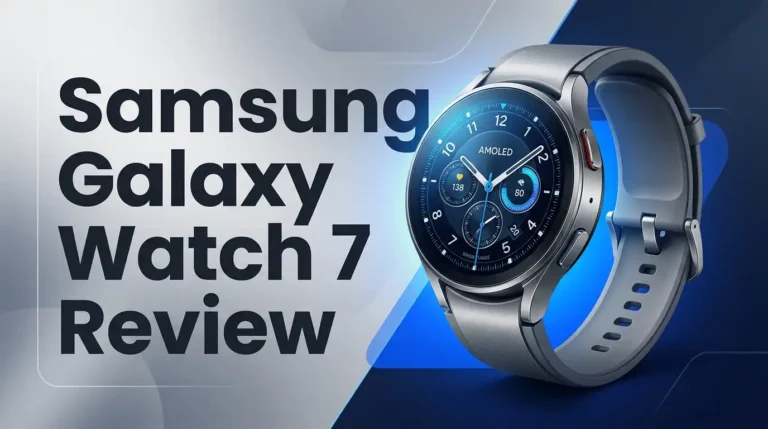
Samsung Galaxy AI Smartwatch 7 Review 2026: Still Worth It?
The Samsung Galaxy Watch 7 launched in 2024, and it still sits on store shelves in 2026. That alone says something. Most smartwatches vanish within a year.
This one hangs around because Samsung keeps pushing software updates to it, and because the price has dropped hard.
I wore this watch daily for several weeks. I tracked sleep with it. I ran with it. I let the battery die on me more than once. This review covers what the Galaxy Watch 7 gets right, what it fumbles, and whether you should spend money on it now that newer models exist.
In a Nutshell:
- The price is the strongest argument. The Galaxy Watch 7 launched at $299 for the 40mm model. In 2026 it regularly sells for far less. You get flagship level health sensors for midrange money, which is the single best reason to consider it today.
- Battery life is the weakest link. Real world use gives you roughly one full day, sometimes a bit more. If you sleep track and use the always on display, you will charge every single night. This frustrates people coming from Garmin or Fitbit.
- The Exynos W1000 chip still feels fast. Samsung moved to a 3nm five core processor here. Apps open quickly. Scrolling stays smooth. Two years later, there is no lag to complain about.
- Health tracking goes deeper than most rivals. You get FDA authorized sleep apnea detection, ECG, body composition, Energy Score, and the odd but interesting AGEs Index.
- It only makes sense with an Android phone. ECG and blood pressure features need a Samsung Galaxy phone. iPhone owners get nothing from this watch.
- Software support continues. One UI 8 Watch based on Wear OS 6 reached the Watch 7, bringing the Now Bar and new running tools. That extends the useful life of this device well into 2027.
Samsung Galaxy Watch 7 Overview
![Samsung Galaxy Watch 7 40mm Bluetooth AI Smartwatch w/Energy Score, Wellness Tips, Heart Rate Tracking, Sleep Monitor, Fitness Tracker, 2024, Cream [US Version, 1Yr Manufacturer Warranty]](https://smartwristvault.com/wp-content/plugins/aawp/public/image.php?url=YUhSMGNITTZMeTl0TG0xbFpHbGhMV0Z0WVhwdmJpNWpiMjB2YVcxaFoyVnpMMGt2TkRGTmIwRlpUR1pMYUV3dWFuQm58MTc5MDg1MjQyNw=)

Last update on 2026-09-29 / Affiliate links / Images from Amazon Product Advertising API
The Galaxy Watch 7 comes in two sizes. The 40mm version carries a 300mAh battery and a 1.3 inch screen. The 44mm version carries a 425mAh battery and a 1.5 inch screen. Both use Super AMOLED panels that hit 2,000 nits of peak brightness.
Inside sits the Exynos W1000, built on a 3nm process with five cores. Samsung paired it with 2GB of RAM and 32GB of storage. That storage jump matters because the Watch 6 gave you only 16GB.
You choose between Bluetooth and LTE versions. Colors include Green and Cream for the small size, Silver and Green for the large one.
The watch runs Wear OS with Samsung’s One UI Watch skin on top. It works with Android phones running Android 11 or newer.
The Unboxing Experience
Samsung keeps the box small and flat. Mine arrived in a white cardboard sleeve with the watch pictured on the front. Nothing feels premium about the packaging, and that is fine.
Slide the sleeve off and the watch sits face up in a molded tray. Lift the tray and you find the charging puck underneath, plus a second strap in a different length. Samsung includes both a small and a large band, so most wrists get a proper fit out of the box.
There is no wall adapter included. You get a USB C cable attached to the wireless charging puck and nothing else. Plan to use an old phone charger.
Setup took me about eight minutes. The Galaxy Wearable app found the watch instantly. The software update that followed took longer than the setup itself.
Design and Build Quality
Samsung went back to a full circle here. The Watch 7 drops the squarish edges some people disliked and returns to a clean round face. It looks like a watch, not a gadget.
The case uses Armor Aluminum. The glass is Sapphire Crystal, which resists scratches better than the standard glass on cheaper watches. After weeks of wear, mine picked up zero visible marks.
Weight sits at 28.8 grams for the 40mm model and 33.8 grams for the 44mm. You forget you are wearing it. That matters a lot for sleep tracking.
The watch carries 5ATM water resistance plus IP68 and MIL STD 810H ratings. You can swim with it.
One complaint: the bezel is touch sensitive only, not rotating. Fans of the old physical rotating bezel will miss it badly.
Display Quality
The Super AMOLED panel is genuinely excellent. The 44mm version pushes 480×480 pixels at 327 PPI. The 40mm version delivers 432×432 at 330 PPI. Text looks sharp at any size.
Peak brightness reaches 2,000 nits. I used this watch outdoors in direct summer sun and read notifications without squinting or cupping my hand over the screen. That brightness matches the Galaxy Watch Ultra.
Colors pop. Blacks look truly black because of the AMOLED technology. Watch faces with dark backgrounds blend into the bezel and make the display look larger than it is.
The always on display works well but eats battery. Turning it on cuts roughly ten hours off your total runtime based on my testing.
Auto brightness responds quickly and rarely gets it wrong.
Top 3 Alternative for Samsung Galaxy Watch 7

Last update on 2026-09-28 / Affiliate links / Images from Amazon Product Advertising API
Google Pixel Watch 3 (41mm)
![Apple Watch Series 10 [GPS 42mm case] Smartwatch with Jet Black Aluminum Case with Black Sport Band - S/M. Fitness Tracker, ECG App, Always-On Retina Display, Water Resistant](https://smartwristvault.com/wp-content/plugins/aawp/public/image.php?url=YUhSMGNITTZMeTl0TG0xbFpHbGhMV0Z0WVhwdmJpNWpiMjB2YVcxaFoyVnpMMGt2TXpGb1VFWXdTMVZ4YjB3dWFuQm58MTc5MDg1MjQyNw=)
Last update on 2026-09-28 / Affiliate links / Images from Amazon Product Advertising API
Apple Watch Series 10 (GPS 42mm)
![Samsung Galaxy Watch FE 40mm Bluetooth AI Smartwatch w/Fitness Tracking, BIA Sensor, Personalized HR Zones, Heart Rate Tracker, Sleep Monitor, 2024, Black [US Version, 1Yr Manufacturer Warranty]](https://smartwristvault.com/wp-content/plugins/aawp/public/image.php?url=YUhSMGNITTZMeTl0TG0xbFpHbGhMV0Z0WVhwdmJpNWpiMjB2YVcxaFoyVnpMMGt2TkRFMU9VUk1XQzFtV2t3dWFuQm58MTc5MDg1MjQyNw=)
Last update on 2026-09-28 / Affiliate links / Images from Amazon Product Advertising API
Samsung Galaxy Watch FE (40mm)
Performance with the Exynos W1000
Samsung made a real jump with this chip. The Exynos W1000 uses one Cortex A78 core at 1.6GHz and four Cortex A55 cores at 1.5GHz. The previous generation used an older dual core design.
The difference shows immediately. Apps launch without a loading pause. Swiping between tiles feels fluid. Google Maps loads and draws routes quickly enough to be useful while walking.
I never saw a stutter during normal use. Even opening the camera controller app and previewing my phone’s viewfinder on the wrist stayed smooth.
The 2GB of RAM keeps several apps in memory, so switching back and forth does not force a reload.
Heat is not an issue. The watch stays cool during GPS workouts, which is where older Samsung watches used to warm up noticeably.
One UI 8 Watch and Wear OS 6
This is where the Watch 7 earns its keep in 2026. Samsung rolled out One UI 8 Watch, built on Wear OS 6, to this model. Older watches usually get abandoned. This one did not.
The update brought a visual refresh with the Now Bar, which shows live activities like timers, music, and workout progress right on the watch face. It borrows the idea from Samsung phones and it works well.
Running features improved too. You get better pacing tools and clearer coaching feedback.
The tile system feels cleaner than before. Tiles group by category now, so you scroll less to find what you need.
Google Assistant works on the watch, and Gemini support arrived through updates as well. Voice replies feel fast.
Health Tracking and the BioActive Sensor
Samsung packed the upgraded BioActive Health sensor into the Watch 7. It combines optical heart rate, electrical heart signal, and bioelectrical impedance readings into one module.
You get continuous heart rate, blood oxygen, ECG, and body composition analysis. The body composition reading estimates body fat, skeletal muscle, and body water in about fifteen seconds.
Two newer features stand out. Energy Score gives you a daily number based on sleep, activity, and heart rate variability. It tells you whether to push hard or rest. The AGEs Index measures advanced glycation end products, which link loosely to metabolic aging.
Honest note: the AGEs Index is interesting but not clinically actionable. It gives you a number. It does not tell you much you can use.
Heart rate accuracy during steady cardio matched my chest strap closely.
Sleep Tracking and Sleep Apnea Detection
Sleep tracking is the Galaxy Watch 7’s best trick. The watch logs sleep stages, blood oxygen, snoring, skin temperature, and movement. It then produces a sleep score and assigns you a sleep animal type.
The sleep apnea detection feature received FDA authorization, which was a first for a smartwatch. It works for users over 22 who have not already been diagnosed. You wear the watch for two nights within a ten day window, and it flags signs of moderate to severe obstructive sleep apnea.
This feature does not diagnose anything. It tells you to see a doctor. That is still valuable.
The comfort factor helps here. The watch is light enough to wear overnight without irritation.
The downside is obvious. Sleep tracking drains the battery you need for the next day.
Fitness and Workout Tracking
The Watch 7 handles over 100 workout types. Running, cycling, swimming, strength training, and rowing all get dedicated modes.
GPS uses dual frequency positioning, which means the watch tracks both L1 and L5 signals. My run routes traced streets accurately even between tall buildings. This is a genuine upgrade over older Samsung watches that wandered off the path.
Automatic workout detection catches walks and runs reliably. It misses strength sessions more often than it catches them.
Samsung Health has improved but still trails Garmin Connect for serious training analysis. You get training load and recovery guidance, though the depth is limited.
Race coaching and personalized heart rate zones work well for casual runners. Marathon trainers will want something more specialized.
Battery Life Reality Check
Here is the honest truth. Battery life disappoints.
The 44mm model gives roughly 40 hours with the always on display turned off. Turn that display on and you drop to about 30 hours. The 40mm model with its smaller 300mAh cell does worse.
Add sleep tracking, continuous heart rate, and a GPS workout, and you land at one day, not two. Many owners report needing a charge by evening.
Charging takes about 80 minutes for a full fill. A 30 minute top up while you shower gets you enough for the night.
This is the single biggest reason to consider a different watch. If you want multiple days of runtime, look at Garmin or the Galaxy Watch Ultra instead.
Galaxy AI Features
Samsung markets Galaxy AI heavily. On the Watch 7, it delivers a few genuinely useful things and some filler.
Energy Score is the standout. It reads your sleep, activity, heart rate, and heart rate variability, then produces a single readiness number with a short explanation. I found it directionally accurate. Poor sleep always dropped the score.
Wellness Tips arrive daily and suggest small changes. Some feel generic. Some hit the mark.
Suggested replies to messages improved a lot. The watch reads context and offers responses that actually fit the conversation.
Gesture controls work too. Double pinch to answer a call or dismiss an alarm. It works maybe eight times out of ten.
The AI features need your Samsung account and a connected phone to function properly.
What the Galaxy Watch 7 Does Not Do Well
Real reviews name the flaws. Here are the ones that matter.
Battery life is the headline problem. One day of use in 2026 feels dated when competitors manage three or more.
No rotating physical bezel. The touch bezel is a downgrade in feel and precision. Wet fingers make it unreliable.
iPhone support does not exist. This watch pairs with Android only.
Blood pressure monitoring requires a Samsung Galaxy phone and manual cuff calibration every 28 days. It is not available in every country either.
The AGEs Index produces a number with no clear instructions on what to do about it.
Third party app selection on Wear OS still lags behind Apple’s watchOS library. Some banking and smart home apps simply are not there.
Finally, the charger is proprietary. Lose it and you are buying another one.
Pros and Cons
Pros
- Bright 2,000 nit Super AMOLED display that stays readable in direct sunlight
- Fast Exynos W1000 chip with 32GB storage and no lag in daily use
- FDA authorized sleep apnea detection plus ECG and body composition
- Dual frequency GPS delivers accurate route tracking
- Light and comfortable enough for overnight wear
- Sapphire Crystal glass resists scratches well
- Updated to One UI 8 Watch on Wear OS 6 with the Now Bar
- Strong price in 2026 compared to launch
Cons
- Battery lasts about one day with normal feature use
- No physical rotating bezel on this model
- Works with Android phones only
- Some health features need a Samsung Galaxy phone specifically
- Charging puck is proprietary and easy to lose
- No wall adapter in the box
- Samsung Health lacks depth for advanced athletes
- AGEs Index offers little practical guidance
Galaxy Watch 7 vs Galaxy Watch 8
The Galaxy Watch 8 arrived with a squircle case design, a slightly brighter screen at 3,000 nits, and a thinner profile. It also added the Antioxidant Index sensor.
Battery capacity grew a little. Real world runtime improved modestly, not dramatically.
Performance is nearly identical. Both use the same generation of Exynos silicon. You will not notice a speed difference.
Software matters less than you think. Both models run One UI 8 Watch. The Watch 7 receives the same core features.
The price gap is the deciding factor. The Watch 8 costs significantly more. The Watch 7 often sells for half of that.
If you want the newest design and a couple of extra sensors, buy the Watch 8. If you want the best value, the Watch 7 wins clearly.
Who Should Buy the Galaxy Watch 7 in 2026
![Samsung Galaxy Watch 7 44mm Bluetooth AI Smartwatch w/Energy Score, Wellness Tips, Heart Rate Tracking, Sleep Monitor, Fitness Tracker, 2024, Silver [US Version, 1Yr Manufacturer Warranty]](https://smartwristvault.com/wp-content/plugins/aawp/public/image.php?url=YUhSMGNITTZMeTl0TG0xbFpHbGhMV0Z0WVhwdmJpNWpiMjB2YVcxaFoyVnpMMGt2TkRGb2VITmtUakJCVDB3dWFuQm58MTc5MDg1MjQyNw=)
Last update on 2026-09-28 / Affiliate links / Images from Amazon Product Advertising API
Buy this watch if you own an Android phone, especially a Samsung Galaxy, and you want deep health tracking without paying flagship prices.
It suits people who care about sleep quality. The apnea detection and sleep staging are genuinely useful tools.
It works for casual runners and gym users. GPS accuracy is strong and workout tracking covers the basics well.
Skip it if you hate charging devices daily. That single issue kills the experience for some people.
Skip it if you own an iPhone. It will not pair.
Skip it if you train seriously for endurance events. Garmin gives you better analysis and far longer battery life.
For everyone else, this is one of the best value smartwatches you can buy right now.
Frequently Asked Questions
Is the Galaxy Watch 7 still worth buying in 2026?
Yes, mainly because of price. It received the One UI 8 Watch update based on Wear OS 6, so software support continues. The hardware still performs well. You get flagship sensors for midrange money.
How long does the Galaxy Watch 7 battery actually last?
Expect around one day of real use. The 44mm model reaches roughly 40 hours with the always on display off and about 30 hours with it on. Sleep tracking and GPS workouts reduce that further.
Does the Galaxy Watch 7 work with an iPhone?
No. The watch requires an Android phone running Android 11 or newer. Several health features, including ECG and blood pressure, need a Samsung Galaxy phone specifically.
Can the Galaxy Watch 7 detect sleep apnea?
It can flag signs of moderate to severe obstructive sleep apnea. The feature received FDA authorization. You must be over 22 and undiagnosed. It is a screening tool, not a diagnosis.
Is the Galaxy Watch 7 waterproof?
It carries 5ATM water resistance plus IP68 and MIL STD 810H ratings. You can swim in pools and shower with it. Avoid hot tubs and high pressure water.
Does the Galaxy Watch 7 have a rotating bezel?
No. It uses a touch sensitive bezel instead of a physical rotating one. For a mechanical rotating bezel, you need the Classic model in Samsung’s lineup.

Hi, I’m Lucy Jones, a dedicated watch enthusiast and reviewer. I spend my time hunting down, testing, and evaluating the most intriguing wristwatches on the market. My goal is to guide you through the overwhelming choices with honest, hands-on insights into every timepiece.