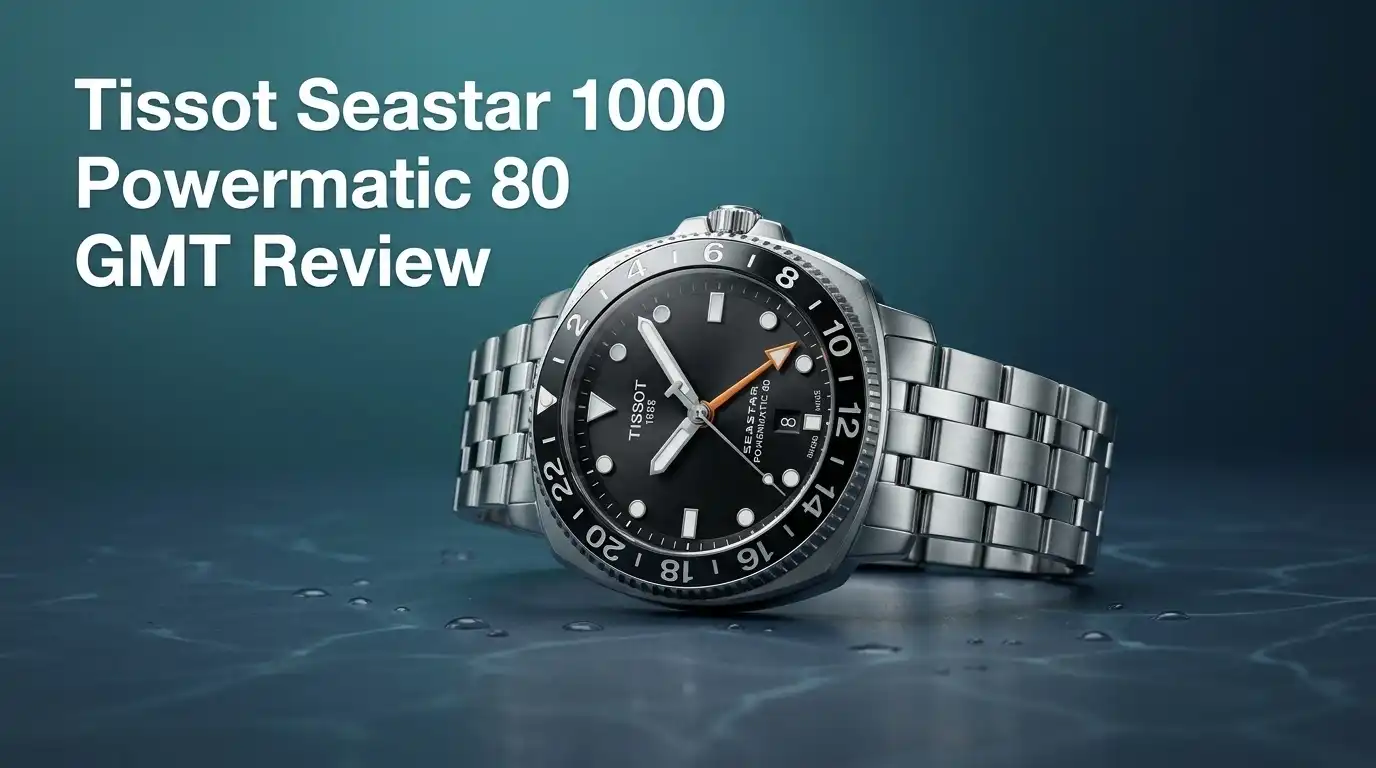
Tissot Seastar 1000 Powermatic 80 GMT Review 2026: Worth It?
Travel watches used to cost a fortune. Then Tissot dropped a true GMT into its most recognizable dive case and changed the math for a lot of buyers. The Seastar 1000 Powermatic 80 GMT gives you a jumping local hour hand, 300 meters of water resistance, and an 80 hour power reserve in one Swiss made package.
This watch also carries a reputation. Some owners love it. Others send it back within a week. The 46mm case sits at the center of that debate, and nobody should buy this watch without understanding that number first.
I spent weeks with this piece on my wrist, in the shower, on flights, and under a desk lamp at 2am. This review covers the good parts, the frustrating parts, and the exact buyer who should press add to cart in 2026.
In a Nutshell:
- The movement is the main attraction. The Powermatic 80.661 is a true traveler GMT, which means the local hour hand jumps forward and backward in one hour steps without stopping the seconds hand. Most watches near this price use a caller GMT instead, where the 24 hour hand moves and the local hand stays fixed. That difference matters a lot to frequent flyers.
- The case is huge and that is the deciding factor. You get 46mm across, 15.4mm thick, and roughly 51mm from lug tip to lug tip. Anything under a 7 inch wrist will struggle here. This is the Seastar 2000 case wearing a Seastar 1000 name badge.
- Build quality punches above the price. Sapphire crystal front and back, a ceramic 24 hour bezel insert, a screw down crown with guards, and 300 meters of water resistance make this a genuine dive tool, not a desk diver pretending.
- Eighty hours of power reserve changes weekend habits. Take it off Friday night and it still runs Monday morning. No resetting, no rewinding, no fuss.
- Value depends entirely on where you buy. List price sits around $1,375, but grey market and authorized sale pricing has repeatedly dipped into the $700 to $900 range, which flips this from fair deal to serious bargain.
- The negatives are real. Thickness, weight, bezel paint durability on some units, and a clasp without quick adjust are legitimate complaints that owners raise again and again.
Tissot Seastar 1000 Powermatic 80 GMT

Last update on 2026-11-13 / Affiliate links / Images from Amazon Product Advertising API
This model carries reference T120.429.11.051.01 and launched as a North American limited production run. Tissot built it on the larger Seastar case, then fitted an anthracite dial with a vertical brushed finish that shifts from charcoal to near black depending on light.
The bezel is the signature element. It uses a bicolor black and green ceramic insert marked in 24 hour increments, so you can track a third time zone by rotating it. A red arrow tipped GMT hand sweeps the dial and reads against that bezel.
Applied hour markers, faceted pencil hands, and a square date window at 3 o’clock complete the layout. Four lines of text sit at 6 o’clock, including the red GMT label. It reads busy in photos and surprisingly balanced in person.
Unboxing Experience and First Impressions
Tissot keeps packaging simple. The watch arrives in a rectangular outer sleeve, then a padded presentation box with a soft cushion holding the bracelet. Inside you get the warranty booklet, the instruction manual, and the international guarantee card.
There is no fancy travel pouch and no extra strap. Tissot spends money on the watch, not the cardboard, which honestly feels like the right call.
The first reaction is weight. You lift it out and your hand drops slightly. This thing has presence before you even clasp it.
Second reaction is the bezel. The green and black ceramic catches overhead light in a way photos never capture. The green reads almost olive indoors and brightens outside. Third reaction, usually about ten seconds later, is the thickness. You notice it immediately.
Design and Dial Details
The dial rewards close inspection. That vertical brushing runs top to bottom and creates a subtle grain under direct light. Indoors it looks like flat anthracite. Outdoors it comes alive.
A black chapter ring frames the dial and separates the markers from the bezel. This small touch adds depth and keeps the face from looking flat.
The handset uses faceted pencil hands filled with lume. The seconds hand carries the traditional Tissot T shaped counterweight, which is a nice brand signature rather than a generic stick.
The red GMT hand provides the only pop of color on the dial. It is bright, easy to spot, and never gets confused with the minute hand. Legibility at a glance is genuinely excellent, which is the whole point of a travel watch.
Top 3 Alternative for Tissot Seastar 1000 Powermatic 80 GMT


Last update on 2026-11-13 / Affiliate links / Images from Amazon Product Advertising API
Tissot Seastar 1000 Swiss Quartz GMT 40mm

Last update on 2026-11-13 / Affiliate links / Images from Amazon Product Advertising API
Seiko 5 Sports SSK001 GMT Automatic

Last update on 2026-11-13 / Affiliate links / Images from Amazon Product Advertising API
Mido Ocean Star GMT Swiss Automatic
Case Size and Wrist Feel
Let us talk honestly about the elephant on your wrist. The case measures 46mm in diameter, 15.4mm thick, and around 51.2mm lug to lug. Lug width is 22mm.
On my 7.25 inch wrist it fits, but it fills every available millimeter. There is zero overhang, yet also zero margin.
Under a shirt cuff it becomes a problem. The thickness catches on cuffs, sleeves, and jacket openings. This is a weekend watch for most office workers, not a Monday to Friday companion.
One saving grace helps. The wide bezel pushes the dial visually inward, so the watch looks smaller than 46mm from above. People with smaller wrists still should not buy blind. Try it on, or at minimum print a paper template and tape it to your wrist for a day.
The Powermatic 80.661 Movement Inside
Tissot uses the Powermatic 80.661, a Swatch Group caliber developed from the ETA family. It beats at 21,600 vibrations per hour, which is 3Hz, and carries 25 jewels.
The headline number is the 80 hour power reserve. That comes from the lower beat rate and a longer mainspring. The tradeoff is a slightly steppier seconds hand sweep compared to a 4Hz movement.
Most versions ship with a Nivachron balance spring, which improves resistance to magnetic fields from phones, laptops, and speakers. This matters more in daily life than most people realize.
The exhibition sapphire caseback lets you watch the rotor spin. The finishing is industrial rather than decorative. You see a functional machine, not hand applied Geneva stripes, and at this price that is completely fair.
How the True GMT Function Works
This is the feature that justifies the whole watch. The Seastar GMT uses a traveler style complication, sometimes called a flyer GMT.
Pull the crown to the first position. Rotate it and the local hour hand jumps forward or backward in clean one hour steps. The minute hand, seconds hand, and 24 hour hand all keep running.
That means you land in a new country, turn the crown four clicks, and you are done. Your seconds never stop and your home time stays intact.
The 24 hour hand tracks your home zone permanently. Rotate the bezel and you can read a third zone at the same time. Most GMT watches under $1,000 cannot do this. They use a caller setup that forces you to move the 24 hour hand instead, which is fine for calling home and clumsy for actual travel.
Bracelet, Clasp, and Comfort
The bracelet follows an Oyster style three link pattern. Outer links are brushed, center links are polished, and the whole thing tapers from 22mm down at the clasp.
Link removal uses standard screws rather than pins, which makes sizing easier for anyone with a basic tool kit. The bracelet also uses quick release spring bars, so swapping to rubber takes about fifteen seconds.
The folding clasp includes a diver extension, which flips out to fit over a wetsuit sleeve. It is stamped rather than milled, and you can feel that difference.
Here is the honest complaint. There is no on the fly micro adjustment. Wrists swell in heat and shrink in cold, and this clasp gives you no way to compensate without tools. At this price, that omission stings.
Bezel Action and Crystal Clarity
The unidirectional bezel clicks through 120 positions. Action is firm with minimal back play. The ceramic insert resists scratches far better than aluminum and keeps its color over years.
Grip is good thanks to deep coin edge knurling. Wet hands still turn it without slipping, which is exactly what a dive bezel needs to do.
Sapphire covers the front with antireflective treatment. Reflections are controlled but not eliminated, so you will still angle your wrist occasionally in bright sun.
Older Seastar models drew complaints about bezel paint flaking at the numerals. The ceramic insert on this GMT version largely solves that issue, though the printed numerals can still show wear on heavily abused units. Check your bezel carefully during the return window.
Lume Performance at Night
Tissot fills the hands, markers, and bezel pip with Super LumiNova. Charge it under a lamp for thirty seconds and the glow is strong and even.
Hour markers, minute hand, and hour hand all light up blue green. The 24 hour GMT hand receives lume too, which many competitors skip entirely.
Duration is respectable rather than class leading. You get a bright first hour, then a slow fade that stays readable for several hours. By morning it has gone dark.
Seiko divers still beat it on raw brightness. Tissot applies lume more conservatively and more evenly. For a genuine 300 meter dive watch, the lume performs where it counts, which is in dark water during the first stretch of a dive.
Water Resistance and Real Dive Credentials
Three hundred meters of water resistance is not a marketing number here. The watch pairs a screw down crown with crown guards, a screw down caseback, and a unidirectional timing bezel.
That combination meets the practical expectations of a dive tool. Swimming, snorkeling, surfing, and recreational scuba all fall inside the envelope with room to spare.
You can shower with it without worry. Just avoid hot tubs and saunas, since heat cycles stress gaskets on any mechanical watch.
Have the gaskets pressure tested every two to three years if you actually swim with it. Tissot service centers handle this inexpensively. For a watch most buyers will wear in a pool rather than a wreck dive, the specification provides serious peace of mind.
Accuracy After Weeks of Wear
Tissot rates the Powermatic 80 at roughly minus 5 to plus 10 seconds per day. My unit settled around plus 4 seconds daily with normal office wear.
Worn consistently, that works out to about half a minute per week. You will reset it once a month and feel no frustration.
Positional variance exists. Dial up overnight ran slightly faster, crown down ran slightly slower. Experimenting with your resting position can shave a second or two per day.
The 80 hour reserve helps accuracy stay stable because the mainspring never drops into its weak final hours during normal use. A watch kept in the healthy part of its power curve simply keeps better time. If your unit runs outside spec, Tissot will regulate it under warranty.
What This Watch Does Not Do Well
Authentic reviews cover the bad parts, so here they are.
The size disqualifies a large share of buyers. Under a 7 inch wrist, this watch looks and feels wrong. No amount of strap swapping fixes a 51mm lug to lug span.
The clasp lacks on the fly adjustment, which competitors at half the price now include.
The watch is heavy. Full bracelet weight lands well over 180 grams, and you feel it by hour ten.
The date window at 3 o’clock is unframed and slightly small for the dial scale. A white date disc on an anthracite dial also breaks the color harmony.
Finally, availability is inconsistent. This was a limited production model, so stock comes and goes, and prices swing hard between sellers.
Pros and Cons
Pros
- True traveler GMT with an independently jumping local hour hand, a feature rarely found under $1,500
- Eighty hour power reserve that survives an entire weekend off the wrist
- Genuine 300 meter water resistance with a screw down crown and crown guards
- Ceramic 24 hour bezel insert that resists scratching and color fade
- Sapphire crystal on the front and an exhibition sapphire caseback
- Swiss made build quality with Nivachron antimagnetic protection
- Quick release bracelet that swaps to rubber in seconds
- Frequent discounting brings the real street price far below list
Cons
- The 46mm case and 15.4mm thickness exclude small and medium wrists
- Clasp offers no on the fly micro adjustment
- Heavy on the wrist during long days
- Lug to lug span of roughly 51mm overhangs many wrists
- Does not fit under a dress shirt cuff comfortably
- Limited production means spotty availability and uneven pricing
- Lume duration trails Japanese competitors
Price and Value in 2026
List price sits at $1,375. Almost nobody pays that. Authorized dealers and grey market sellers have repeatedly listed this reference between $700 and $900.
At $1,375, the value proposition is only acceptable. You are paying close to Mido and Hamilton money for a Tissot.
At $800, the equation changes completely. You are buying a Swiss made true GMT with a ceramic bezel and 300 meter rating for the price of a basic automatic diver.
That price gap is the single biggest factor in whether this watch makes sense for you. Set a price alert and wait for a sale. Patience here saves real money, and this model goes on discount often enough that paying full retail feels unnecessary.
Who Should Buy It and Who Should Skip It
Buy this watch if you have a wrist measuring 7 inches or larger, you travel across time zones more than a few times a year, and you want one watch that handles water, airports, and weekends.
Buy it if you appreciate true GMT functionality and refuse to pay Rolex or Grand Seiko prices for it.
Skip it if your wrist measures under 6.75 inches. You will not enjoy the fit, and you will resell it at a loss.
Skip it if you need a watch for business formal settings. It will not slide under a cuff.
Skip it if you want a caller GMT for tracking a remote colleague. A cheaper quartz GMT does that job for a fraction of the cost.
Final Verdict
The Tissot Seastar 1000 Powermatic 80 GMT is a specialist, not a generalist. It does one thing exceptionally well and one thing poorly.
The movement, the bezel, the water resistance, and the power reserve all deliver genuine value. The sizing is the deal breaker that no feature can offset.
I rate it 4.2 out of 5 for the right buyer and 2 out of 5 for the wrong one. That spread is unusually wide and entirely about case dimensions.
If you fit it, you own a travel watch that competes with pieces costing three times more. If you do not fit it, the 40mm quartz GMT version delivers most of the same travel utility in a case you can actually wear every day.
Measure your wrist first. Everything else follows from that number.
Frequently Asked Questions
Is the Tissot Seastar 1000 GMT a true GMT or a caller GMT?
It is a true GMT, also called a traveler or flyer GMT. The local hour hand jumps in one hour increments while the minute and seconds hands keep running. This is the preferred setup for people who physically cross time zones.
How big is the Tissot Seastar 1000 Powermatic 80 GMT?
The case measures 46mm in diameter, 15.4mm thick, and roughly 51.2mm lug to lug. Lug width is 22mm. It uses the larger Seastar 2000 case, so it wears significantly bigger than other Seastar 1000 models.
What movement powers this watch?
The Powermatic 80.661 automatic caliber runs it. The movement beats at 21,600 vibrations per hour, holds 25 jewels, and delivers up to 80 hours of power reserve. Most units include a Nivachron balance spring for better magnetic resistance.
Can I actually dive with this watch?
Yes. It carries a 300 meter rating, a screw down crown with guards, and a unidirectional timing bezel. Those specifications cover recreational scuba diving. Have the seals pressure tested every two to three years if you dive regularly.
How accurate is the Powermatic 80 movement?
Tissot rates it at approximately minus 5 to plus 10 seconds per day. Most real world units land between plus 2 and plus 8 seconds daily. If yours falls outside the rated range, warranty service will regulate it.
Does the bracelet have quick release spring bars?
Yes. The bracelet uses quick release bars, so you can swap to a rubber strap or NATO without tools. The 22mm lug width also gives you a wide selection of aftermarket options.
Is it worth buying at full retail price?
Not usually. The watch frequently sells well below its $1,375 list price, sometimes in the $700 to $900 range. Waiting for a discount makes the value far stronger, since competitors at full retail offer similar specifications.

Hi, I’m Lucy Jones, a dedicated watch enthusiast and reviewer. I spend my time hunting down, testing, and evaluating the most intriguing wristwatches on the market. My goal is to guide you through the overwhelming choices with honest, hands-on insights into every timepiece.