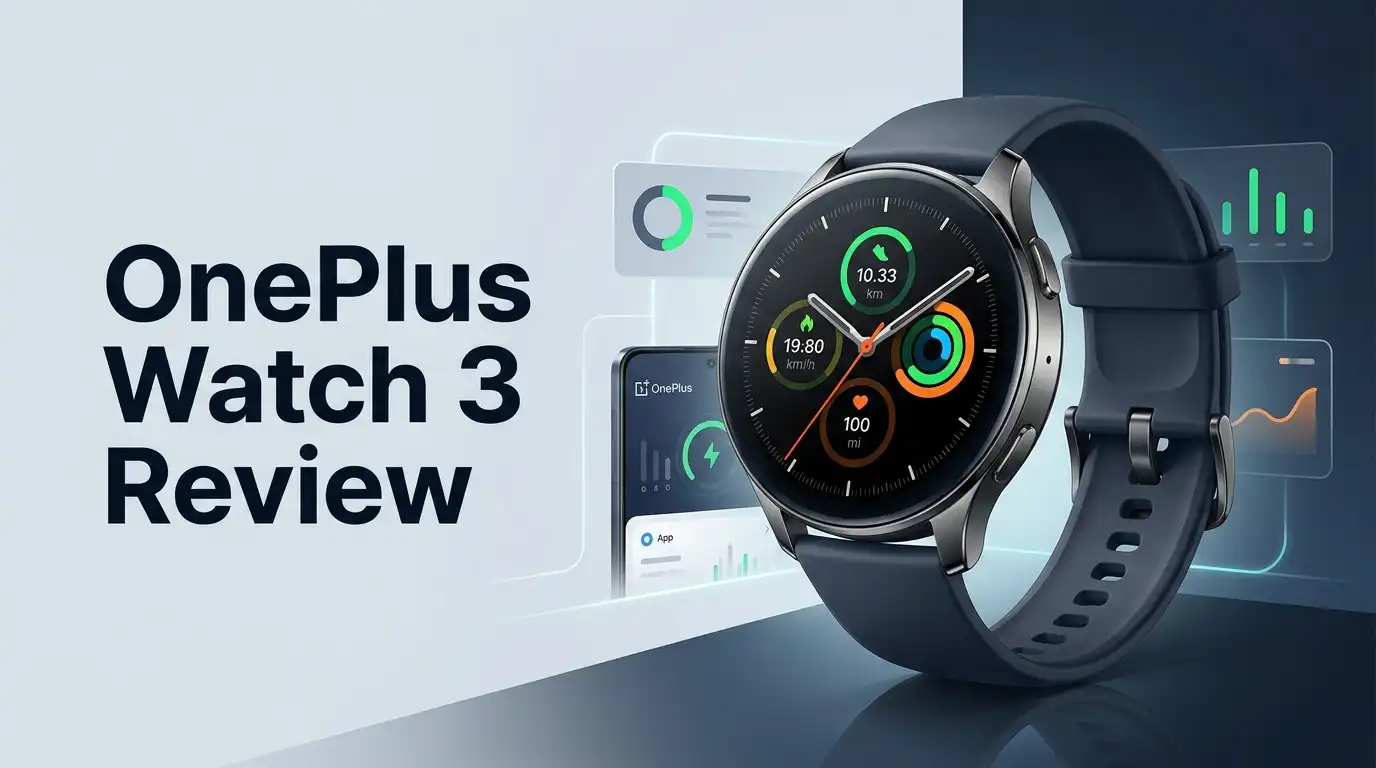
OnePlus Watch 3 Review 2026: Still Worth It?
The OnePlus Watch 3 arrived with one big promise. It said you could get real Wear OS apps and still forget about your charger for most of the week.
That sounded too good. Most Android smartwatches die in a day. I wore this one for weeks, tracked workouts, slept in it, and pushed the battery until it begged for power.
This review shares what the watch does well and where it falls short. I will also cover the smaller 43mm version, the software update situation in 2026, and the missing features that still annoy buyers in North America. If you want a smartwatch that lasts, keep reading.
Key Takeaways
- Battery life is the main reason to buy it. The 46mm model holds a 631mAh cell. I averaged four full days with the always on display active, nightly sleep tracking, and one hour of daily exercise. Turn the always on display off and you reach five or six days easily.
- Power Saver mode changes everything. The watch drops to its RTOS layer and runs up to 16 days on one charge. You lose app support in this mode, but you keep notifications, steps, heart rate, and sleep.
- Charging is incredibly fast. Twenty minutes gives roughly 75 percent. A half hour fills it completely. Ten minutes buys you a full day of use.
- Fitness tracking finally works properly. Step counts landed within 30 steps of my manual count. Heart rate matched a Pixel Watch worn on the other wrist. Auto pause reacts almost instantly.
- The flaws are about missing features, not broken ones. No ECG in North America, no LTE option, and only two major OS updates. The 46mm case is also genuinely large.
- Price makes it easy. It launched at $329.99 and now sells lower during sales. Nothing in Wear OS matches that value for battery life.
Why The OnePlus Watch 3 Still Matters In 2026

Last update on 2026-10-01 / Affiliate links / Images from Amazon Product Advertising API
The smartwatch market moved fast since this watch launched. Samsung and Google released new models. Yet the OnePlus Watch 3 still owns one crown. No other Wear OS watch comes close on battery life.
That matters because battery anxiety kills smartwatch habits. People stop wearing a watch that needs nightly charging. Sleep tracking becomes impossible. The OnePlus Watch 3 removes that problem completely.
OnePlus built this with a dual chip design. The Snapdragon W5 handles heavy tasks like Google apps and maps. A separate BES2800 chip handles simple jobs like step counting and notifications. The watch switches between them automatically. You never notice the handoff.
In 2026 the price also dropped. Deals push it under $250 regularly. At that price it becomes one of the smartest buys on any Android wrist.
Unboxing Experience And First Impressions
The box is compact and uses that familiar OnePlus red. Lift the lid and the watch sits face up in a foam tray. It looks heavier than it feels, which is a nice surprise.
Underneath you find a magnetic charging dock and a bright red USB cable. There is no power brick inside. You need a OnePlus charger for the fastest speeds. Any OnePlus phone charger works fine.
Paperwork is thin. A quick start card, a warranty leaflet, and that is it.
First impressions were strong. The titanium bezel catches light nicely. The sapphire crystal feels solid under a fingernail. The fluoroelastomer strap felt slightly stiff on day one but softened within a week.
Setup took about eight minutes. You install the OHealth app, scan a code, and wait for firmware to load.
Design And Build Quality
This watch feels premium for the money. The case uses stainless steel, the bezel uses titanium, and the front uses sapphire crystal glass. It carries IP68, 5ATM, and MIL STD 810H ratings.
The 46mm model measures 46.6 x 47.6 x 11.75mm and weighs 49.7g without the strap. That is big. On a slim wrist it looks oversized and it sticks out past the bone.
The rotating crown sits at the 2 o’clock position instead of the usual 3 o’clock spot. This keeps it clear of the back of your hand during workouts. It is textured, grippy, and it actually rotates.
The haptics deserve special praise. Each scroll click feels crisp and tight. It is easily the best crown feel on any Wear OS watch.
Any standard 22mm strap fits, so band swaps are cheap.
Display Quality In Daily Use
The 46mm model uses a 1.5 inch LTPO AMOLED panel at 466 x 466 pixels. Peak brightness reaches 2,200 nits. That is bright enough to read in direct summer sun without squinting.
The best part is less obvious. OnePlus uses DC dimming instead of PWM dimming. If flicker bothers your eyes, this panel is far more comfortable in a dark bedroom. Most rival watches still use PWM.
Colors look punchy and text stays sharp. The thin bezel and the printed tick marks around the edge give it a watch like look rather than a screen strapped to your arm.
Always on display works well and barely dents battery life. I kept it enabled the whole time. Touch response feels immediate, with no lag when swiping between tiles.
Top 3 Alternative for OnePlus Watch 3


Last update on 2026-09-28 / Affiliate links / Images from Amazon Product Advertising API
Samsung Galaxy Watch 8

Last update on 2026-09-28 / Affiliate links / Images from Amazon Product Advertising API
Google Pixel Watch 4

Last update on 2026-10-01 / Affiliate links / Images from Amazon Product Advertising API
Amazfit Balance 2
Battery Life Tested
This is where the watch earns its reputation. OnePlus claims up to 120 hours in Smart mode and 72 hours under heavy use. My results matched closely.
With the always on display on, sleep tracking every night, and a tracked hour of exercise daily, I got four solid days. Switch the always on display off and five or six days becomes normal. Skip sleep tracking too and you can stretch toward a week.
Power Saver mode is the wild card. The watch leans on the RTOS chip and loses Wear OS apps. In return you get around 16 days of notifications, heart rate, steps, and sleep.
You can flip between modes whenever you like. That flexibility is rare. Garmin gives you endurance. Wear OS gives you apps. This gives you both.
Charging Speed And Habits
Charging is almost as impressive as the runtime. The magnetic dock snaps on firmly and will not slide off a nightstand.
A twenty minute session adds roughly 75 percent. Another twenty minutes tops it off completely. Ten minutes alone adds about a day of use. That is a genuine lifesaver before a flight or a long hike.
This speed changes how you charge. You stop plugging it in overnight. Instead you drop it on the dock while you shower or eat breakfast. One short charge per week is enough for most people.
The only small complaint is the dock itself. It is a puck rather than a cradle, so the watch lies flat and you cannot use it as a bedside clock while charging.
Performance And Wear OS 5 Software
The watch shipped with Wear OS 5 plus the RTOS layer. Performance feels quick. Apps open fast, the Play Store works normally, and Google Maps runs properly on your wrist.
The 2GB of RAM and 32GB of storage are generous. You can load music offline and leave your phone at home during a run, though audio only plays through Bluetooth headphones.
Software updates are the weak spot. OnePlus promised Wear OS 6 during 2026, and the rollout has been slow and poorly communicated. Owners spent much of the year waiting. Wear OS 7 is planned for 2027, then support ends.
That means two major OS updates and security patches through the end of 2027. Samsung and Google both offer more. Keep that in mind if you hold devices for years.
Fitness And Workout Tracking Accuracy
The OnePlus Watch 2 had a real heart rate problem. It smoothed over fast spikes, which ruined interval training data. The Watch 3 fixes that completely.
I wore it alongside a Pixel Watch for dozens of workouts. Heart rate curves lined up closely. Step counts were even better. The OnePlus landed within about 30 steps of a manual count, while the Pixel overshot by roughly 150.
GPS uses dual band L1 and L5 signals plus four other satellite systems. Routes traced streets accurately, including under tree cover.
Auto pause is the sleeper feature. It stops the timer nearly the moment you stop walking or cycling, then resumes instantly. Few watches do this so cleanly.
Post workout summaries include a satellite map with an animated route replay and selectable data overlays.
Sleep Tracking Results
Sleep tracking works, but the case size hurts it. The watch logs sleep stages, blood oxygen, breathing quality, and wrist temperature. It also gives a sleep score each morning.
When the strap sits snug, the data looks believable. Bedtimes and wake times matched reality. Stage breakdowns felt reasonable compared to a dedicated tracker.
The problem is comfort. A 49.7g watch with a 46.6mm case is a lot of hardware to sleep in. I loosened the strap on warm nights, and loose straps produce sloppy readings.
If sleep data is your main goal, consider the 43mm model instead. It is lighter and far easier to wear in bed.
Battery is never the obstacle here. You can track sleep every night and still skip the charger for days.
OHealth App Review
OHealth is the companion app, and it improved a lot. The dashboard shows eight metrics without any scrolling: steps, calories, exercise minutes, activity sessions, heart rate with a graph, sleep time with a graph, a mind and body score, and SpO2.
That beats the Fitbit app layout, which surfaces fewer metrics upfront. Nothing here sits behind a subscription. You pay once for the watch and get all your data.
Privacy is a genuine plus. Workout data stays on your watch and phone rather than a cloud account. Moving to a new phone carries your history with you.
The downsides are real. You cannot customize the dashboard at all. No reordering, no swapping metrics. The app also lacks advanced training load and recovery scoring that Fitbit and Garmin provide.
The 43mm Model Compared

Last update on 2026-09-28 / Affiliate links / Images from Amazon Product Advertising API
OnePlus later added a 43mm version, and it solves the size complaint. It uses a 1.32 inch AMOLED display, a stainless steel case, and a smaller 354mAh battery.
Battery life drops as expected. OnePlus rates it around 60 hours. Real use lands near two days with the always on display enabled, or roughly five days in Power Saver mode. That is still better than most rivals.
Everything else stays intact. Same Snapdragon W5 chip, same dual engine setup, same OHealth experience, same crown. Straps drop to 20mm here.
Pick this one if you have smaller wrists or you sleep in your watch. Pick the 46mm if battery life matters most. Both sell around the same price, which makes the choice purely about size.
What The OnePlus Watch 3 Does Not Do Well
Honest reviews list the gaps, so here they are.
There is no ECG in North America. The hardware includes the sensor. Buyers elsewhere use it. FDA clearance costs money and OnePlus skipped it. Rival watches offer ECG at this price, so this stings.
There is no LTE model. Leave your phone behind and you lose calls and messages unless you are on Wi Fi.
Software support is shorter than the competition, and the Wear OS 6 rollout dragged badly through 2026.
The 46mm case is too large for many wrists, and it is heavy for overnight wear.
OHealth lacks training load, recovery scoring, and dashboard customization. Serious athletes will still want Garmin or Coros. Casual users will not notice.
Pros And Cons
Pros
- Battery life reaches four to six days in Smart mode and about 16 days in Power Saver mode
- Charging is extremely fast, with roughly 75 percent in twenty minutes
- Bright 2,200 nit AMOLED panel with eye friendly DC dimming
- Excellent rotating crown with the best haptics on any Wear OS watch
- Accurate heart rate, step counting, and dual band GPS
- Auto pause works almost instantly during walks and rides
- No subscription required for any health data
- Premium titanium, steel, and sapphire build with strong durability ratings
- Standard strap sizes keep band swaps cheap
- Health data stays local on your phone and watch
Cons
- No ECG function for North American buyers
- No LTE version available
- The 46mm case is large and heavy on slim wrists
- Only two major OS updates, with security patches ending in 2027
- Wear OS 6 arrived late and the schedule was unclear
- OHealth offers no dashboard customization
- Missing advanced training load and recovery metrics
- No power adapter included in the box
Who Should Buy The OnePlus Watch 3
Buy it if battery life sits at the top of your list. Nothing else in Wear OS lasts this long while keeping full app support. That single advantage justifies the purchase for most Android users.
It suits people who track daily workouts, want reliable heart rate data, and hate paying monthly fees for their own health stats. Hikers, runners, and gym regulars all get accurate numbers here.
It also suits anyone sensitive to screen flicker thanks to DC dimming.
Skip it if you need ECG readings, LTE connectivity, or a small watch. Skip it if you plan to keep the same watch for five years, since update support ends sooner than rivals.
Pick the 43mm model if the 46mm looks too bulky for your wrist.
Final Verdict
The OnePlus Watch 3 remains one of the smartest smartwatch buys in 2026. It solved the problems of the Watch 2 and kept the thing that made it special.
Battery life is the headline. Four days of heavy use, six days of normal use, and over two weeks in Power Saver mode is genuinely unmatched on Wear OS. Charging speed removes any remaining worry.
Fitness tracking is now accurate enough to trust. The display is excellent. The build feels more expensive than the price tag suggests. The crown is a small joy every single day.
The gaps are about features OnePlus left out rather than things it got wrong. No ECG in North America, no LTE, a big case, and shorter update support.
Accept those four limits and you get the best battery life on any Android watch.
FAQs
How long does the OnePlus Watch 3 battery really last?
Expect four days with the always on display enabled, nightly sleep tracking, and an hour of daily exercise. Turning the always on display off pushes you to five or six days. Power Saver mode reaches around 16 days with reduced app support.
Does the OnePlus Watch 3 work with iPhone?
No. It requires an Android phone running Android 8 or newer. iPhone users cannot pair it or use the OHealth app.
Why is there no ECG on my OnePlus Watch 3?
The sensor exists in the hardware, but OnePlus did not pursue FDA clearance for North America. Owners in other regions can use the ECG feature normally. A software update will not change this for North American units.
Should I buy the 43mm or the 46mm model?
Choose the 46mm for maximum battery life and the biggest screen. Choose the 43mm if you have smaller wrists, sleep in your watch, or prefer a lighter feel. Features are otherwise nearly identical.
Will the OnePlus Watch 3 get more software updates?
OnePlus committed to two major OS updates, ending with Wear OS 7 in 2027, plus security patches through the end of 2027. The Wear OS 6 rollout was slower than promised during 2026.
Can I use the OnePlus Watch 3 for swimming?
Yes. It carries 5ATM and IP68 ratings, so pool swimming and showering are fine. It tracks pool and open water swim workouts. Avoid hot tubs and high pressure water jets.

Hi, I’m Lucy Jones, a dedicated watch enthusiast and reviewer. I spend my time hunting down, testing, and evaluating the most intriguing wristwatches on the market. My goal is to guide you through the overwhelming choices with honest, hands-on insights into every timepiece.