Suunto Race 2 Review 2026: Worth Buying?
Suunto spent years in the shadow of Garmin. That story changed with the Race 2. This watch landed in late 2025 with a brighter screen, a smarter heart rate sensor, and battery numbers that make expensive rivals look thirsty.
I have spent months reading real owner reports, forum threads, and long term test data to build this review.
This review answers that honestly. You will read about the good parts, the frustrating parts, and the things Suunto still gets wrong.
In a Nutshell:
- Battery life leads the class. The Race 2 delivers around 50 hours of dual band GPS tracking in real use, with up to 200 hours in Tour mode. One tester lost only 4 to 5 percent battery on a two hour run. A Forerunner 970 would drop roughly 10 percent in the same session.
- The screen is genuinely stunning. Suunto fitted a 1.5 inch AMOLED panel with 466 x 466 resolution and 2,000 nits of brightness. That is double the brightness of the original Race. Maps render smoothly and sunlight readability is excellent.
- Heart rate accuracy improved a lot. The original Race often locked onto cadence instead of pulse. The new optical sensor matches chest straps on most runs, though it still throws an odd result now and then.
- You give up smart features. No music storage, no contactless payments, no speaker, no microphone, and no physical flashlight. This is a training tool first and a smartwatch second.
- Value is the main argument. You get sapphire glass, 100m water resistance, offline maps, and 115 plus sport modes for $250 less than Garmin’s flagship running watch.
- Software remains the weak spot. Customising workout data screens takes real effort, and step counts run low.
Suunto Race 2 at a Glance

Last update on 2026-10-27 / Affiliate links / Images from Amazon Product Advertising API
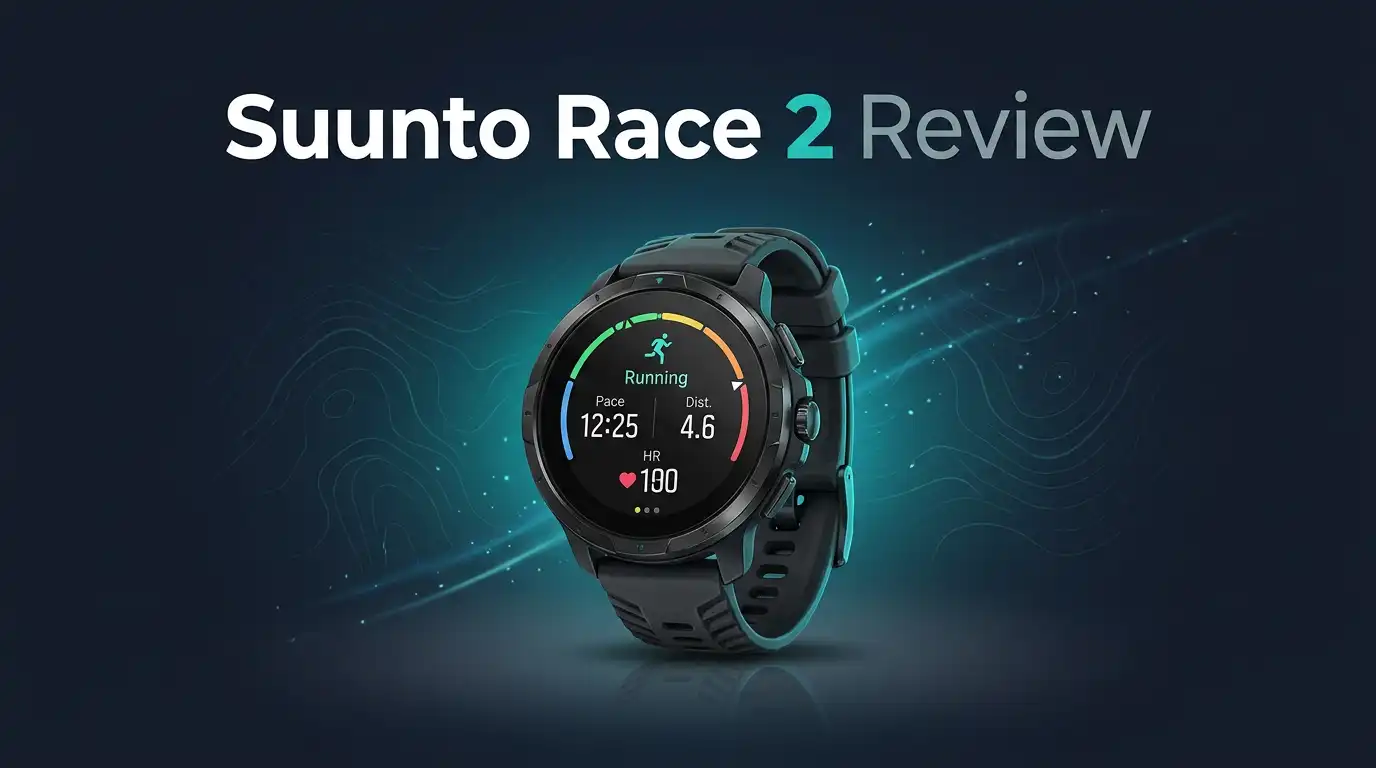
The Race 2 is a 49mm multisport watch built for runners, cyclists, and hikers who want serious data. The case measures 49 x 49 x 12.5mm and weighs 76g in steel or roughly 65g in titanium. Sapphire crystal protects the display. Water resistance reaches 100 metres, which beats most running watches at this price.
Suunto packs in five satellite systems: GPS, GLONASS, GALILEO, QZSS, and BEIDOU. Storage sits at 32GB for offline maps. You get 115 plus sport modes, wrist based heart rate, blood oxygen readings, HRV tracking, and sleep analysis.
The headline change over the first Race is refinement rather than reinvention. Suunto kept the shape and the software feel. It fixed the screen, the sensor, the charger, and the bulk.
Unboxing the Suunto Race 2
The box is small and plain. Suunto uses recycled cardboard with a simple product photo on the front. Inside you find the watch, a magnetic charging cable, and a thin paper quick start guide. No extra strap, no case, no frills.
The first thing owners notice is the bezel. The original Race had a serrated edge that looked tough but scratched skin and caught on sleeves. The Race 2 uses a smooth bezel instead. It feels like a watch you can wear to dinner.
The new charging dock deserves praise. Old Race owners complained that the charger needed tiny adjustments before it would connect. The Race 2 clips on with a solid clunk and stays put. Small change, big relief.
Design and Build Quality
This watch feels dense in the hand. Metal makes up most of the visible surfaces, and that gives the Race 2 a premium weight that plastic rivals cannot match. Testers who ran through forests, mountains, and alpine trails reported zero scratches on the sapphire glass after hundreds of miles.
The trade off is mass. At 76g the steel model is noticeably heavier than the 56g Forerunner 970. People with slim wrists may find it top heavy during sleep tracking. The titanium version solves part of this and drops around 10g.
One small annoyance appears in owner reports. The strap keeper pin sits slightly proud and catches on the buckle when you fasten the watch. It loosens over weeks, but the first month is fiddly.
Top 3 Alternatives for Suunto Race 2


Last update on 2026-10-27 / Affiliate links / Images from Amazon Product Advertising API
Garmin Forerunner 970

Last update on 2026-10-27 / Affiliate links / Images from Amazon Product Advertising API
COROS PACE Pro

Last update on 2026-10-27 / Affiliate links / Images from Amazon Product Advertising API
Polar Vantage M3
The 1.5 Inch AMOLED Display
Suunto grew the screen from 1.43 inches to 1.5 inches and pushed brightness from 1,000 nits to 2,000 nits. The panel uses LTPO technology, which lets the refresh rate drop when nothing moves and saves power.
The result impresses almost everyone who tests it. Colours look rich. Text stays sharp. Maps scroll without stutter thanks to extra onboard memory. In harsh midday sun the display stays readable without squinting, and on dark misty mornings it does not blind you.
Touch response feels quick. You also get a rotating crown and two buttons, so you can work the watch with gloves or wet hands. Several reviewers called this the best screen they had used on any sports watch. That is high praise in a crowded field.
GPS Accuracy on Road and Trail
The first Suunto Race had a reputation problem. Its GPS track zigzagged under tree cover and added phantom distance. The Race 2 fixes most of that.
One tester logged 173.53 miles on the Race 2 against 171.61 miles on a COROS Vertix 2s across Colorado mountains, the French Alps, and city streets. Elevation came in at 29,590 feet versus 29,398 feet. Those gaps are small enough to call a tie.
Satellite lock happens fast, often from indoors. That matters on cold winter mornings. Honest reporting requires one caveat though. Some reviewers still saw the Race 2 run wide on corners or drift parallel to the real path under heavy canopy. It is accurate, but not perfect.
Heart Rate Accuracy and Sensors
This was the biggest complaint about the original Race. Owners reported a heart rate pinned at 206 bpm on easy runs, which happened to match their cadence. Classic optical sensor failure.
The Race 2 uses an upgraded sensor array and the improvement is real. Across repeated tests against chest straps and armbands, the Race 2 either matched the reference or sat within 1 bpm. It handles anaerobic efforts far better than its predecessor.
It is still an optical sensor. One reviewer noted the occasional run where readings went completely wrong, and readings lag behind a strap during sharp intervals. Serious interval athletes should still pair a chest strap. The watch supports external sensors over Bluetooth, though it lacks ANT+ support.
Battery Life in Real Use
This is the Race 2 superpower. Suunto claims 55 hours in Performance mode using dual band GPS. Independent testing landed closer to 48 to 50 hours, which is still remarkable.
Other modes stretch things further. Endurance gives 65 hours, Ultra reaches 90 hours, and Tour mode pushes to 200 hours with reduced accuracy. In daily smartwatch use the Race 2 lasts up to 18 days, or roughly seven to eight days with always on display plus daily running.
Compare that to the Forerunner 970 at 21 hours of dual band tracking and four or five days of mixed use. The gap is enormous. One owner reported finishing 50 miles of the Leadville course with battery to spare.
Offline Maps and Navigation
Suunto gives you 32GB of storage for free offline topographic maps. The map rendering is clean, colourful, and easy to read at speed. Many testers prefer Suunto’s cartography to Garmin’s.
Route planning inside the Suunto app is straightforward. You draw a route, add waypoints, check the elevation profile, then sync it to the watch. Turn by turn guidance works during the activity, and new climb guidance shows what remains on a long ascent.
There is one real limitation. Suunto maps are not routable. The watch follows a route you loaded, but it cannot build a new path on the fly or reroute you after a wrong turn. Garmin does that. Downloading map regions over Bluetooth is also slow and sometimes stalls.
Sport Modes and Training Features
You get more than 115 sport modes. Running splits into road, trail, track, vertical, and mountain variants. Hiking, trekking, Nordic walking, and mountaineering all have their own profiles. Beyond that you find squash, badminton, disc golf, horseback riding, parkour, skateboarding, and even a chores mode.
Training tools cover training load, recovery guidance, HRV status, and race time predictions. The SuuntoPlus app store adds extras such as ZoneSense, which tracks aerobic and anaerobic transitions using HRV data. ZoneSense needs a chest strap to work properly.
Structured workouts build easily in the app and sync to the watch. Suunto leans on TrainingPeaks and Stryd integrations rather than building native coaching plans. That suits athletes who already follow a programme.
Sleep, Recovery and Daily Tracking
The Race 2 tracks sleep stages, resting heart rate, HRV, blood oxygen, and body resources throughout the day. The morning summary is clean and easy to read on the big screen.
Accuracy here is mixed. Sleep stage detection works reasonably on normal nights, but testers reported the watch occasionally missing half a night entirely. HRV figures also ran low compared with dedicated sleep bands.
Step counting is the weaker area. One reviewer found the Race 2 logged around 14,000 daily steps while a Garmin logged over 20,000 and a phone logged 18,000 for the same days. If daily step goals matter to you, this undercount will annoy you. Treat the wellness data as a trend indicator rather than a precise number.
The Suunto App Experience
The Suunto app is pleasant and uncluttered. Activity summaries look good, the route planner is better than Garmin Connect in many users’ opinion, and syncing to Strava works without fuss.
The friction appears on the watch itself. You cannot customise an existing sport mode. If you want different data fields, you must create an entirely new custom mode from scratch. Setting up a display for a structured interval workout takes trial and error.
Reviewers consistently flag this as the single most frustrating part of owning a Race 2. COROS lets you click and go. Suunto makes you build it yourself. Once configured it works well, but the first week involves tinkering you did not expect.
What the Suunto Race 2 Does Not Do Well
Honest reviews list the gaps, so here they are. There is no onboard music storage and no streaming support. You can control your phone’s audio, nothing more. There are no contactless payments. There is no speaker or microphone, so no calls and no voice commands.
The flashlight uses the screen rather than a dedicated LED, which is far less useful in the dark. There is no ECG function. Connectivity is Bluetooth only, with no ANT+.
Firmware has also caused trouble. Suunto forums carry threads about reboot loops and post update bugs on certain firmware versions. Early adopters of any Suunto release should expect a few patches. The company does push fixes, but the first months were bumpy for some owners.
Suunto Race 2 vs Garmin Forerunner 970
The Forerunner 970 costs $749. The Race 2 costs $499 or $599. That gap buys a lot of running shoes.
Garmin wins on software depth, training readiness, running economy metrics, routable maps, music, payments, the built in flashlight, and more reliable step counting. Testers who wore both agreed the Garmin is the better overall sports watch.
Suunto wins decisively on battery life, water resistance at 100m versus 50m, screen size, and price. Build quality feels more premium on the Suunto thanks to the metal construction.
Choose Garmin if you want every feature and smartwatch convenience. Choose Suunto if you want excellent running essentials, huge battery life, and $250 back in your pocket.
Pros and Cons
Here is the balanced summary.
Pros
- Outstanding battery life at around 50 hours of dual band GPS and up to 18 days of daily wear
- Brilliant 1.5 inch AMOLED display with 2,000 nits and sapphire glass protection
- Much improved optical heart rate sensor that now matches chest straps on most runs
- Free offline topographic maps with 32GB storage and clean, readable rendering
- Premium metal build with 100m water resistance and no visible wear after hard trail use
- Strong value against Garmin equivalents, saving $150 to $250
Cons
- No music storage, contactless payments, speaker, microphone, or LED flashlight
- Heavy at 76g in steel, which some thin wrists find uncomfortable overnight
- Sport modes cannot be edited, forcing you to build custom modes for workout screens
- Step counting underreports significantly compared with phones and rivals
- Maps are not routable and map downloads over Bluetooth are slow
- Some firmware versions caused reboot issues reported on Suunto forums
Who Should Buy the Suunto Race 2
Last update on 2026-10-27 / Affiliate links / Images from Amazon Product Advertising API
Buy this watch if you are a runner, cyclist, hiker, or triathlete who already follows a training plan and wants reliable data with huge battery life. Ultra runners benefit most. A watch that survives a 50 hour effort in full accuracy mode removes real anxiety.
It also suits people who want maps without paying Fenix prices, and anyone who prefers a watch that looks good off the trail.
Skip it if you want a true smartwatch. If paying with your wrist, storing playlists, or taking calls matters, Garmin or Apple serve you better. Also skip it if you hate tinkering with settings. The Race 2 rewards patience and punishes impatience.
Frequently Asked Questions
Is the Suunto Race 2 worth the upgrade from the original Race?
Yes, if the heart rate sensor frustrated you. The optical sensor, screen brightness, charger, and slimmer case are all meaningful improvements. If you were happy with your original Race and used a chest strap, the upgrade is less compelling.
Does the Suunto Race 2 play music?
No. The watch has no internal music storage and no streaming app support. You can control music playing on your connected phone using play, pause, and skip controls on the watch.
How accurate is the GPS on the Suunto Race 2?
Very good. Independent tests showed distance and elevation within roughly one percent of reference watches across mountains, forests, and city streets. Occasional drift still happens under thick tree cover.
Should I choose steel or titanium?
Titanium saves around 10g and costs $100 more. If you have slim wrists or plan to wear the watch overnight, the weight saving is worth it. Otherwise steel performs identically.
Can the Suunto Race 2 use a chest strap?
Yes. It pairs with Bluetooth heart rate monitors, power meters, and footpods. It does not support ANT+ sensors, so check your existing gear before buying.
How long does the battery really last?
Expect roughly 48 to 50 hours of dual band GPS tracking, which falls slightly short of the 55 hour claim. Daily use with always on display gives seven to eight days.

Hi, I’m Lucy Jones, a dedicated watch enthusiast and reviewer. I spend my time hunting down, testing, and evaluating the most intriguing wristwatches on the market. My goal is to guide you through the overwhelming choices with honest, hands-on insights into every timepiece.