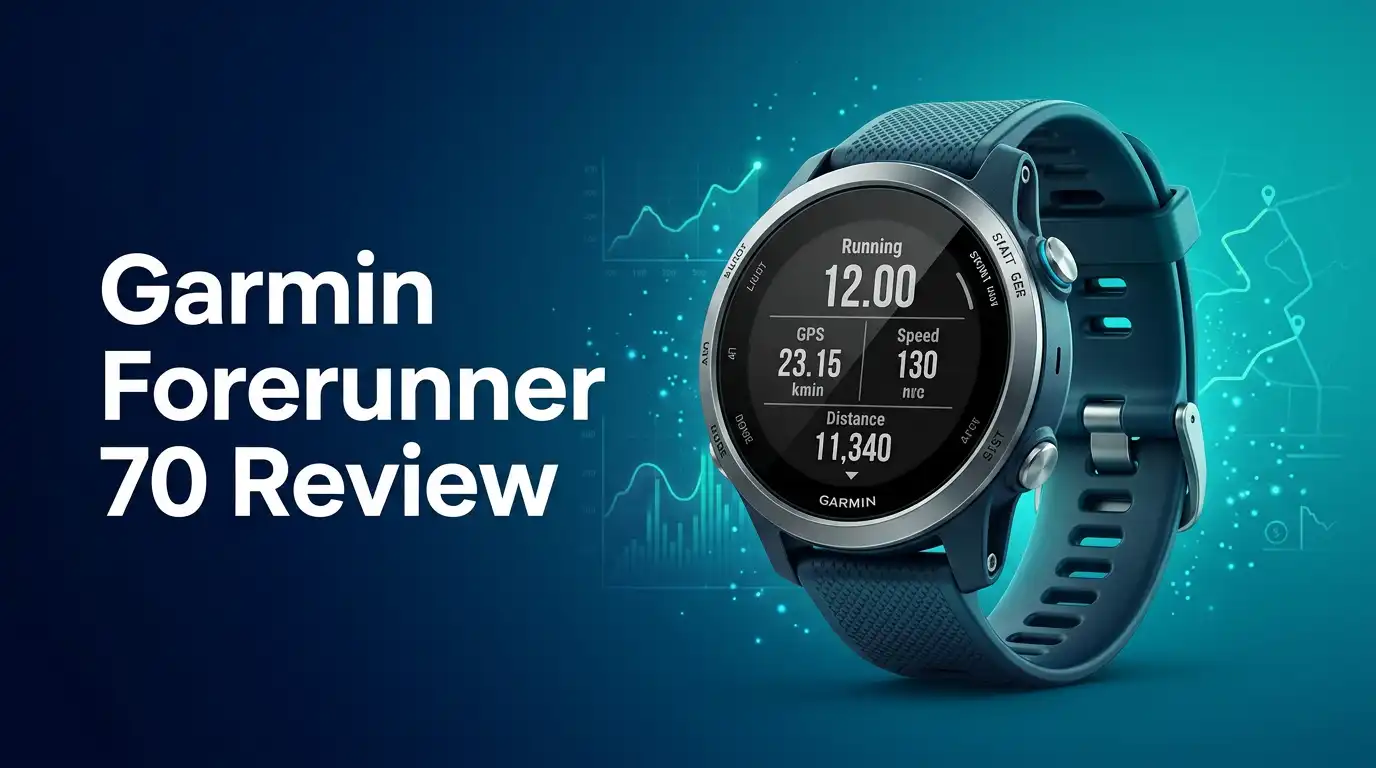
Garmin Forerunner 70 Review 2026: Worth Buying?
Garmin finally replaced the aging Forerunner 55, and the result surprised almost everyone. The Forerunner 70 costs $249, yet it carries training tools that used to live on watches twice the price.
I wore it for weeks of easy miles, intervals, gym sessions, and sleep tracking. This review covers what the watch nails, what it quietly skips, and whether your money belongs here instead of on a Coros or an older Forerunner. No fluff, no marketing copy, just honest notes from real wrist time.
In A Nutshell:
- Price and value: The Forerunner 70 sells for $249 and already dips near $219 during sales. That buys Garmin’s cleanest beginner running watch, and it feels underpriced for the feature list.
- Big upgrade over the Forerunner 55: You get a 1.2 inch AMOLED touchscreen, a new ELEVATE V4 heart rate sensor, over 70 sport profiles, and the same software platform used by the Fenix and Forerunner 970 families.
- Serious training tools: Training Readiness, Training Status, Acute Load, running power, and Running Dynamics all appear on Garmin’s cheapest watch for the first time. That alone changes the value equation.
- Battery that lasts: Garmin claims 13 days in smartwatch mode and 23 hours in GPS mode. Real testing with the display always on and daily runs produced roughly 4.5 days.
- Clear gaps: No Garmin Pay, no offline music, no WiFi, no barometric altimeter, no dual frequency GPS, no maps, and no triathlon mode. Those cuts are deliberate.
- Best for: New runners, half marathon chasers, and budget buyers who care about training data more than smartwatch extras.
Garmin Forerunner 70 Overview


Last update on 2026-10-27 / Affiliate links / Images from Amazon Product Advertising API
The Forerunner 70 is Garmin’s entry level running watch for 2026. It sits below the Forerunner 170 and replaces the Forerunner 55 after nearly five years.
The case measures 42.6mm wide and 11.9mm thick, and the whole watch weighs just 40g. A 1.2 inch AMOLED display sits under glass, and five physical buttons surround it. Water resistance reaches 5 ATM, so pool swims and showers are fine.
The headline change is software. Garmin moved this budget watch onto the same codebase as its premium models. That means hundreds of small refinements arrive here instantly, from widget folders to eight data fields per screen.
You are no longer buying a stripped down side project. You are buying a real Garmin with a shorter spec sheet.
The Unboxing Experience
Do not expect theater here. The box is small, flat, and recyclable cardboard. Slide the sleeve off and the watch sits face up in a simple tray.
Underneath you find a charging cable with USB C on one end and Garmin’s standard four pin connector on the other. Then a few paper booklets. That is the entire contents.
There is no charging brick, no spare band, and no screen protector. Garmin assumes you own a USB C charger already, which in 2026 is a fair bet. The watch arrives with roughly half a charge, so you can pair it with Garmin Connect and start walking within ten minutes.
The whole unboxing takes under a minute, and honestly that simplicity feels right for a $249 product. Less packaging, more running.
Design And Comfort On The Wrist
The Forerunner 70 disappears on your arm. At 40g with the silicone band, I forgot it was there during sleep, which matters because overnight tracking drives half the features.
The plastic case feels light rather than cheap. It fits slim wrists well, and the 43mm size avoids the chunky look of bigger trail watches.
Five buttons handle every core action. Start and stop live on the right, back and light on the left. The touchscreen works for scrolling widgets and panning menus, and you can switch it off per sport if sweat causes mis taps.
Button plus touch together is the right combination for running. The band uses quick release pins, so swapping colors takes seconds. Four color options launched, including black, soft pink, and two muted neutrals.
Top 3 Alternative for Garmin Forerunner 70

Last update on 2026-10-27 / Affiliate links / Images from Amazon Product Advertising API
Garmin Forerunner 170

Last update on 2026-10-27 / Affiliate links / Images from Amazon Product Advertising API
Garmin Forerunner 165

Last update on 2026-10-27 / Affiliate links / Images from Amazon Product Advertising API
COROS PACE 4
Display And Daily Readability
The 1.2 inch AMOLED panel is bright, sharp, and easy to read in direct sun. I tested it in midday glare and on a wet grey morning, and neither caused squinting. Colors pop on the default watch face, and text stays legible at a glance mid stride.
By default the screen uses gesture mode, so it wakes when you raise your wrist. I prefer always on mode, which dims instead of sleeping. Always on costs you battery, roughly halving smartwatch runtime, but it feels far more like a normal watch.
Garmin also added a larger font option, which helps anyone who struggles with small numbers during hard efforts. A screen based flashlight exists too. It is not a real LED torch, just a white screen, but it works for finding keys in the dark.
GPS Accuracy In Real Running
The Forerunner 70 uses multi GNSS tracking with GPS, GLONASS, Galileo, BeiDou, and QZSS. It does not include the dual frequency mode found on pricier Garmins. On paper that sounds like a downgrade. In practice the tracks held up well against premium watches across park loops, suburban streets, and open country roads.
Where you may notice the difference is dense city running. Tall buildings bounce signals, and single frequency receivers drift more in those conditions. If your daily route runs between skyscrapers, this is a real consideration.
Rivals at the same price include dual frequency, so Garmin loses a point here. Lock time was quick though, usually under ten seconds outdoors, and pace stability during intervals felt steady rather than jumpy. For most road runners, accuracy is a non issue.
Heart Rate And Sensor Performance
Garmin fitted the ELEVATE V4 optical sensor, an upgrade over the V3 in the Forerunner 55 but two generations behind the V5 in flagship models. Steady state running produced reliable numbers that matched a chest strap closely. Easy runs, tempo blocks, and long efforts all tracked cleanly.
Sharp intervals exposed the usual wrist sensor lag. Sprint starts took a few seconds to register, and gym sessions with grip heavy lifting drifted at times. This is normal behavior for any optical sensor, not a Garmin flaw.
Pair a chest strap for track workouts if precision matters to you. The watch supports external heart rate monitors over both ANT+ and Bluetooth, plus footpods, cycling speed and cadence sensors, and radar. Pulse Ox and overnight HRV tracking are included, which the Forerunner 55 never offered.
Battery Life Tested
Garmin quotes 13 days of smartwatch use, 28 days in battery saver, 23 hours in GPS only mode, and 16 hours with all satellite systems active. Those figures assume gesture based display. Turn on always on and the smartwatch number drops to around five days.
Real world results landed close. Running daily with always on enabled, the watch lasted about 4.5 days per charge. With gesture mode and three runs a week, I comfortably cleared a week. That beats the pricier Forerunner 170, which is a pleasant twist.
A new battery widget shows exactly what is draining power, so you can hunt down a greedy watch face. Charging from empty takes roughly an hour. There is no wireless charging and no WiFi sync, so expect the cable and your phone.
Training Readiness And Training Status
This is the reason to buy the Forerunner 70. Training Readiness scores how prepared your body is right now, using sleep, recovery time, HRV status, acute load, recent sleep scores, and recent stress. The number shifts through the day, dropping after hard sessions and climbing as you recover.
Training Status judges whether your training mix is actually making you faster, returning labels like Productive, Maintaining, Peaking, or Unproductive. You also get Acute Load, Load Ratio, Load Focus, VO2 Max trending, recovery time, and race time prediction.
Garmin skews conservative here, preferring injury prevention over aggressive mileage jumps. Set your heart rate zones correctly before trusting the output, because wrong zones poison every downstream metric. Daily Suggested Workouts adapt to a race on your calendar automatically.
The New Quick Workout Feature
Quick Workout debuted on this watch before any flagship Garmin, which is unusual and welcome. The idea is simple. Open the Run app, choose Training, then Quick Workout.
Pick how hard you want to work from four intensity levels, then pick a duration of 30, 45, or 60 minutes. The watch instantly generates up to four structured sessions.
You pick one and start running. No phone, no app, no waiting. The workouts scale to your fitness, and they improve after about four weeks of data. Unlike Daily Suggested Workouts, Quick Workout will give you something genuinely brutal if you ask for it.
It does not hold back to protect you. At the end you receive an execution score showing how well you hit the targets. For runners who decide their session at the door, this feature alone justifies the purchase.
Sport Modes And Everyday Tracking
Garmin loaded over 70 sport profiles here, which is absurd for a budget watch. Running, trail running, track running, treadmill, ultra running, cycling in six flavors, pool swimming, strength, HIIT, yoga, pilates, rowing, hiking, rucking, skiing, pickleball, padel, boxing, and plenty more. Strength sessions include a muscle map showing which groups you hit.
Daily tracking covers steps, floors are missing, intensity minutes, stress, Body Battery, and respiration. Body Battery remains the most useful of these. It starts high after good sleep and drains through stress and effort.
Widget glances let you check everything with one button press, and you can group them into folders. Breadcrumb course following works without maps, including waypoints, Up Ahead markers, aid station timers, and cutoff times for ultra runners.
Sleep Tracking And Health Features
Sleep tracking runs automatically, including nap detection, which is new across the Garmin line. Each morning you get a Sleep Score, sleep stages, and a list of factors that explain the result. Sleep Coach then suggests how much rest you need tonight based on recent training.
Overnight HRV tracking needs 19 nights before it establishes your personal baseline. After that, sudden drops reliably flag fatigue or oncoming illness. Your numbers are yours alone, so never compare them to a friend.
The Morning Report greets you with sleep data, weather, calendar events, and your suggested workout. An Evening Report reviews the day and sets up tonight’s rest. Health Snapshot records a two minute vitals check. Smart Wake Alarm finds a light sleep window near your set time.
What The Forerunner 70 Does Not Do Well
Honesty time. This watch has real gaps, and some will matter to you.
There is no Garmin Pay, so contactless payments are out. There is no offline music storage and no streaming service support, so your phone stays in your pocket on every run. There is no WiFi, meaning syncing depends on Bluetooth or a USB cable.
No barometric altimeter means elevation comes from GPS alone, so hill profiles look rougher and less accurate. No dual frequency GPS limits precision in dense cities. No maps, only breadcrumb lines, which gets confusing at trail junctions.
No triathlon mode and no open water swimming, which rules out triathletes entirely. No cycling power meter or smart trainer support. Garmin gatekeeps these deliberately to protect pricier models, and that is frustrating at $249.
Garmin Forerunner 70 Pros And Cons
Pros
- Excellent value at $249, with sale prices already reaching $219 and likely to fall further through 2026.
- Training Readiness, Training Status, and Acute Load arrive at this price for the first time, giving serious runners real guidance.
- Light 40g build with a bright 1.2 inch AMOLED screen that reads clearly in full sun.
- Strong battery life, roughly 4.5 days with always on display and daily running, which beats the pricier Forerunner 170.
- Quick Workout creates instant structured sessions on device, with no phone or app needed.
- Over 70 sport profiles plus running power, Running Dynamics, and the Connect IQ store.
Cons
- No Garmin Pay, no offline music, and no WiFi, removing Garmin’s usual advantage over rival brands.
- No barometric altimeter, so elevation data relies on GPS and looks less smooth.
- Single frequency GPS only, which trails competitors that include dual frequency at the same price.
- No maps, no triathlon mode, and no open water swimming support.
- ELEVATE V4 heart rate sensor rather than the newer V5 found on flagship models.
Forerunner 70 vs Forerunner 165 vs Coros Pace 4
The Forerunner 165 costs the same $249 and remains on sale. It offers music storage on the Music edition and Garmin Pay, but its training analysis is thinner. Choose the 165 if smart features matter more than data. Choose the Forerunner 70 if you want deeper training insight and longer battery.
The Forerunner 170 adds an altimeter, compass, barometer, NFC payments, cycling power meter support, and optional music for extra money. It is the upgrade path if those gaps bother you.
The Coros Pace 4 is the toughest rival. It brings dual frequency GPS, a barometric altimeter, full multisport modes, and longer battery at a similar price. On raw specification the Coros wins. Garmin counters with a better app ecosystem, smoother interface, and more refined coaching tools.
Who Should Buy The Garmin Forerunner 70
Last update on 2026-10-27 / Affiliate links / Images from Amazon Product Advertising API
Buy this watch if you are a new runner who wants room to grow. The beginner friendly interface will not overwhelm you, and the advanced metrics wait quietly until you need them. It suits 5K, 10K, and half marathon training perfectly, and it handles marathon builds without complaint.
It also fits experienced runners who want a light secondary watch or who simply refuse to spend $600 on a wrist computer. Gym users, walkers, and casual cyclists get plenty of value too.
Skip it if you are a triathlete, a trail runner who needs maps, or someone who pays with their wrist every day. Those buyers should look at the Forerunner 170, the Forerunner 570, or the Coros Pace 4 instead. Match the watch to your actual habits.
Final Verdict
The Garmin Forerunner 70 is the best value running watch Garmin has made in years. It takes the premium software platform, the training analysis that used to cost double, and a genuinely useful new Quick Workout tool, then packages them in a 40g body for $249. The AMOLED screen looks great, battery life holds up, and the five button layout stays practical mid run.
The missing pieces are real. No payments, no music, no altimeter, and no dual frequency GPS. Garmin cut those on purpose to protect pricier models, and the Coros Pace 4 exposes that choice.
Even so, for runners who care about training rather than gadgets, this is an easy recommendation. Score it 4.5 out of 5. Wait for a sale and it becomes close to unbeatable.
Frequently Asked Questions
How much does the Garmin Forerunner 70 cost?
The Forerunner 70 launched at $249 in the United States and £219 in the United Kingdom. Amazon has already discounted it to around $219 during promotions. Garmin watches typically drop further within six months of launch, so patient buyers may see prices near $199.
Does the Garmin Forerunner 70 have music storage?
No. The Forerunner 70 cannot store offline music and does not support Spotify, Amazon Music, or Deezer. It can control music playing on your phone. For offline storage you need the Forerunner 170 Music or the Forerunner 165 Music.
Is the Forerunner 70 waterproof for swimming?
Yes, it carries a 5 ATM rating, which covers pool swimming, showering, and rain. A dedicated pool swim mode tracks laps, strokes, and distance. Open water swimming is not supported, and the watch is not rated for diving or high speed water sports.
How long does the battery actually last?
Garmin claims 13 days in smartwatch mode and 23 hours in GPS only mode. Real testing with the always on display and a run every day produced about 4.5 days. Gesture mode with three weekly runs comfortably reached a full week between charges.
Does the Forerunner 70 work with iPhone and Android?
Yes, it pairs with both through the Garmin Connect app. Android users get extra perks including photo attachments in notifications and the ability to reply to text messages. iPhone users can read and dismiss notifications but cannot reply, due to Apple restrictions.
Can beginners use the Forerunner 70 easily?
Absolutely. Garmin designed it as the entry point to the Forerunner line. The default setup is simple, the watch face is clean, and Daily Suggested Workouts tell you what to run each day. Advanced metrics stay hidden in menus until you choose to explore them.

Hi, I’m Lucy Jones, a dedicated watch enthusiast and reviewer. I spend my time hunting down, testing, and evaluating the most intriguing wristwatches on the market. My goal is to guide you through the overwhelming choices with honest, hands-on insights into every timepiece.