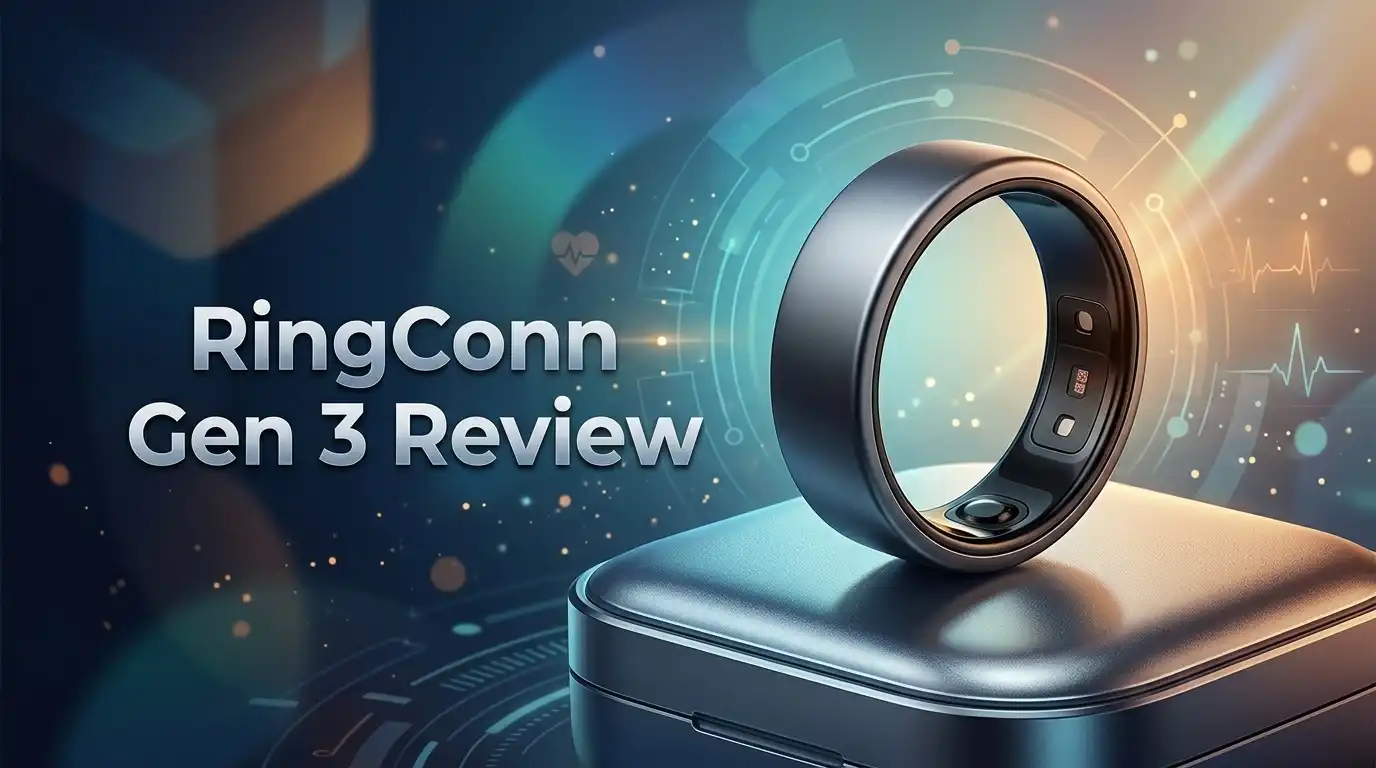
RingConn Gen 3 Review 2026: Worth Buying?
Smart rings got crowded fast. Dozens of brands now promise sleep scores, recovery data, and health insights on your finger. Most of them want a monthly fee too. RingConn took a different route.
The Gen 3 arrived in 2026 with a vibration motor, a new vascular tracking feature, and a battery that runs for close to two weeks. No subscription. No locked features.
This review covers what the ring measures well, what it fumbles, and whether the $349 price makes sense in a market where Oura and Ultrahuman keep raising the bar. Read on before you spend.
In a Nutshell:
- Battery life is the headline. RingConn rates the Gen 3 at 11 to 14 days with vibration off, and roughly 10 to 13 days with vibration switched on. In real use I charged it once in two weeks. The travel case adds over 150 days of backup power.
- No subscription, ever. Every feature, including Vascular Trend and sleep apnea pattern insights, comes free with the ring. That saves you about $70 per year compared to Oura.
- Vascular Trend is the new flagship feature. It samples your vascular patterns every 15 to 20 minutes and plots the trend over weeks. It is not a blood pressure cuff replacement. Think context, not diagnosis.
- Vibration alerts feel unfinished. You get sedentary nudges, battery warnings, and wellness alerts. You do not get a silent wake up alarm yet. RingConn says that update lands later in 2026.
- Sleep tracking is the strongest data. Sleep duration correlated at 94% with Whoop and 91% with Garmin in my side by side testing.
- Workout heart rate runs hot. Max heart rate readings came in 9 to 11 bpm above a Garmin reference during runs. Buy a chest strap if training precision matters.
RingConn Gen 3 Smart Ring

Last update on 2026-10-29 / Affiliate links / Images from Amazon Product Advertising API
The Gen 3 is RingConn’s most complete ring so far. It uses aerospace grade titanium with a medical grade resin inner shell. Thickness sits at 2.3mm at the thinnest point. Weight runs between 2.5 grams for size 6 and 3.5 grams for size 15.
Water resistance is rated IP68 and 10ATM. You can shower, swim, and snorkel without removing it. That matters more than it sounds. A ring that stays on your finger collects uninterrupted data, and gaps are the enemy of trend tracking.
Five finishes ship at launch: Future Silver, Royal Gold, Matte Black, Brushed Silver, and Brushed Rose Gold. The brushed options hide fingerprints better than the glossy Gen 2 did. Sizes run 6 through 15. RingConn changed its sizing system this generation, so Gen 2 owners should order a fresh sizing kit rather than guessing.
Unboxing Experience
The box is small, flat, and surprisingly heavy for something holding a 3 gram ring. Lift the lid and the ring sits inside the charging case, already seated in its cradle. No fumbling with foam inserts.
Inside you get the ring, the universal wireless charging case, a short USB C cable, and a thin quick start card. That is it. RingConn skipped the clutter. No manuals the size of a paperback, no stickers, no filler.
The charging case feels like a chunky pebble. It is matte, pocket friendly, and the lid snaps shut with a satisfying click. The universal design is a genuine upgrade. Gen 2 cases were size specific, which annoyed anyone who swapped sizes later.
Setup took under five minutes. Download the app, create an account, hold the ring near the phone, and pairing completes. The ring arrived at roughly 70% charge, so I wore it the same night.
Design and Comfort
RingConn kept its signature profile. The outer edge is flat and squared. The inner surface curves smooth against skin. It reads as a health device rather than jewellery, and I am fine with that.
Comfort is excellent. The edges are rounder than on Gen 2, which makes the ring look narrower than it measures. I slept with it nightly and never woke up aware of it.
The Gen 3 is slightly thicker than Gen 2 because of the vibration motor and bigger battery. On the finger I could not tell the difference. Typing, gripping a bar, and holding a coffee cup all felt normal.
Fit still decides everything. Too loose and the sensors drift. Too tight and swelling after a salty meal becomes uncomfortable. I wore mine on the index finger, which gave the most stable sensor contact. There is no visible orientation marker, which remains a small annoyance during workouts.
Top 3 Alternative for RingConn Gen 3


Last update on 2026-10-29 / Affiliate links / Images from Amazon Product Advertising API
Oura Ring 4

Last update on 2026-10-29 / Affiliate links / Images from Amazon Product Advertising API
Ultrahuman Ring AIR

Last update on 2026-10-29 / Affiliate links / Images from Amazon Product Advertising API
Samsung Galaxy Ring
Battery Life and Charging
This is where RingConn beats almost everybody. The Gen 3 is rated for 11 to 14 days on a single charge with vibration disabled. Turn vibration on and expect roughly 10 to 12 days.
Those numbers held up for me. I charged the ring once across a full fortnight of normal use, including nightly sleep tracking and a handful of logged runs. Larger ring sizes last longer because they house bigger cells.
Enabling extra features shortens the run. Sleep apnea monitoring and the Vascular Trend auto check both raise sampling frequency, and both drain more power. That is expected, and RingConn states it openly.
The charging case holds around 15 extra charges. Combined runtime exceeds 150 days with the lid closed. For travel this is the feature that actually changes behaviour. You stop packing a charger. Offline storage also improved to 10 days, up from 7 on Gen 2.
Health Tracking Features
The Gen 3 tracks continuously in the background. You do not start sessions or log moods unless you want to. The sensor array covers heart rate, heart rate variability, blood oxygen, skin temperature, respiratory rate, and motion.
From that raw data the app builds sleep scores, stress readings, activity totals, readiness style insights, menstrual cycle predictions, and sleep apnea pattern flags. That is a wide net for a device this small.
RingConn publishes its own accuracy figures. The company claims over 98% heart rate accuracy, under 1.9% mean absolute error on SpO2, over 95% step counting accuracy, and under 3.5ms error on HRV. These come from internal and partner testing, so treat them as directional rather than clinical.
My own step counts landed within 3 to 4% of manual counts. Distance tracking on outdoor runs came within 1.6% of a Garmin Forerunner. Solid for a ring.
Vascular Trend Explained
Vascular Trend is the headline addition for Gen 3. It watches long term vascular patterns instead of giving you a single number. The app shows a status such as Stable alongside daytime and nighttime averages.
Setup is not instant. You complete a short survey and enter several cuff based baseline readings during the first 24 hours. Skip that step and the feature stays dormant.
Once calibrated, the ring samples automatically every 15 to 20 minutes while you are relaxed. You can also run a manual check, which takes about 30 seconds of sitting still with a warm, relaxed hand.
This is not a blood pressure monitor. RingConn states plainly that the Gen 3 is a health management device, not a medical device, and the readings should never guide medical decisions. In my testing the trend stayed green and matched my cuff readings, which is reassuring but not revelatory.
Vibration Alerts
A ring has no screen, so a buzz is the only way it can reach you. RingConn added a small vibration motor to Gen 3 and the idea is smart.
You can enable vibration for three things: battery reminders, sedentary reminders, and wellness notifications. The buzz is short and discreet. It nudges without nagging the way a smartwatch does.
Execution is where it stumbles. Alerts did not fire consistently across every enabled category during my testing. The app also needs to stay running in the background, which feels fragile.
The bigger gap is alarms. There is no silent wake up alarm and no custom timed reminders. RingConn has said vibration alarm support is planned through firmware updates later in 2026. Until that ships, the motor is a promising feature rather than a finished one. Do not buy this ring for the buzz alone.
Sleep Tracking and Sleep Apnea Insights
Sleep is the Gen 3’s strongest performance. The morning report breaks down duration, stages, resting heart rate, HRV, blood oxygen, breathing rate, light exposure, and circadian alignment.
Against reference devices my sleep duration correlated at 94% with Whoop and 91% with Garmin. Average sleep length came in at 7 hours 10 minutes versus 7 hours 18 and 7 hours 16 on the other two. Very close agreement.
The sleep apnea pattern feature carries over from Gen 2. RingConn cites a study with Shanghai Ruijin Hospital showing roughly 90.7% detection accuracy against hospital equipment.
Read that carefully. The ring flags patterns worth discussing with a doctor. It cannot diagnose sleep apnea and it cannot rule it out. If the app raises a flag, book a proper sleep study rather than drawing your own conclusion.
Accuracy During Workouts
Here is the honest part. Finger based optical sensors struggle when you move hard, grip things, or get cold.
Distance tracking surprised me. Across two outdoor runs the Gen 3 landed 1.6% under and 1.0% over a Garmin Forerunner. That is genuinely good.
Heart rate was uneven. On one run RingConn averaged 136 bpm against Garmin’s 135 bpm, which is excellent. On a second run it reported 141 bpm against Garmin’s 134 bpm.
Maximum heart rate ran consistently high. The ring logged 156 and 167 bpm where the Garmin recorded 147 and 156 bpm. That is a meaningful gap if you train by zones.
This is an improvement over Gen 2, but it is not a replacement for a chest strap. Treat the Gen 3 as a daily activity tracker that handles casual workouts, not as a training tool.
The RingConn App
RingConn redesigned the app for this generation and it reads cleaner now. The home screen gives you headline numbers first, then lets you drill into layers of detail.
There is a lot buried in there. Sleep alone has enough sub screens to keep you scrolling for twenty minutes over breakfast. Data lovers will enjoy that. Casual users may feel buried.
The philosophy leans toward raw numbers with light interpretation. Oura pushes more coaching and narrative. RingConn hands you the figures and some guidance, then steps back.
Some insight language still feels generic, and not every card earns its space. One nice touch was a headache risk alert that landed the morning after a late night out. It felt uncannily well timed. The app works on both iOS and Android, with no feature gated behind a payment wall.
No Subscription Value
Every feature on the Gen 3 is included in the purchase price. Vascular Trend, sleep apnea patterns, cycle tracking, detailed sleep data, historical charts. All free.
Compare that to Oura, which charges roughly $5.99 per month on top of a similar hardware price. Over three years that is well over $200 in extra cost.
At $349 the Gen 3 is competitive on hardware and clearly cheaper over time. Ultrahuman also skips subscriptions, but its battery life is shorter on the Ring AIR.
For anyone who dislikes recurring fees, this is the strongest argument RingConn makes. The risk is that unsubscribed companies sometimes slow their software development. RingConn has shipped steady firmware updates so far, which is a good sign, but the vibration alarm delay shows the roadmap can slip.
What RingConn Gen 3 Does Not Do Well
No review is honest without this section. Start with the vibration alerts. They are inconsistent and the most useful version, a silent alarm, is simply missing at launch.
Workout heart rate overreads at higher intensities. If you run intervals or lift heavy, the numbers will mislead you.
There is no orientation marker on the ring. You have to feel for sensor placement, which is awkward when you are half asleep or rushing out the door.
The ring is slightly thicker than Gen 2. Anyone who prized the thinner profile loses a little there.
Vascular Trend requires manual cuff calibration, which defeats some of the passive appeal. It also needs you to sit perfectly still for manual checks, and cold fingers cause failed readings.
Finally, the app can overwhelm. Not every insight is actionable, and some cards repeat the same message in different words.
Pros and Cons
Pros
- Battery life of 11 to 14 days beats almost every competing smart ring, and the case adds 150 plus days of backup
- Zero subscription fees with every feature unlocked from day one, saving roughly $70 per year versus Oura
- Excellent comfort for overnight wear, with a smooth inner surface and rounded edges
- Strong sleep tracking accuracy, correlating above 90% with Whoop and Garmin on sleep duration
- IP68 and 10ATM water resistance covers showers, swimming, and snorkelling
- Universal wireless charging case removes the size specific hassle of Gen 2
- Five finishes, including brushed options that hide fingerprints well
Cons
- Vibration alerts fire inconsistently and there is no silent wake up alarm yet
- Maximum heart rate during workouts reads 9 to 11 bpm high compared to a Garmin reference
- Vascular Trend needs cuff based calibration and still carries a clear non medical disclaimer
- Slightly thicker than Gen 2 at 2.3mm
- No orientation marker makes correct sensor placement a guessing game
- App can feel dense, with some insights repeating each other
- Not suitable as a replacement for a sports watch or chest strap
Who Should Buy the RingConn Gen 3
Buy this ring if you want passive health tracking that disappears into daily life. It suits people who care about sleep quality, recovery trends, and long term patterns rather than split times.
It is a strong fit for anyone allergic to subscriptions. You pay once and you own the full feature set.
It also works well for travellers. Two weeks of battery plus a case that holds 15 extra charges means you can leave the cable at home.
Skip it if you are a serious athlete. The workout heart rate data will frustrate you, and a watch or strap serves you better.
Skip it too if you specifically want a silent alarm today. That feature is promised, not delivered. Existing Gen 2 owners who are happy with their ring can also wait, unless Vascular Trend genuinely appeals to them.
RingConn Gen 3 Final Verdict
Last update on 2026-10-29 / Affiliate links / Images from Amazon Product Advertising API
The Gen 3 is the best RingConn yet and one of the easiest smart rings to live with. Battery life, comfort, and the absence of fees make it a genuine value pick at $349.
Sleep tracking is reliable. Daily activity data holds up. Vascular Trend adds something no rival offers in quite the same way, even with its calibration quirks.
The weak spots are real though. Vibration alerts need more work, and workout heart rate still runs hot at intensity.
I would score it around 8.6 out of 10. It does the quiet background job brilliantly and stumbles only when it tries to compete with sports watches.
If you want a ring that tracks your health without demanding attention or a monthly payment, the RingConn Gen 3 earns the recommendation. Just buy it for what it does today, not for the firmware promises.
Frequently Asked Questions
How long does the RingConn Gen 3 battery actually last?
RingConn rates it at 11 to 14 days with vibration off and roughly 10 to 12 days with vibration on. In my testing I charged it once across two weeks. Larger ring sizes last longer because they hold bigger batteries. Enabling sleep apnea monitoring or Vascular Trend auto check shortens runtime.
Does the RingConn Gen 3 need a subscription?
No. Every feature is included in the purchase price. That covers Vascular Trend, sleep apnea pattern insights, cycle tracking, and all historical data. This remains one of the ring’s biggest advantages over Oura.
Can the RingConn Gen 3 measure blood pressure?
No. Vascular Trend shows long term vascular patterns, not blood pressure readings. RingConn states clearly that the device is a health management tool and not a medical device. Always use a validated cuff and consult a doctor for actual measurements.
Is the RingConn Gen 3 better than the Oura Ring 4?
It depends on priorities. The Gen 3 wins on battery life and costs less over time with no fees. Oura offers a more polished app, a larger ecosystem, and more interpretive coaching. If budget and battery matter most, RingConn wins.
Does the RingConn Gen 3 have a silent alarm?
Not at launch. The ring has a vibration motor, but wake up alarms and custom timed reminders are not available yet. RingConn has indicated these will arrive through firmware updates later in 2026, though timing may shift.
Can I wear the RingConn Gen 3 while swimming?
Yes. It carries an IP68 and 10ATM water resistance rating based on third party testing. Showering, swimming, and snorkelling are all fine. Avoid scuba diving or high pressure water jets, since water resistance can degrade with wear.
Is the RingConn Gen 3 accurate for running?
Distance tracking is good, landing within about 1.6% of a Garmin in my tests. Heart rate is less reliable at higher intensities, with maximum readings running roughly 9 to 11 bpm high. Use a chest strap for serious training.
Does my RingConn Gen 2 size fit the Gen 3?
Not necessarily. RingConn changed its sizing system for this generation. Order a fresh sizing kit rather than assuming your old size carries across. A correct fit matters because loose rings produce unstable sensor contact.

Hi, I’m Lucy Jones, a dedicated watch enthusiast and reviewer. I spend my time hunting down, testing, and evaluating the most intriguing wristwatches on the market. My goal is to guide you through the overwhelming choices with honest, hands-on insights into every timepiece.