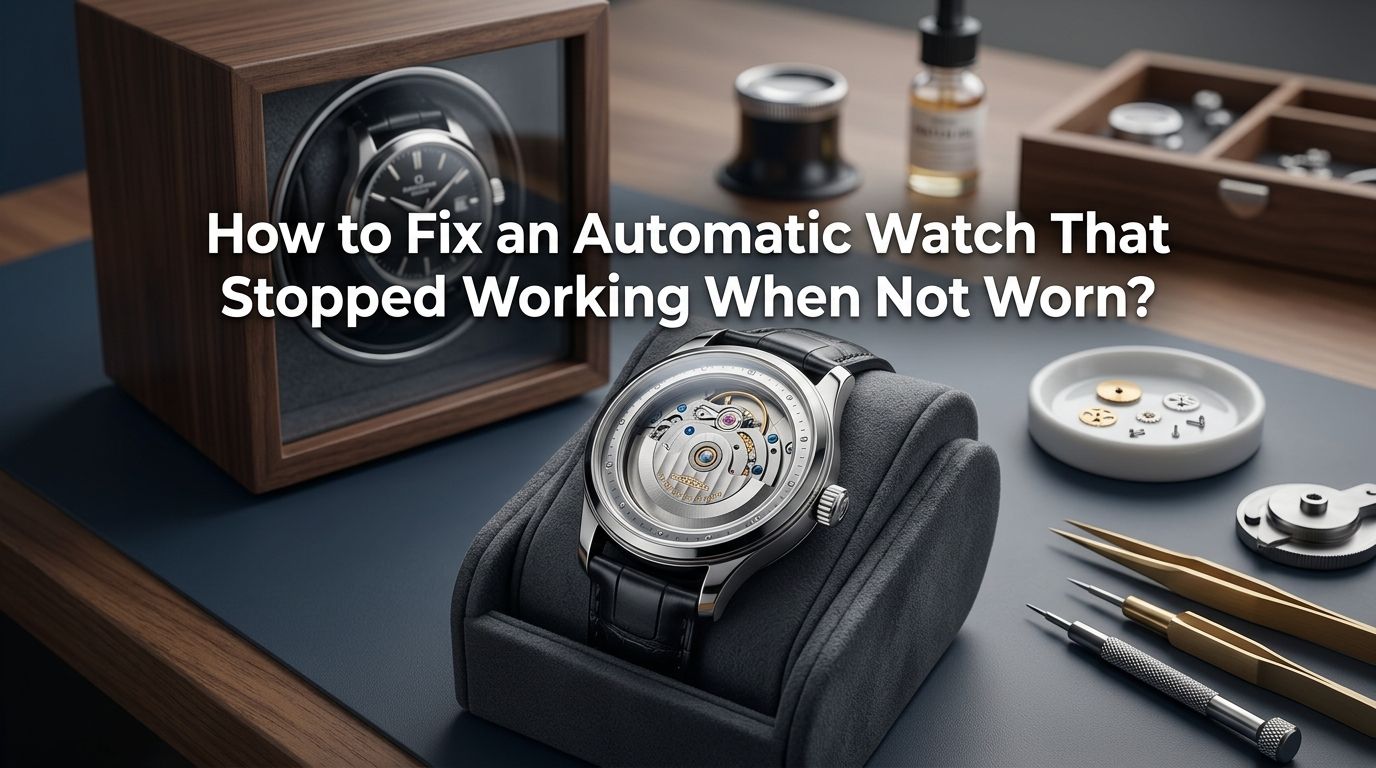
How to Fix an Automatic Watch That Stopped Working When Not Worn?
You picked up your automatic watch after a few days off your wrist and noticed it had completely stopped. The hands are frozen. The second hand is still. You might feel a jolt of worry, thinking something broke inside that beautiful timepiece.
Take a deep breath. This is one of the most common issues automatic watch owners face, and it almost never means your watch is damaged.
Automatic watches depend on the motion of your wrist to stay powered. When you stop wearing one, it loses its energy source. The mainspring unwinds, and the watch simply stops.
Key Takeaways
- Automatic watches stop because they run out of stored energy. Most automatic watches have a power reserve of 38 to 48 hours. If you do not wear your watch for two days or more, it will stop. This is completely normal and does not mean the watch is broken.
- Manual winding is the fastest fix. You can restart most automatic watches by turning the crown clockwise 20 to 30 times. This charges the mainspring and gives the watch enough energy to start running again.
- A watch that stops repeatedly after winding may need professional service. Old or dried lubricants inside the movement can cause friction. This friction drains power faster than usual. A full service every 3 to 5 years keeps the movement running well.
- Magnetization is a hidden cause of stopping and poor timekeeping. Phones, laptops, and tablet cases contain magnets that can magnetize your watch. A magnetized watch may run fast, run slow, or stop entirely. An inexpensive demagnetizer tool can fix this at home.
- A watch winder can keep your watch running during days off, but it has trade offs. Winders add convenience but also add extra wear on the rotor and gears over time. You should weigh the pros and cons before relying on one daily.
- Low wrist activity may not generate enough power. People with desk jobs or limited arm movement may find their watches losing power. Wearing the watch on your dominant wrist or giving it a manual wind in the morning can solve this.
Why Automatic Watches Stop After You Take Them Off
Automatic watches use a small rotor inside the case that spins with the motion of your wrist. This rotor winds the mainspring, which stores energy. When you remove the watch, the rotor stops spinning, and the mainspring slowly releases its remaining energy.
Most automatic movements hold a power reserve of 38 to 48 hours. Some higher end models can hold up to 70 hours or more. Once that reserve drains completely, the watch stops.
This process is entirely normal. It is how every automatic watch works. The watch does not need a battery. It needs your movement. So if you left your watch on a nightstand for a weekend, it will stop. That alone is not a sign of any problem.
How to Restart Your Automatic Watch Step by Step
Getting your watch running again is simple. Follow these steps carefully to avoid any damage to the movement.
Step 1: Remove the watch from any storage and hold it in one hand. Step 2: Locate the crown on the side of the case. Pull it out to the first or neutral position if needed. Step 3: Turn the crown clockwise slowly. Count about 20 to 30 full turns. You should feel slight resistance building as the mainspring tightens.
Step 4: Set the correct time and date. Step 5: Place the watch on your wrist and go about your day. Your arm movement will continue to power the watch from this point.
Do not force the crown if you feel strong resistance. Some automatic watches have a slipping clutch that prevents overwinding, but being gentle is always the right approach.
Understanding Power Reserve and What It Means for You
The power reserve tells you how long your watch will run without any winding or wrist movement. Think of it like a fuel tank. A full tank gives you a set number of hours before the watch dies.
Standard automatic watches offer 38 to 48 hours of power reserve. That is roughly a day and a half to two full days. Premium models can offer 70 hours or more, giving you up to three days off the wrist.
The power reserve also affects accuracy. A fully wound watch keeps better time than one running on its last few hours of reserve. The balance wheel swings with less force as power drops, and this leads to slower timekeeping. For the best accuracy, try to keep your watch at least half charged by wearing it regularly or winding it every morning.
Can Shaking the Watch Restart It
Many people instinctively shake their watch to get it going again. This does work in some cases. Shaking moves the rotor inside the case, which gives the mainspring a small charge.
However, shaking alone rarely provides enough energy for the watch to run reliably. The rotor might generate a few minutes of power, but the watch could stop again soon after.
Manual winding through the crown is far more effective. It delivers a direct and consistent charge to the mainspring. Think of shaking as a quick jumpstart and manual winding as a full charge.
Pros of shaking: Quick and easy, no tools needed, works as a fast test.
Cons of shaking: Provides very little power, watch may stop again, does not fully charge the mainspring.
Dried Lubricants and Their Effect on Your Watch
Inside every automatic watch, tiny gears and jewels work together. These parts need lubrication to reduce friction. Over time, these lubricants can dry out or thicken, especially if the watch sits unused for months or years.
When lubricants degrade, friction increases. The movement has to work harder to keep the balance wheel swinging. This drains the power reserve faster, and the watch may stop sooner than expected, even after a full wind.
The solution is a professional service. A watchmaker will disassemble the movement, clean every component, and apply fresh lubrication. Most brands recommend servicing every 3 to 5 years for regular wearers. Watches stored for long periods without use should still get serviced every 7 to 8 years to prevent lubricant issues.
Magnetization: A Hidden Reason Your Watch Stops
Magnetization is one of the most overlooked causes of a malfunctioning automatic watch. Modern life surrounds us with magnets. Smartphones, laptop speakers, tablet covers, handbag clasps, and even refrigerator doors can expose your watch to magnetic fields.
When the hairspring inside the movement becomes magnetized, its coils can stick together. This causes the watch to run extremely fast, lose time, or stop completely.
You can test for magnetization at home with a simple compass. Place the watch near the compass. If the needle moves noticeably, the watch is likely magnetized. An inexpensive demagnetizer tool can fix the issue in seconds. Place the watch on the demagnetizer, press the button, and slowly lift the watch away.
Pros of home demagnetizing: Fast, cheap, no watchmaker visit needed.
Cons of home demagnetizing: A low quality tool may not fully remove magnetism, and severe cases might still require professional attention.
Should You Use a Watch Winder
A watch winder is a device that rotates your watch while you are not wearing it. It keeps the rotor spinning and the mainspring charged. This means your watch is always ready to wear with the correct time and date.
Watch winders are especially helpful for watches with complicated calendar functions, moon phase displays, or perpetual calendars. Resetting these functions after a full stop can be tedious and sometimes requires careful adjustment.
However, winders do add extra operational hours to the movement. The rotor, its bearings, and the winding gears experience continuous use. Over years, this can slightly accelerate wear and bring the next service date forward.
Pros of watch winders: Watch stays ready to wear, no need to reset time and date, great for complicated watches.
Cons of watch winders: Adds wear to moving parts, uses electricity, and may shorten service intervals slightly.
Low Wrist Activity and Power Drain
Not all wrist movement is created equal. Automatic watches need a certain amount of physical motion to stay fully wound. If you have a sedentary job or spend most of your day at a desk, your wrist may not move enough to keep the mainspring charged.
People who work on computers, drive for long hours, or perform fine motor tasks often find their automatic watches running low on power by the end of the day. The rotor needs consistent, varied motion to spin effectively.
A quick fix is to manually wind the crown 10 to 15 times each morning. This gives the watch a solid base charge, and your daily movement will top it off throughout the day. You can also try wearing the watch on your dominant hand for increased motion, though this may take some getting used to.
Signs Your Automatic Watch Needs Professional Service
A watch that stops once after sitting off the wrist is normal. A watch that keeps stopping or behaving strangely needs attention. Here are the warning signs to look for.
The watch loses or gains more than 20 seconds per day even after a full wind. This suggests the movement is out of regulation or has worn components. The second hand stutters or jumps instead of sweeping smoothly. This can indicate a problem with the gear train or an issue with the escapement.
The crown feels gritty or stiff when you wind it. This points to possible debris or dried lubricant in the winding mechanism. The watch stops within a few hours of a full manual wind. This could mean the mainspring is damaged or the barrel has an issue. If you notice any of these signs, take your watch to a qualified watchmaker for inspection.
How to Store Your Automatic Watch Properly
Proper storage can prevent many of the problems that cause automatic watches to stop or malfunction. Always store your watch in a cool, dry place away from direct sunlight. Heat and UV light can damage lubricants and degrade gaskets over time.
Keep your watch away from magnets. Avoid placing it near phones, speakers, or electronics. A dedicated watch box or case with a soft lining will protect the watch from scratches and dust.
If you plan to store a watch for several months, give it a full manual wind once a month. This keeps the lubricants moving through the movement and prevents them from settling or drying in one spot. It also gives you a chance to check that the watch is still running correctly.
Common Myths About Automatic Watches Stopping
Several myths circulate online about automatic watches, and believing them can lead to unnecessary worry or bad habits.
Myth: An automatic watch that stops is broken. This is false. Stopping after a period of non wear is completely normal behavior for every automatic watch ever made.
Myth: You can overwind an automatic watch. Most modern automatic watches have a slipping clutch mechanism that prevents overwinding. You can wind the crown freely without worrying about damage in the vast majority of cases.
Myth: Automatic watches never need maintenance. This is also false. Every mechanical movement needs periodic servicing. Lubricants dry out, gaskets age, and tiny parts wear down. Regular service every 3 to 5 years keeps your watch healthy.
Myth: Placing your watch near a phone will destroy it. Brief exposure to a phone’s magnet likely will not cause permanent damage, but prolonged contact can magnetize the movement. Keep some distance as a habit.
When to Visit a Watchmaker
You should visit a watchmaker if your watch does not start after a full manual wind of 30 or more turns. You should also go if the watch starts but stops again within a few hours despite being on your wrist.
Unusual sounds like clicking, grinding, or rattling from the case are another clear signal. These noises can indicate loose or broken internal parts. A professional can open the case back, inspect the movement, and diagnose the issue accurately.
Expect a basic service to include cleaning, lubrication, regulation, and water resistance testing. Costs vary based on the brand and movement type, but a standard service typically takes a few weeks. Investing in professional care protects your watch and keeps it running accurately for years to come.
Frequently Asked Questions
Is it bad to let an automatic watch stop?
No, letting an automatic watch stop is not harmful to the movement. The watch simply runs out of stored energy and the gears come to rest. Modern automatic movements are built to handle repeated stopping and restarting. However, if you have a watch with a date or calendar function, you will need to reset those features each time the watch stops, which can be mildly inconvenient.
How long can an automatic watch sit before it stops?
Most automatic watches have a power reserve of 38 to 48 hours. This means the watch will keep running for about one and a half to two days after you remove it from your wrist. Some premium movements offer reserves of 70 hours or longer. Once the power reserve is fully depleted, the watch will stop until it receives energy again through winding or wrist motion.
Can I damage my automatic watch by winding it too much?
Modern automatic watches have a built in safety mechanism called a slipping clutch that prevents overwinding. Once the mainspring is fully wound, the clutch disengages and the crown spins freely without adding more tension. You are unlikely to cause any damage through manual winding on a modern automatic watch. Still, always wind gently and stop if you feel unusually strong resistance.
Why does my automatic watch stop even though I wear it every day?
If your watch stops despite daily wear, a few things could be happening. Your wrist activity may be too low to fully charge the mainspring. The movement’s lubricants may have dried out, causing excess friction and faster power drain. The watch could also be magnetized. Try giving it 20 to 30 manual winds each morning and observe if the issue continues. If it does, a professional service is likely needed.
How do I know if my automatic watch is magnetized?
A magnetized watch typically runs significantly fast, sometimes gaining several minutes per day. In some cases, it may also stop or run erratically. You can test for magnetization by holding a small compass near the watch. If the compass needle deflects noticeably, magnetism is likely present. A watch demagnetizer tool or a visit to a watchmaker will resolve the issue quickly.
Do I need a watch winder for my automatic watch?
A watch winder is not a requirement, but it can be a useful accessory. It keeps your watch running and set to the correct time, which is especially helpful for watches with complex calendar functions. However, winders do add extra operational time to the movement. If you only own one or two watches and wear them regularly, manual winding after a period of rest is a perfectly good and simpler alternative.

Hi, I’m Lucy Jones, a dedicated watch enthusiast and reviewer. I spend my time hunting down, testing, and evaluating the most intriguing wristwatches on the market. My goal is to guide you through the overwhelming choices with honest, hands-on insights into every timepiece.