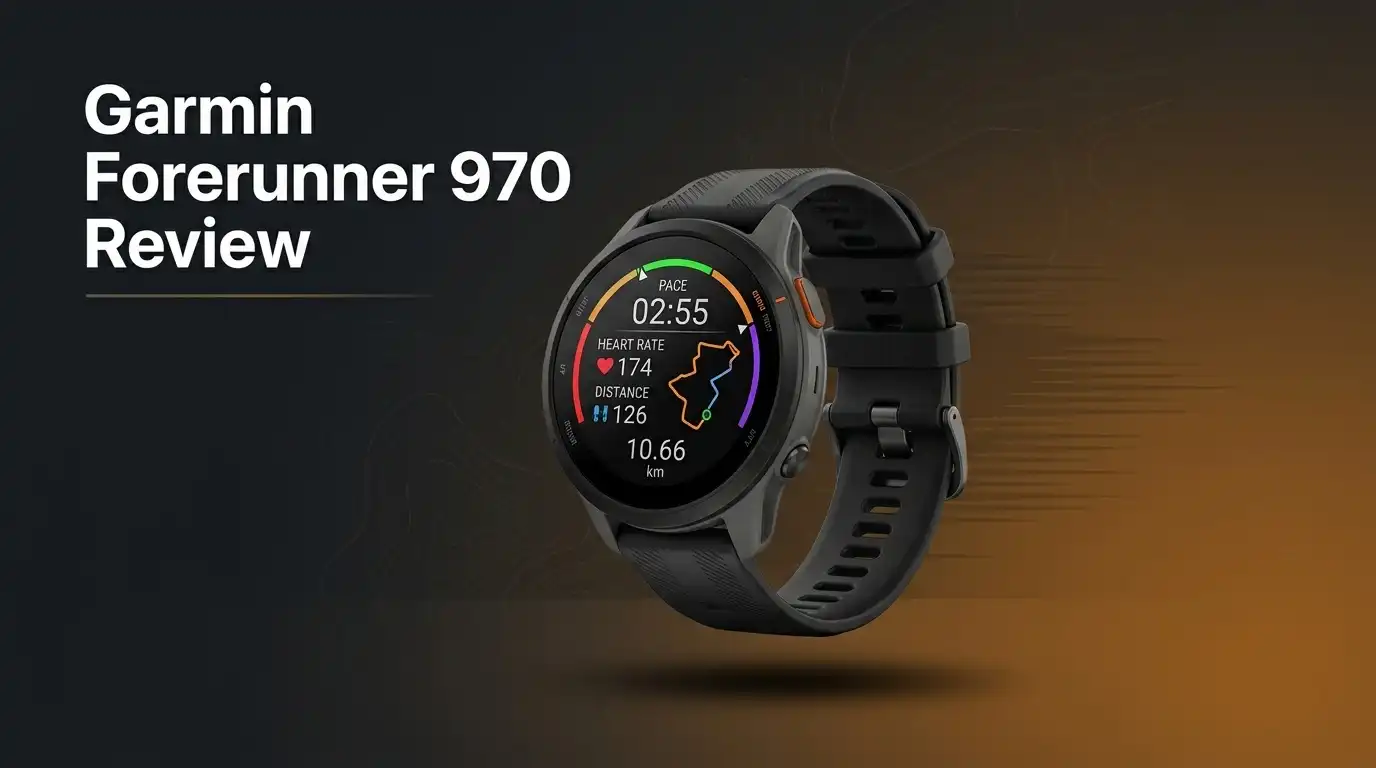
Garmin Forerunner 970 Review 2026: Still Worth It?
Running watches keep getting smarter, brighter, and sadly more expensive. The Garmin Forerunner 970 sits right at the top of that pile. It costs $749.99 at full price, though street prices have dropped closer to $649 during sale events.
That is serious money for a wrist device. So the real question is simple. Does this watch earn its price tag in 2026, or should you save cash and buy something cheaper?
This review covers what works, what annoys me, and who should actually buy it. No fluff, no hype. Just an honest look at Garmin’s flagship running watch.
In a Nutshell:
- The display is stunning. The 1.4 inch AMOLED screen is brighter than the Forerunner 965 and stays readable in harsh sunlight, even through polarized sunglasses. This is the best screen I have used on a running watch.
- Build quality jumped up a level. You get a titanium bezel and sapphire crystal glass. My old 965 picked up scratches fast. The 970 still looks clean after months of abuse.
- Battery life is good, not amazing. Garmin claims up to 15 days in smartwatch mode and 21 hours with dual band GPS. In real use with always on display and daily running, I charged it every four or five days.
- Training data is the real selling point. Running tolerance, running economy, and step speed loss give you coaching insight that no rival matches right now.
- It feels laggy sometimes. Saving activities and panning maps can stutter. A faster processor would fix this.
- The price hurts. The Forerunner 965 does 85 percent of the job for far less money. You are paying a premium for polish and a few clever metrics.
Garmin Forerunner 970 Overview


Last update on 2026-11-11 / Affiliate links / Images from Amazon Product Advertising API
The Forerunner 970 launched as the direct replacement for the much loved Forerunner 965. Garmin positions it as a premium running and triathlon watch. It measures 47 x 47 x 12.9mm and weighs 56g. That keeps it lighter and thinner than the Fenix 8, which matters a lot on long runs.
You get 32GB of storage, 5 ATM water resistance, and a sapphire crystal screen. Garmin added a built in flashlight, a speaker, and a microphone. The heart rate sensor is the newer fifth generation unit with ECG support and skin temperature readings.
In short, Garmin took the Forerunner formula and bolted on almost every Fenix feature. The result is a watch that does nearly everything, in a body that thin wrists can actually live with.
Unboxing Experience
The box is small, flat, and very Garmin. No drama, no theatrics. You lift the lid and the watch sits face up in a cardboard tray. It looks sharper in person than in photos. The titanium bezel catches light in a way that press images never show.
Under the tray you find a short USB C charging cable, a quick start guide, and warranty paperwork. That is it. No wall plug, no extra strap, no case. At this price, a spare strap would have been a nice touch.
The silicone band feels soft straight out of the box with no break in period. Setup took me around eight minutes. You pair the watch with Garmin Connect, pick your sport profiles, and the maps are already loaded. No waiting around for huge downloads.
Design and Build Quality
The 970 feels premium without feeling heavy. The titanium bezel adds toughness and the sapphire glass resists scratches far better than the glass on the 965. I knocked mine against a door frame twice and it still looks new.
The five button layout returns, and the buttons feel firmer and more clicky than before. That sounds minor until you try pressing lap with cold, wet fingers mid race. The improved button feel is a genuine upgrade.
At 56g it sits comfortably for 24 hour wear, including sleep. The case is plastic under the titanium bezel, which keeps weight down but makes it feel slightly less luxurious than a Fenix. If you want a tank, buy the Fenix. If you want light and fast, this wins.
Top 3 Alternative for Garmin Forerunner 970

Last update on 2026-11-11 / Affiliate links / Images from Amazon Product Advertising API
Garmin Forerunner 965

Last update on 2026-11-11 / Affiliate links / Images from Amazon Product Advertising API
Garmin Fenix 8 47mm AMOLED

Last update on 2026-11-11 / Affiliate links / Images from Amazon Product Advertising API
COROS PACE Pro
Display and Everyday Comfort
The 1.4 inch AMOLED panel is the star feature. Colors pop, maps look crisp, and text stays sharp. Garmin pushed peak brightness higher than the 965, and that shows in midday sun. I never once shaded the screen with my hand to read a split.
You can run always on display or raise to wake. Always on drains battery faster but looks better. I kept always on enabled because the watch felt more like a watch that way.
The touchscreen responds well, though I still prefer buttons during hard efforts. Sweat on the glass rarely caused ghost taps. Comfort is excellent for sleep tracking too, since the case does not dig into your wrist when you lie on your side.
GPS Accuracy on the Run
GPS performance is where Garmin usually wins, and the 970 keeps that record intact. It uses multi band satellite tracking with SatIQ, which switches modes automatically to save power.
I ran city loops surrounded by tall buildings, forest trails under heavy tree cover, and a few track sessions. Distance stayed within a few meters of my measured routes almost every time. Track laps came out at 400m or very close, which is a strong result.
Lock on time is fast. Most runs started tracking within five seconds. On trails the track lines stayed tight with no wild zigzags. If you care about accurate pace during intervals, this watch delivers it consistently.
Heart Rate, ECG, and Health Sensors
The fifth generation Elevate sensor handles steady runs well. My readings tracked closely with a chest strap during easy and tempo efforts. Short, sharp intervals still cause lag, which is normal for all wrist sensors. For accurate sprint data, pair a strap.
The 970 adds ECG recording, which checks for signs of atrial fibrillation. It works in about 30 seconds and saves a report you can share with a doctor. Availability depends on your country.
Skin temperature tracking also arrived here. It gives trend data rather than precise medical readings. Some users have reported odd real time temperature values, so treat it as a trend tool only. It is useful for spotting illness early, not for diagnosing anything.
Training Features That Actually Help
This is where the 970 justifies its price. Running tolerance assigns a mileage value based on the intensity of each run. Hard sessions add more load than easy ones. Over a week you see whether your body can handle your plan.
Running economy measures how efficiently you move, but it needs the Garmin HRM 600 chest strap. That strap costs around $170 extra, which stings at this price point.
Step speed loss shows how much speed you lose on each foot strike. It takes time to interpret, but it reveals form problems. Garmin’s daily suggested workouts and race predictions remain the best in the business. The coaching feels like a smart training partner rather than a nagging app.
Battery Life in Real Use
Garmin quotes up to 15 days in smartwatch mode and up to 21 hours with always on display and dual band GPS. GPS only mode reaches roughly 26 hours.
My real numbers landed lower than the headline figures, as always. With always on display, daily runs of about an hour, sleep tracking, and notifications enabled, I charged roughly every four or five days. Switch to raise to wake and you stretch that closer to eight days.
A single hour of running costs around four to five percent of battery. That is fine for marathons but tight for long ultras. Charging is quick though. Twenty minutes on the cable gets you back to a comfortable level.
Maps, Navigation, and the Flashlight
The 970 ships with full color topographic maps preloaded. You can follow GPX routes, get turn by turn directions, and create round trip courses straight from the wrist. Rerouting works when you wander off course.
Map panning is smooth enough, though zooming can lag slightly. The maps look gorgeous on the AMOLED screen, with clear trail names and contour lines.
The built in LED flashlight is the feature I did not expect to love. It has white and red modes with adjustable brightness. It genuinely helps on dark early morning runs. Flicking it on to find your keys or check a trail junction becomes a habit fast. Garmin finally brought this feature to the Forerunner line, and it belongs here.
Smart Features: Speaker, Microphone, Music, and Payments
The 970 includes a speaker and microphone. You can answer calls from your wrist when your phone is nearby. Call quality is acceptable for quick conversations, not for long chats. Voice commands work for setting timers and starting activities.
Music storage covers roughly 2,000 songs across 32GB. Spotify, Amazon Music, and Deezer offline playlists all work. Pairing wireless earbuds takes seconds.
Garmin Pay handles contactless payments, assuming your bank supports it. Notifications arrive reliably on both Android and iPhone. This is not an Apple Watch replacement, since there is no app store or LTE. But for a sports watch, the smart side is more than good enough.
Pros and Cons
Pros
- Brilliant AMOLED display that stays readable in direct sunlight
- Titanium bezel and sapphire glass survive daily knocks and scratches
- Outstanding GPS accuracy in cities, forests, and on the track
- Running tolerance and running economy add real coaching value
- Built in flashlight with white and red modes
- Full offline maps with turn by turn navigation
- Light and comfortable at 56g for round the clock wear
- ECG and skin temperature add useful health insight
Cons
- Expensive at $749.99 compared to rivals
- Noticeable lag when saving activities or panning maps
- Running economy requires a $170 chest strap
- Battery life drops fast with always on display
- Plastic case under the titanium bezel feels less premium than a Fenix
- Skin temperature readings can look inconsistent
- No LTE or satellite messaging
What the Forerunner 970 Does Not Do Well
Honest reviews mention the bad parts, so here they are. The software lag is the biggest frustration. Saving a long run sometimes takes several seconds, and the map screen stutters when you pan quickly. For a flagship costing this much, that feels sloppy.
Battery life disappoints relative to older Forerunners. The brighter screen eats power. Ultra runners will want a Fenix instead.
Value is the other weak spot. The Forerunner 965 still covers maps, music, payments, and excellent GPS for far less money. Paying an extra few hundred dollars for a flashlight, sapphire glass, and two new metrics is a hard sell for casual runners. The paywalled running economy feature also feels like double dipping.
Forerunner 970 vs Forerunner 965 vs Fenix 8
The Forerunner 965 remains the value champion. It shares maps, music, payments, and a strong AMOLED screen. It lacks the flashlight, sapphire glass, speaker, ECG, and the new training metrics. For most runners, the 965 gives you roughly 85 percent of the experience for a much lower price.
The Fenix 8 matches the 970 on sports features and adds a tougher metal case, dive tracking, and longer battery life. It is heavier, thicker, and pricier. Thin wrists will find it bulky.
The 970 sits in the sweet spot. It is basically a lighter Fenix 8 shaped for runners. Choose it if you want flagship features without the weight.
Who Should Buy the Garmin Forerunner 970?

Last update on 2026-11-11 / Affiliate links / Images from Amazon Product Advertising API
Buy this watch if you train seriously and want the best running data available. Marathon runners, triathletes, and trail runners will get real value from the maps, the recovery insight, and the GPS accuracy. The flashlight alone earns its keep for early risers.
Skip it if you run a few times a week for fitness. The Forerunner 965 or the COROS PACE Pro will serve you better for the money. Skip it also if you need LTE, satellite messaging, or an app store. Those belong to the Apple Watch Ultra and the Fenix 8 Pro.
Think of the 970 as a tool for people chasing performance. If data drives your training, this is the watch. If it does not, you are overpaying.
Final Verdict
The Garmin Forerunner 970 is the best pure running watch you can buy in 2026. The screen, the GPS accuracy, the navigation, and the training analysis all sit at the top of the market. It looks good, feels light, and survives daily life without complaint.
It is not perfect. The lag frustrates, the battery drains faster than older models, and the price feels steep. The extra chest strap requirement adds insult.
Still, I keep wearing mine. That says more than any score. If you can find it discounted near $649, it becomes a much easier recommendation. At full price, think hard about whether you really need the upgrades over a Forerunner 965.
Frequently Asked Questions
Is the Garmin Forerunner 970 waterproof?
Yes. It carries a 5 ATM rating, so it handles swimming, showers, and rain without issue. It is not a dive watch though. For scuba use, look at the Fenix 8 instead.
How long does the Forerunner 970 battery last?
Garmin quotes up to 15 days in smartwatch mode and 21 hours with dual band GPS and always on display. In real daily use with running, expect four to eight days depending on your display setting.
Do I need the HRM 600 chest strap?
Only for running economy and a few advanced form metrics. The watch works fine with any ANT Plus or Bluetooth strap for heart rate. The optical sensor is reliable for most training too.
Is the Forerunner 970 better than the 965?
Yes, but the gap is smaller than the price difference suggests. The 970 adds sapphire glass, a titanium bezel, a flashlight, a speaker, ECG, and new training metrics. The 965 remains excellent value.
Does it work with iPhone and Android?
Yes. Garmin Connect supports both platforms fully. Notifications, music transfer, and syncing work on each. Some reply options for messages remain limited on iPhone.
Can it replace an Apple Watch?
Partly. It handles notifications, calls, payments, and music well. It lacks an app store, LTE connectivity, and deep iPhone integration. For sports tracking, it beats the Apple Watch comfortably.

Hi, I’m Lucy Jones, a dedicated watch enthusiast and reviewer. I spend my time hunting down, testing, and evaluating the most intriguing wristwatches on the market. My goal is to guide you through the overwhelming choices with honest, hands-on insights into every timepiece.