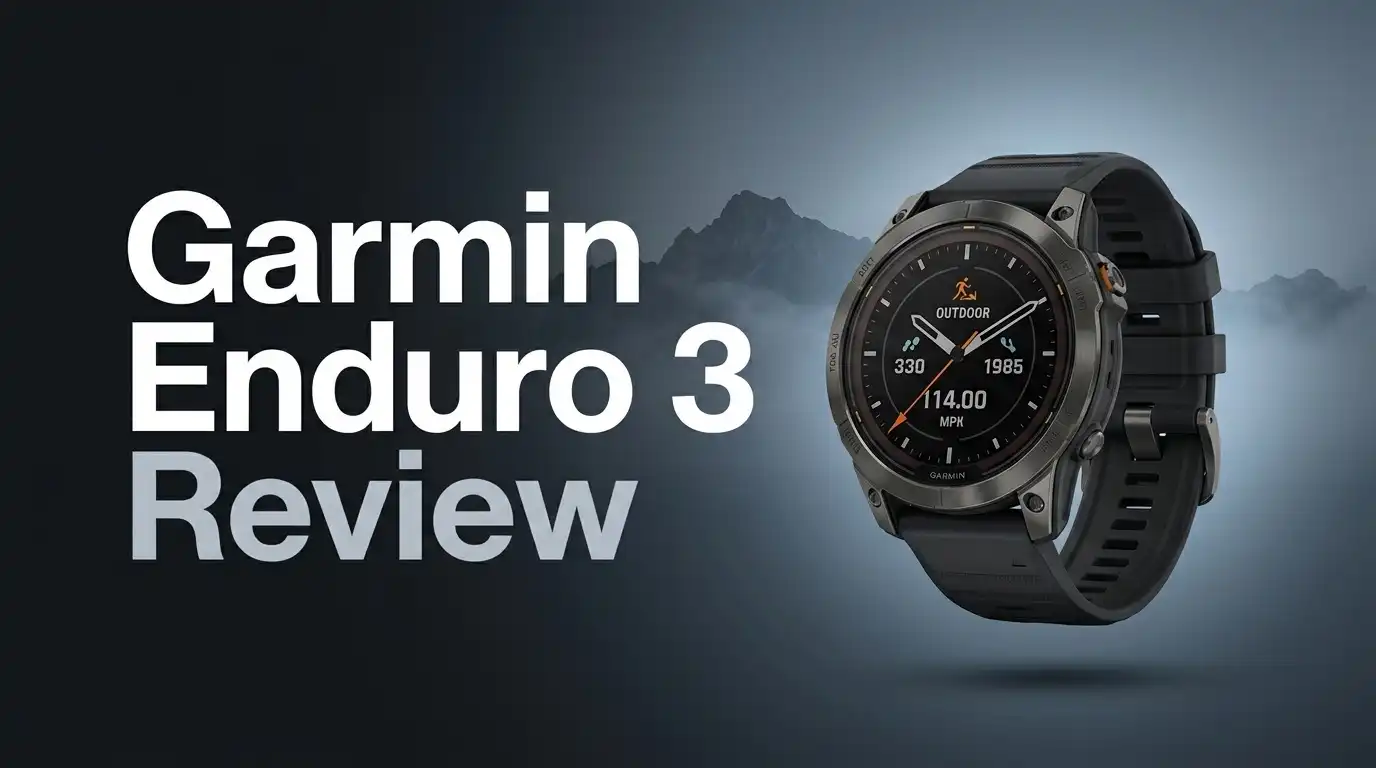
Garmin Enduro 3 Review 2026: Still Worth It?
The Garmin Enduro 3 landed in 2024 with one loud promise. It would outlast every other GPS watch on your wrist. Two years later, that promise still holds up.
Garmin has since released the Enduro 4, and prices on the Enduro 3 have fallen hard. That makes this watch one of the most interesting buys in 2026 for runners, hikers, and anyone who hates charging cables.
I wore this watch through long trail days, gym sessions, rainy commutes, and plenty of ordinary evenings. This review covers what the Enduro 3 does brilliantly, where it frustrates, and whether you should spend your money here or move up to a newer model.
In A Nutshell:
- Battery life is the headline feature. Garmin claims up to 36 days in smartwatch mode and 90 days with solar charging. In GPS activity mode, you get up to 120 hours, stretching to 320 hours with strong sunlight. Real world testing by long distance hikers lands close to those numbers when the map page stays off.
- It is a lighter, cheaper Fenix. The Enduro 3 weighs only 63 grams with the nylon strap and shares nearly every software feature with the Fenix 8 family. You give up the speaker, microphone, and diving tools.
- The MIP display is a tradeoff. It looks fantastic in bright sun and sips power. In forests, dim rooms, or at dusk, it becomes hard to read without the backlight.
- Maps and navigation are genuinely useful. You get full offline topographic maps, on device route creation, round trip routing, and ClimbPro.
- Price now makes it compelling. It launched at $899 and has dropped to roughly $749 or lower during sales, which puts it well under newer flagships.
- It is big. Only one size exists at 51mm, so small wrists should look elsewhere.
Garmin Enduro 3 Overview


Last update on 2026-11-11 / Affiliate links / Images from Amazon Product Advertising API
The Enduro 3 is Garmin’s ultraperformance GPS smartwatch built for people who spend entire days outdoors. It uses a 51mm case with a titanium bezel, sapphire glass, and a 1.4 inch memory in pixel display at 280 by 280 pixels.
A redesigned solar ring wraps the outer edge and harvests roughly double the energy of the Enduro 2 panel.
Inside you get the Elevate Gen 5 optical heart rate sensor with ECG capability, 32GB of storage for maps and music, Garmin Pay, Wi-Fi syncing, and a bright white and red LED flashlight.
It runs the same software platform as the Fenix 8 series, so feature updates arrive together. Think of it as a Fenix stripped of the parts that drain batteries, then given a far bigger power budget.
Unboxing Experience And First Impressions
The box is small and plain. Garmin ships a simple cardboard sleeve, and inside you find the watch, a USB charging cable, a quick start sheet, and nothing else. No extra strap. No case. For a watch that once cost $899, the presentation feels modest.
The surprise comes when you pick it up. The Enduro 3 looks enormous in the tray, then feels almost weightless in your hand. That contrast is the whole personality of this watch. The UltraFit nylon strap is soft right out of the box with no break in period.
First boot asks you to choose a font size, which is a thoughtful touch. Pairing with Garmin Connect took about four minutes. The watch arrived with roughly 70 percent charge, so I was training within the hour.
Design, Build Quality And Comfort
Garmin built this watch to take abuse. The sapphire lens resisted scratches through rock scrambles and door frames. The titanium bezel shows only faint marks after months of use. Five physical buttons handle everything, and they stay reliable with gloves or wet hands.
Comfort is the real win. At 63 grams total, the Enduro 3 sits lighter than most watches two thirds its size. The nylon strap breathes well and dries fast after swims or sweaty runs. Many owners report they forget the watch is on their wrist during sleep tracking.
The honest downside is diameter. A 51mm case dominates a slim wrist and catches on jacket sleeves. The watch also sits 15.7mm thick, so it bumps into things. Try it on before committing if your wrist measures under 16cm.
Top 3 Alternative for Garmin Enduro 3

Last update on 2026-11-11 / Affiliate links / Images from Amazon Product Advertising API
Garmin Enduro 4

Last update on 2026-11-11 / Affiliate links / Images from Amazon Product Advertising API
Garmin Fenix 8 Solar 51mm
No products found.
COROS VERTIX 2S
Battery Life Tested In Real Conditions
This is why you buy the Enduro 3. Garmin rates smartwatch mode at 36 days, rising to 90 days with solar. GPS activity mode reaches 80 hours normally, 120 hours in extended battery mode, and up to 320 hours with solar in ideal light.
Real use matches the spirit of those claims. With daily wear, sleep tracking, and one hour of GPS running per day, many owners report around 3 to 5 percent drain per day. That works out to roughly a month between charges. An hour long GPS run costs only 1 to 2 percent.
One warning. Leaving the map page open during an activity destroys battery life. Independent testing on an eight hour mountain hike dropped the projected total from 120 hours to around 57 hours simply because the map stayed visible. Keep a data page up and the numbers stay spectacular.
Solar Charging Performance
The solar system on the Enduro 3 is the most meaningful hardware upgrade over the Enduro 2. Garmin moved the panel into a thicker black ring around the bezel and removed the transparent layer over the screen. That change boosted harvesting and improved screen clarity at the same time.
In practice, the panel adds about 30 minutes of GPS battery for every hour spent in 50,000 lux sunlight. That is double the Enduro 2 rate. On a bright summer hike, the battery percentage can hold steady for hours.
Solar is not magic. Cloudy days, winter light, long sleeves, and indoor work kill the benefit almost entirely. Treat solar as a bonus that extends an already huge battery, not as a reason to skip the charger permanently.
Display Quality And Readability
The Enduro 3 uses a memory in pixel panel instead of AMOLED. In direct sun it is superb. Glance at your pace on a bright ridge and the numbers appear instantly with zero glare. The always on display never dims or sleeps, and it costs almost nothing in power.
Then you step into a forest. Readability falls apart in low light. Shaded trails, early mornings, and indoor gyms all force you to press the backlight. Reviewers hiking through dense woods have described the map as effectively unusable without it.
Resolution is modest too. At 280 by 280 pixels, maps look coarse next to any AMOLED watch, and text has visible edges. You trade visual polish for battery life. If that trade bothers you, an AMOLED model suits you better.
GPS Accuracy And Satellite Modes
Accuracy is excellent. Using SatIQ, which switches to multiband signals automatically when conditions worsen, the Enduro 3 produced clean tracks through city streets, canyon walls, and tree cover in testing. Distance totals matched reference watches closely.
The interesting question is the battery saving GPS only mode. Side by side testing on mountain hikes showed slightly more wobble in the track, mostly during forest climbs. Over a full day, that produced up to 2km of distance difference compared to SatIQ on a long route. GPS only remains usable, but SatIQ is the smarter default unless you are chasing a record battery run.
Garmin also added automatic track cleanup. The watch reviews questionable recordings after upload and smooths out obvious errors using internal sensor data. You can disable it if you prefer raw files.
Maps And Navigation Features
Full colour topographic maps ship on the watch, and they are fully routable. You can create a route on the wrist without a phone, something most rivals cannot do. Round trip routing now adjusts mid run if you wander off course, which is genuinely handy when exploring a new area.
ClimbPro breaks a route into individual climbs and shows remaining gradient and elevation. For ultrarunners and hikers, this single feature changes how you pace a long day. You also get map layer toggles, a north up shortcut, and a temporary touch unlock for quick map panning.
Speed is the weak point. Generating a 30km route on device took around 75 seconds in comparison testing, which is slower than newer Garmin processors manage. Opening a saved course takes about eight seconds.
Training Metrics And Recovery Tools
Garmin’s training suite remains the most complete in the category. You get Training Readiness, Training Status, acute and chronic load, VO2 max estimates, HRV status, endurance score, hill score, recovery time, and race predictors. Daily suggested workouts adapt to your recent training and sleep.
Multisport profiles cover running, trail running, cycling, swimming, strength, skiing, hiking, rowing, golf, and dozens more. Structured workouts sync from Garmin Connect and third party platforms. Garmin has also pushed newer features to the Enduro 3 through free updates, including rucking tools and improved indoor rowing metrics that arrived alongside the Enduro 4 launch.
The data can overwhelm newcomers. Most people use maybe a quarter of what is here. Spend a week exploring Garmin Connect before deciding the watch is too complicated.
Health Tracking, Sleep And Daily Wear
The Elevate Gen 5 sensor handles heart rate, Pulse Ox, skin temperature, respiration, and ECG recordings. Heart rate accuracy during steady running and hiking tracked closely with chest strap data in independent testing. Interval sessions and heavy weightlifting still cause lag, which is normal for wrist sensors.
Sleep tracking produces a nightly score with stages, restlessness, and a morning report summarising readiness. The light case helps here. Many watches feel awful overnight, but this one disappears.
Body Battery remains the most intuitive metric Garmin offers. It shows energy draining through a hard day and recharging overnight. It is a useful nudge toward rest when motivation says otherwise. Pulse Ox drains battery noticeably, so leave it on spot check mode unless you are at altitude.
Smartwatch Features: Music, Payments And Flashlight
Offline music works properly. Load playlists from Spotify, Amazon Music, YouTube Music, or your own files onto 32GB of storage, pair Bluetooth headphones, and leave the phone behind. Garmin Pay handles contactless payments at most terminals.
The LED flashlight deserves its own paragraph. It is bright, has multiple intensity levels, offers a red mode to protect night vision, and includes a strobe that pulses with your running cadence. Once you own a watch with a flashlight, every watch without one feels incomplete.
Notifications, weather, calendar, and Garmin Messenger all function. What you do not get is a speaker or microphone, so no voice calls, no voice assistant, and no voice notes. Garmin removed them deliberately to protect battery life, and most Enduro buyers never miss them.
What The Garmin Enduro 3 Does Not Do Well
Honest reviews list the problems, so here they are. The dim light display is the biggest flaw. You will press the backlight constantly indoors and in shade, and that gets old.
Size limits the audience. One 51mm option means small wrists are excluded entirely. There is no 43mm or 47mm version.
The user interface added swipe lanes for navigation and music that create more pages than before. You cannot disable the music lane easily, and ClimbPro displays different information depending on which lane you are in. It feels unfinished.
Mapping is slower than current generation Garmin hardware. There is no diving support, no depth gauge, and no LTE or satellite messaging. Accessories are expensive, and the box includes no spare strap. Finally, solar gains shrink to nearly nothing in winter.
Garmin Enduro 3 vs Enduro 4 vs Fenix 9
The Enduro 4 arrived in late 2026 at the same $899 launch price. It adds a faster processor, 50 percent more RAM, 64GB of storage, a grey titanium bezel, and the more comfortable ComfortFit band. Battery life, display, case size, and solar hardware are identical to the Enduro 3.
Crucially, Garmin is pushing nearly all the new Enduro 4 software features down to the Enduro 3 for free. Stamina zones, rucking tools, rowing upgrades, and field tools are all coming. Only the new perspective map view, faster map rendering, and ArcheryX stay exclusive.
The Fenix 9 Pro Solar adds diving, a speaker and microphone, LTE, satellite messaging, and smaller sizes. It also weighs considerably more and costs $1,099 or higher. If you skip those extras, the Enduro saves real money.
Pros And Cons Of The Garmin Enduro 3
Pros
- Class leading battery life at up to 36 days smartwatch mode, 90 days with solar, and 120 to 320 hours in GPS activity mode
- Remarkably light at 63 grams despite the large 51mm case, which makes all day and overnight wear comfortable
- Sapphire glass and a titanium bezel survive serious abuse without meaningful scratching
- Full offline routable maps with on device route creation, round trip routing, and ClimbPro
- Excellent GPS accuracy with SatIQ multiband switching plus automatic track correction after uploads
- Complete training suite including Training Readiness, HRV status, endurance score, and daily suggested workouts
- Genuinely useful LED flashlight with white, red, and cadence strobe modes
- Cheaper than the Fenix equivalent while sharing almost all the same software features
Cons
- MIP display becomes hard to read in forests, shade, and indoor lighting without the backlight
- Only one 51mm size, which excludes smaller wrists completely
- No speaker, microphone, voice control, or diving features
- Map pages drain the battery far faster than Garmin’s headline numbers suggest
- Mapping and route generation run slower than newer Garmin processors
- Swipe lane interface adds clutter and cannot be fully customised
- Solar benefit nearly disappears in cloudy or winter conditions
- Minimal accessories included in the box for the price
Garmin Enduro 3 Price And Value In 2026

Last update on 2026-11-11 / Affiliate links / Images from Amazon Product Advertising API
The Enduro 3 launched at $899, already $200 below the Enduro 2 it replaced. Since the Enduro 4 arrived, street prices have fallen significantly. The watch has been spotted at $749 and lower during sale events, and occasionally under $700.
At that price the value equation changes completely. You are buying a watch with the longest GPS battery life in the category, full offline maps, a sapphire lens, titanium bezel, and a software roadmap that still brings new features for free. The Fenix 9 Pro Solar costs roughly $350 more for diving, LTE, and a microphone.
Value depends entirely on what you actually do. Marathon runners, thru hikers, expedition travellers, and ultra athletes get enormous return here. Casual gym users are paying for endurance they will never need.
Who Should Buy The Garmin Enduro 3
Buy this watch if you spend long days outside and hate charging. Ultrarunners, thru hikers, adventure racers, expedition travellers, and backcountry skiers will find no better battery companion. Anyone who has watched a watch die at hour 30 of a hundred miler understands the appeal.
It also suits people who want Fenix capability without Fenix pricing. The software is the same. The savings are real.
Skip it if you have a small wrist, if you want a sharp AMOLED screen, or if you need diving, LTE, or voice features. Casual fitness users should buy a Forerunner instead and keep the difference. Those who want the newest mapping speed should look at the Enduro 4 or Fenix 9.
Final Verdict
The Garmin Enduro 3 is still one of the smartest buys in GPS watches in 2026. Its battery life remains unmatched in real world use, the build quality holds up to years of punishment, and Garmin keeps feeding it new features long after launch. The falling price only strengthens the case.
It is not perfect. The dim light display genuinely annoys. The 51mm case will not suit everyone. Mapping could be faster. Those are real limitations, not minor quibbles.
If you need a watch that simply refuses to die, this is the one. If you want a beautiful screen and smartwatch extras, look elsewhere. Clear priorities make this an easy decision in either direction.
Frequently Asked Questions
How long does the Garmin Enduro 3 battery actually last?
With everyday wear, sleep tracking, and about an hour of GPS activity daily, most owners report roughly one month between charges. Drain sits near 3 to 5 percent per day. In pure GPS mode, expect around 120 hours without solar and considerably more with strong sunlight, provided you avoid leaving the map page open.
Is the Garmin Enduro 3 still worth buying in 2026?
Yes, especially at discounted prices. Garmin is delivering most Enduro 4 software features to the Enduro 3 through free updates, so the gap between generations is mainly processor speed and storage. The battery, display, solar hardware, and case are identical between the two models.
Does the Garmin Enduro 3 have a touchscreen?
Yes. The Enduro 3 includes touch input alongside five physical buttons. Touch is disabled during activities by default to prevent accidental presses, but a quick unlock icon lets you temporarily enable it for map panning and zooming.
Can the Garmin Enduro 3 track swimming?
Yes. It supports pool swimming, open water swimming, and triathlon multisport mode. The case carries a 10 ATM water rating. It does not include scuba or freediving features or a depth gauge, which remain exclusive to the Fenix line.
Does the Garmin Enduro 3 work without a phone?
Mostly yes. You can create routes on the watch, navigate offline maps, play stored music through Bluetooth headphones, and pay with Garmin Pay. A phone or Wi-Fi connection is needed to sync activities, download new maps, and receive notifications.
Is the Enduro 3 too big for small wrists?
Possibly. The case measures 51mm wide and 15.7mm thick, and Garmin offers no smaller version. The light 63 gram weight helps a lot, but the physical footprint is large. Anyone with a wrist under about 16cm should try it on first or consider a Forerunner or Fenix in a smaller size.

Hi, I’m Lucy Jones, a dedicated watch enthusiast and reviewer. I spend my time hunting down, testing, and evaluating the most intriguing wristwatches on the market. My goal is to guide you through the overwhelming choices with honest, hands-on insights into every timepiece.