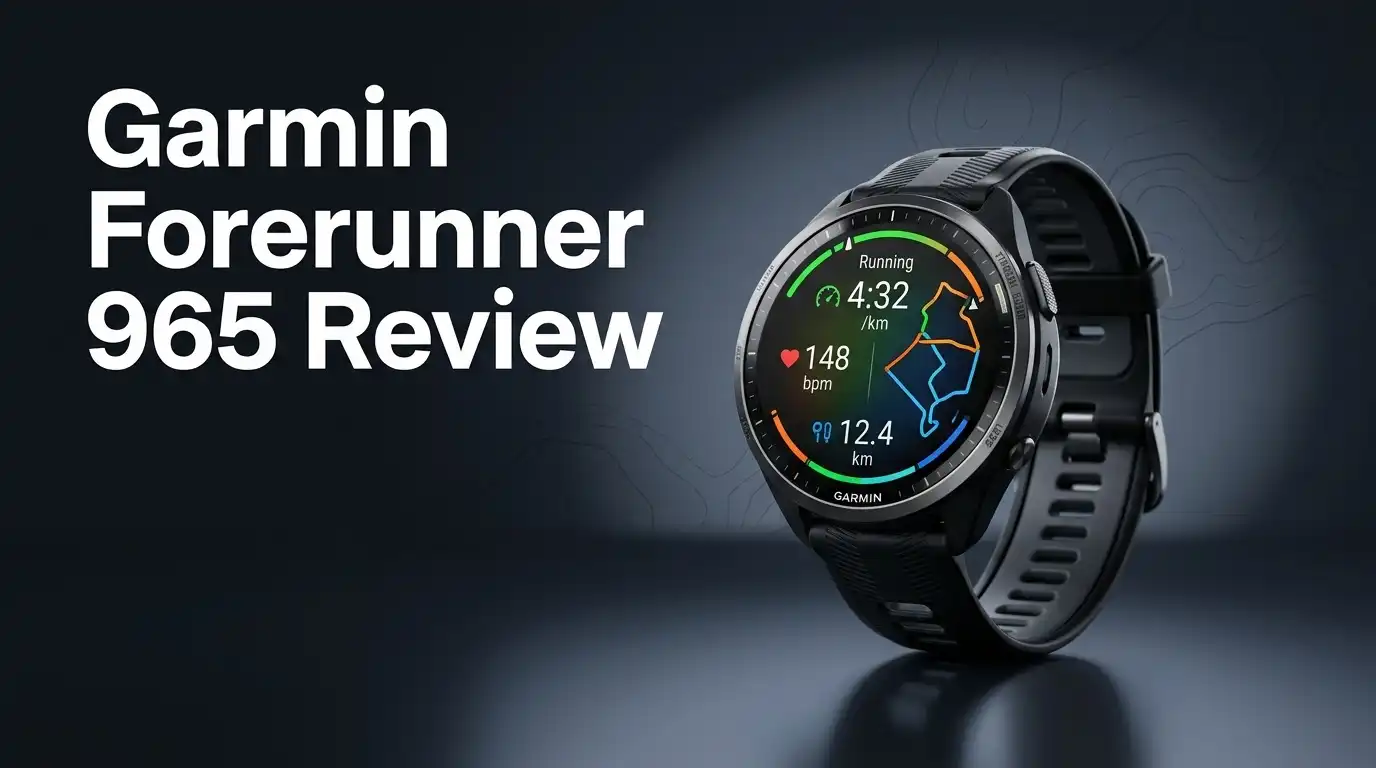
Garmin Forerunner 965 Review 2026: Still Worth It?
The Garmin Forerunner 965 arrived in 2023, yet runners still argue about it in 2026. That says something. A watch does not stay relevant for three years unless it gets the basics right.
This review looks at the 965 with fresh eyes, after newer models have launched and prices have shifted. You will learn how the battery actually behaves, where the GPS slips, what the maps can and cannot do, and which runners should skip it entirely.
No marketing fluff. Just the daily reality of wearing this watch on long runs, easy jogs, sleep, and everything in between.
In A Nutshell:
- The AMOLED display is the headline feature. The 1.4 inch, 454 x 454 pixel screen stays sharp in bright sun and looks closer to a phone than a sports watch. Once you use it, older memory in pixel screens feel dull.
- Battery life is strong but marketing numbers mislead. Garmin claims up to 23 days in smartwatch mode and 31 hours with GPS. Real world owners with always on display report closer to four to nine days of normal use.
- Training tools remain best in class. Daily suggested workouts, training readiness, race predictor, HRV status, and running power all work without a subscription fee.
- Maps are genuinely useful, not a gimmick. Full color topographic maps with 32 GB of storage let you explore trails and reroute mid run.
- The weak points are real. Some owners report faster than expected battery drain, occasional software bugs after updates, and a 47 mm case that overwhelms smaller wrists.
- Value in 2026 depends on price. At a discount it beats most rivals. At full price, newer options deserve a look first.
Garmin Forerunner 965 Overview

Last update on 2026-11-11 / Affiliate links / Images from Amazon Product Advertising API
The Forerunner 965 sits at the top of Garmin’s running focused lineup. It packs a 47.7 mm case, a titanium bezel, a 1.4 inch AMOLED touchscreen, and 32 GB of storage.
Weight lands at roughly 53 grams with the silicone band, which feels light for the size. Garmin rates it at 5 ATM for water resistance, so pool swims and rain pose no issue.
This is a serious training device first and a smartwatch second. It records running, cycling, swimming, triathlon, strength, hiking, golf, and dozens of other activities.
Multiband GNSS, full color maps, offline music, and Garmin Pay all come standard. There is no monthly fee for any training feature, which separates Garmin from several competitors.
The Unboxing Experience
Garmin keeps packaging simple. The 965 arrives in a small cardboard box with a cutout that cradles the watch face up. Lift the tray and you find a short USB C charging cable, a quick start guide, and warranty paperwork. That is everything. No charging dock, no extra band, no carry case.
The first thing you notice is the screen. Even powered off, the glossy Gorilla Glass DX looks premium. Pick it up and the lightness surprises you. The 53 gram weight feels almost hollow compared to a steel smartwatch, in a good way.
Setup takes about ten minutes. You pair with Garmin Connect over Bluetooth, sign in, and the watch downloads updates. Budget thirty minutes before your first run, because that initial firmware update can take a while.
Design And Build Quality
The titanium bezel is the standout detail. It resists scratches better than aluminum and gives the watch a quiet, serious look. The polymer case keeps weight down. Five physical buttons surround the screen, three on the left and two on the right, and they click with reassuring firmness.
You get buttons and touch together, which matters more than you think. Sweaty fingers and rainy runs make touchscreens unreliable, so the buttons become your backup.
The 22 mm quick release band swaps in seconds. The stock silicone strap breathes reasonably well but gets clammy on hot days.
The size is the real issue. At 47.7 mm wide and 13.2 mm thick, this watch dominates slim wrists. Anyone with a wrist under 6.5 inches should try one on first.
Top 3 Alternative for Garmin Forerunner 965

Last update on 2026-11-11 / Affiliate links / Images from Amazon Product Advertising API
Garmin Forerunner 265

Last update on 2026-11-11 / Affiliate links / Images from Amazon Product Advertising API
COROS PACE Pro


Last update on 2026-11-11 / Affiliate links / Images from Amazon Product Advertising API
Garmin Forerunner 970
The AMOLED Display Explained
Garmin spent years using memory in pixel screens that looked dim and dated. The 965 changed that. Colors pop, map detail reads clearly, and text stays crisp at 454 x 454 pixels.
Outdoor visibility is excellent. Direct sunlight does not wash out the screen. Indoors and at night, the automatic brightness keeps things comfortable without blinding you during a 5 a.m. alarm check.
You choose between gesture activation and always on display. Gesture mode wakes the screen when you raise your wrist, and it works maybe 90 percent of the time. Always on mode looks better but costs serious battery.
One honest complaint: some third party watch faces handle always on display poorly and fall back to a plain Garmin screen. Stick with official faces for the cleanest result.
Battery Life In Real Use
Garmin advertises up to 23 days in smartwatch mode, 7 days with always on display, and up to 31 hours in GPS only mode. Independent testing has reached around 29 hours of GPS recording and roughly 20 days of light daily use.
Real owners report different numbers. With always on display active, plenty of runners see four to five days. Turn it off and nine to twelve days is common. Heavy multiband GPS use, music playback, and pulse ox monitoring drain it faster.
A few users have reported sudden battery drops of 10 percent per day on specific firmware versions. Garmin usually patches these.
Practical takeaway: charge once a week, keep always on display off unless you love it, and you will never worry about running out mid marathon.
GPS Accuracy On Real Runs
The 965 uses multiband GNSS, meaning it reads two satellite frequencies at once. This matters in cities with tall buildings and on tree covered trails.
In open parks and on roads, tracks line up almost perfectly with the actual route. Downtown runs between high rises show far less drift than older single band watches. Trail runners report solid performance under heavy tree cover, with occasional minor smoothing on tight switchbacks.
Satellite lock usually takes five to fifteen seconds when you run from the same place regularly. The watch caches satellite data, which speeds this up.
Multiband mode costs battery, so Garmin lets you choose. For most road running, standard all systems mode is accurate enough and saves hours of battery. Save multiband for races and complicated terrain.
Heart Rate And Health Tracking
The 965 uses Garmin’s Elevate v4 optical sensor. For steady efforts, easy runs, and long runs, readings track closely with a chest strap.
Interval training exposes the limits. Wrist sensors lag during sharp pace changes, and the 965 is no exception. Expect a delay of several seconds when you sprint, and occasional cadence lock during cold weather runs.
Resting heart rate, HRV overnight tracking, respiration, stress scores, and pulse oximetry all work well for trend spotting. Body Battery gives a surprisingly useful read on how much energy you have left in the day.
If you train by heart rate zones, buy a chest strap. The watch pairs with any ANT Plus or Bluetooth strap in seconds, and that combination gives you lab grade data.
Training Metrics And Daily Suggested Workouts
This is where Garmin earns its price. Training Readiness combines sleep, HRV, recovery time, and recent load into one score each morning. It tells you whether to push or back off.
Daily suggested workouts adapt automatically. Miss a few days and the watch eases you back in. Garmin Coach builds full 5K, 10K, and half marathon plans at no extra cost.
Training Status, Acute Load, Load Focus, and Race Predictor round out the picture. Running power comes from the wrist, no accessory pod required. Running dynamics like ground contact time and vertical oscillation need an HRM Pro strap or Running Dynamics Pod.
The PacePro feature deserves special mention. It builds a hill aware pacing strategy for any course, then guides you through it in real time.
Maps, Navigation, And Storage
Full color topographic maps come preloaded for your region. You can pan, zoom, and search points of interest directly on the watch.
Turn by turn navigation works for both planned routes and spontaneous exploring. Round Trip Routing generates loop suggestions when you enter a distance. ClimbPro shows each upcoming hill with gradient and remaining distance, which is a mental lifesaver during hilly races.
The 32 GB of storage holds maps plus thousands of songs. You can download extra map regions over Wi Fi for free.
Honest limitation: map rendering stutters a little when you zoom quickly, and the small screen makes complex urban navigation harder than a phone. It works best as a confidence check, not a primary navigation tool.
Music, Payments, And Smart Features
The 965 stores music offline. Spotify, Amazon Music, and Deezer all support downloads for premium subscribers. You can also sideload your own MP3 files.
Pair any Bluetooth earbuds and leave your phone at home. Audio quality depends entirely on your earbuds, and connection stability has been reliable in testing.
Garmin Pay handles contactless payments if your bank participates, though coverage varies by country. Smart notifications arrive from your phone, and Android users can send quick replies. iPhone users cannot.
Do not expect an Apple Watch experience. There is no speaker, no microphone, no voice assistant, and no cellular. The app store, Connect IQ, has useful tools but a dated interface.
Sleep Tracking And Recovery Tools
Sleep tracking runs automatically. You get sleep stages, a sleep score, and a Sleep Coach recommendation for how much rest you need based on recent training.
Accuracy is decent for a wrist device. It correctly spots bedtime and wake time almost every night, though deep sleep numbers should be treated as a trend rather than a fact.
The Morning Report greets you with sleep quality, HRV status, training readiness, and the day’s weather. It takes five seconds to read and genuinely shapes training decisions.
Recovery Time tells you how many hours until your next hard session. HRV Status is the most valuable recovery metric here, because a sustained drop reliably signals illness, stress, or overtraining before you feel it yourself.
Pros And Cons
Pros
- Bright 1.4 inch AMOLED screen that stays readable in direct sunlight
- Light 53 gram build with a scratch resistant titanium bezel
- Full color offline maps with turn by turn navigation and ClimbPro
- Multiband GNSS delivers excellent accuracy in cities and on trails
- Complete training suite with no subscription required
- 32 GB storage for maps and offline music
- Five physical buttons plus touchscreen for all conditions
- Strong battery life when always on display stays off
Cons
- 47.7 mm case feels oversized on smaller wrists
- Always on display cuts battery life dramatically
- Optical heart rate lags during intervals and sprints
- Occasional software bugs appear after firmware updates
- No speaker, microphone, or voice assistant
- Charging cable only, no dock or spare band included
- Connect IQ app store feels dated
- Full retail price is hard to justify against newer models
What The Forerunner 965 Does Not Do Well
Honesty matters here. The 965 is not flawless. Battery drain complaints are the most common owner frustration. Some users see 10 percent daily loss without any activity, usually traced to pulse ox, always on display, or a buggy firmware build.
Software updates occasionally break things. Garmin forums fill with reports after major releases, and fixes can take weeks. If you need absolute stability, wait a month before installing new firmware.
The watch also fails as a casual smartwatch. No calls, no voice replies on iPhone, no music control beyond basics.
Finally, the size limits who can wear it. There is no smaller version of the 965, unlike the Forerunner 265 which offers a 265S. Small wrists get left out entirely.
Forerunner 965 Versus Forerunner 970
The Forerunner 970 launched in 2025 as the direct successor. It adds a brighter sapphire screen, a built in speaker and microphone, an LED flashlight, an ECG sensor, and running tolerance metrics.
The 965 fights back on battery. It delivers up to 23 days in smartwatch mode versus 15 days on the 970, and 31 hours of GPS versus the 970’s shorter figure in comparable modes.
Core training features overlap heavily. Maps, multiband GPS, daily suggested workouts, and PacePro all appear on both.
The 970 costs considerably more. For most runners, the extra money buys convenience features rather than better training data. If the flashlight and ECG do not excite you, the 965 remains the smarter purchase.
Who Should Buy The Garmin Forerunner 965
Last update on 2026-11-11 / Affiliate links / Images from Amazon Product Advertising API
Buy this watch if you run regularly and want structured training guidance without a subscription. Marathon runners, half marathon trainers, and triathletes get the most value.
Trail runners benefit enormously from the maps and ClimbPro. Anyone who has ever taken a wrong turn at mile eighteen understands why.
It also suits runners upgrading from an older Forerunner with a dull screen. The AMOLED jump feels dramatic.
Skip it if you mainly walk, lift, or want an everyday smartwatch. The Forerunner 265 covers casual running for less money. Skip it if your wrist is slim, because the 47 mm case will look and feel wrong.
In 2026, the 965 makes the most sense at a discounted price, where it often undercuts newer watches while matching them on the features that actually improve your running.
Frequently Asked Questions
Is the Garmin Forerunner 965 still worth buying in 2026?
Yes, especially at a discount. The training features, maps, and display still compete with current models. You lose the speaker, ECG, and flashlight found on newer watches, but you gain longer battery life and a lower price.
How long does the Forerunner 965 battery really last?
Expect four to nine days of mixed use depending on your settings. Always on display cuts life roughly in half. GPS recording lasts around 29 to 31 hours in standard mode and less with multiband plus music.
Does the Forerunner 965 work with an iPhone?
Yes. It pairs through Garmin Connect and delivers notifications, music sync, and data uploads. iPhone users cannot send quick text replies from the watch, which is an Apple restriction rather than a Garmin one.
Can you swim with the Forerunner 965?
Yes. The 5 ATM rating covers pool swimming, open water swimming, and showering. It tracks stroke type, distance, and SWOLF automatically. Avoid high pressure water jets and hot tubs to protect the seals.
Does the Forerunner 965 need a subscription?
No. Every training metric, map, workout plan, and recovery tool works for free. You only pay for music streaming services if you want offline Spotify or Amazon Music playlists.
Is the Forerunner 965 too big for small wrists?
Possibly. The case measures 47.7 mm wide and 13.2 mm thick. Runners with wrists under 6.5 inches often find it bulky. The Forerunner 265S offers a 42 mm alternative with most of the same training features.

Hi, I’m Lucy Jones, a dedicated watch enthusiast and reviewer. I spend my time hunting down, testing, and evaluating the most intriguing wristwatches on the market. My goal is to guide you through the overwhelming choices with honest, hands-on insights into every timepiece.