Garmin Forerunner 570 Review 2026: Worth It?
The Garmin Forerunner 570 sits in a strange spot. It costs $549.99 at list price, yet it skips features that cheaper watches already include. Still, it keeps selling. It has become one of the most popular Garmin running watches on Amazon, and street prices have dipped near $449 during sales.
So what is going on here? I spent weeks running, sleeping, and commuting with this watch. I compared its data against a chest strap and against the pricier Forerunner 970. Some results impressed me. One result annoyed me every single evening.
This review covers the good, the frustrating, and the parts Garmin quietly left out. You will learn exactly who should buy this watch and who should save money or spend more. No marketing talk. Just what the watch actually does on your wrist.
In a Nutshell:
- Accuracy matches the flagship. The Forerunner 570 uses the same multiband GNSS chip and the same Elevate Gen 5 heart rate sensor as the $749 Forerunner 970. My runs tracked within 0.01 miles of the 970. Heart rate stayed within a few beats of a chest strap during intervals.
- The AMOLED screen is the best part. The 47mm model carries a 1.4 inch display at 454 x 454 pixels. The 42mm model uses a 1.2 inch panel. Both read clearly in direct sun. Garmin calls these its brightest smartwatch displays yet, and that claim holds up.
- Battery life went backward. The 42mm model drops to a claimed 10 days in smartwatch mode, down from 15 days on the Forerunner 265. With always on display enabled, expect roughly 3 days of heavy use.
- No maps, no ECG, no flashlight. These three omissions define the watch. Breadcrumb navigation only. This is the single biggest reason buyers hesitate.
- Training tools are genuinely excellent. Training Readiness, Training Load Ratio, Garmin Triathlon Coach, Evening Report, and Daily Suggested Workouts all work well and adapt fast.
- Value depends entirely on sale pricing. At $549 it feels overpriced. At $449 it becomes a strong buy.
What Is the Garmin Forerunner 570?


Last update on 2026-11-11 / Affiliate links / Images from Amazon Product Advertising API
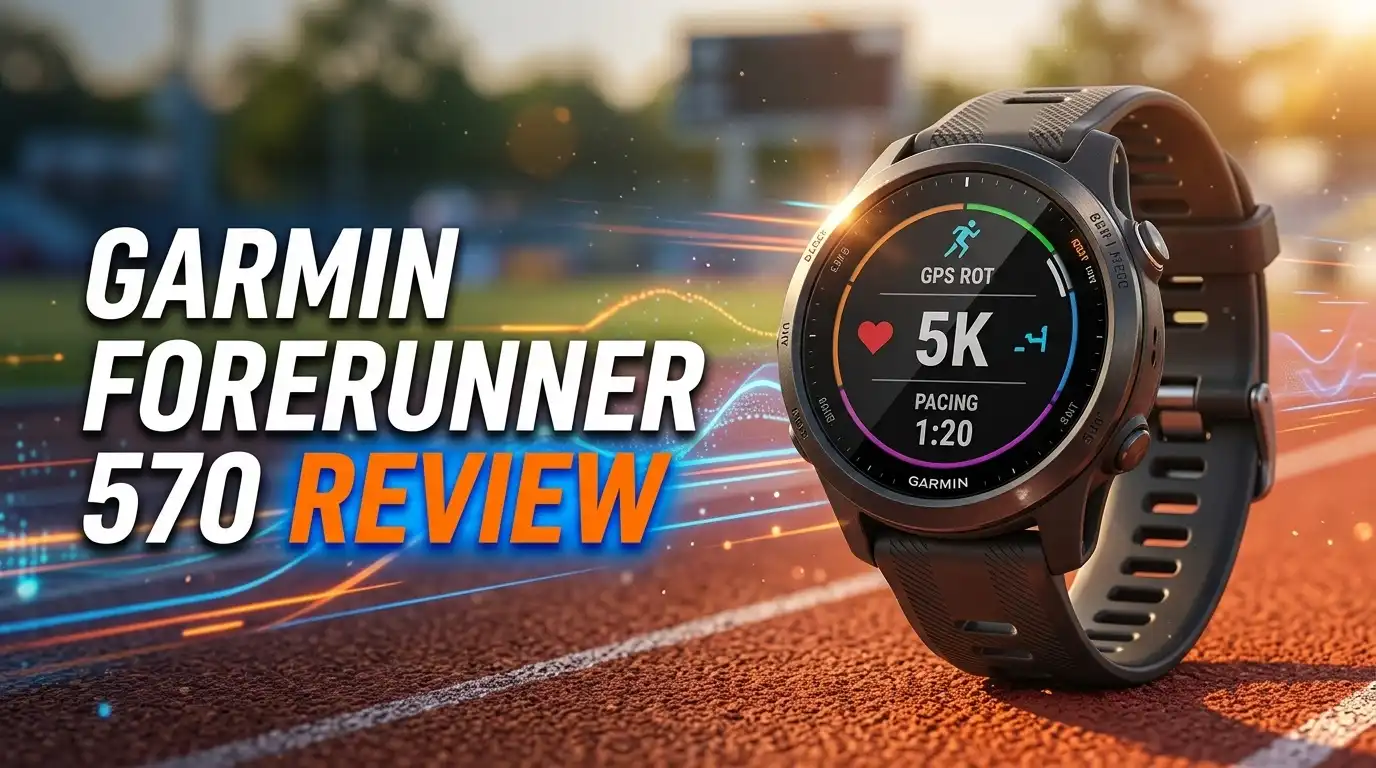
The Forerunner 570 is Garmin’s midrange running and triathlon smartwatch. Garmin launched it in May 2025 alongside the flagship Forerunner 970. It replaces the Forerunner 265, and the odd jump in model numbers happened because Garmin felt the upgrade was too large for a 270 badge.
The watch comes in two sizes. The 42mm version weighs 42 grams. The 47mm version weighs 50 grams. Both share a fiber reinforced polymer body, an aluminum bezel, and Corning Gorilla Glass 3. Water resistance is rated at 5 ATM, so pool swims and open water sessions are fine.
Inside you get 8GB of music storage, Garmin Pay, Wi Fi, ANT+, and Bluetooth. The headline additions over the 265 are a speaker, a microphone, and a skin temperature sensor. Garmin lists more than 80 activity profiles, including a full golf suite.
Unboxing the Forerunner 570
The box is small and plain. Garmin has clearly trimmed packaging down over the years. You lift the lid and the watch sits face up in a cardboard tray, already wearing its silicone band. Under that tray you find a short USB C charging cable and a thin folded quick start leaflet. That is everything. No charging brick, no spare band, no extras.
My 47mm review unit came in the raspberry colorway with a translucent bone and mango strap. The first impression is lightness. You pick it up and it feels almost too light for a $549 device, though that changes once the aluminum bezel catches the light.
Setup took about eight minutes. Power on, pair with Garmin Connect, accept updates, wait. The firmware update after pairing took longer than the setup itself.
Design and Build Quality
Garmin finally had fun with this one. The translucent straps and bold bezel colors break from the usual grey and black lineup. Mine drew comments at the running club, which almost never happens with a Garmin.
The aluminum bezel is the real upgrade over the 265, which used plain polymer. After weeks of gym sessions and bag tossing, mine showed no visible marks. Oddly, the aluminum resisted scratches better than the titanium finish on the pricier 970.
The five button layout stays, and it remains the best control system in running watches. Buttons work with wet hands, with gloves, and during hard efforts when the touchscreen feels fiddly. You can also assign Hot Keys for quick shortcuts.
The trade off is Gorilla Glass 3 instead of sapphire crystal. Drop this on rock and you will notice the difference.
The AMOLED Display Experience
The screen is the reason people fall for this watch. The 47mm panel runs 1.4 inches at 454 x 454 pixels. Colors pop. Text stays sharp. Maps of your pace data look clean rather than cramped.
Sunlight readability impressed me most. Mid run, squinting into a low morning sun, I could still read split times at a glance. Harsh light that washes out cheaper panels barely affects this one.
You get always on mode, gesture backlighting, and manual brightness control. The refreshed interface borrows from the Fenix 8 line, with larger font options and cleaner menus.
Here is the catch. Always on display drains the battery fast. Garmin knows this, which is why raise to wake is the default. You are choosing between a gorgeous screen and multiday battery life.
Top 3 Alternative for Garmin Forerunner 570

Last update on 2026-11-11 / Affiliate links / Images from Amazon Product Advertising API
Garmin Forerunner 970

Last update on 2026-11-11 / Affiliate links / Images from Amazon Product Advertising API
Garmin Forerunner 265

Last update on 2026-11-11 / Affiliate links / Images from Amazon Product Advertising API
Garmin Forerunner 165
GPS Accuracy and Tracking Performance
This is where the 570 earns its price. It connects to GPS, GLONASS, Galileo, QZSS, and BeiDou. Multiband GNSS is available, and SatIQ switches modes automatically based on your surroundings.
I ran the 570 against the Forerunner 970 for a month. Distance figures matched within 0.01 miles on almost every session. Elevation differed by roughly 100 feet across long hilly runs, which is normal variance between barometric altimeters.
City running is the real test, and the 570 passed. Tall buildings and tree cover produced no obvious track wander in multiband mode. Lap splits stayed consistent on a measured track.
You are getting flagship positioning hardware in a cheaper shell. That single fact explains why so many buyers skip the 970 and pocket the $200 difference.
Heart Rate and Sensor Accuracy
The Elevate Gen 5 sensor uses green, red, and infrared LEDs. The added wavelengths improve readings across different skin tones and during cold weather runs.
I compared it against the Garmin HRM 600 chest strap. Average and maximum heart rate figures rarely differed by more than two beats per minute. Steady runs tracked nearly perfectly. Hard interval sessions showed slight lag at the start of each rep, which is normal for any wrist sensor.
Running Dynamics come from the wrist here. Ground contact time registered roughly 20 to 30 milliseconds longer than the chest strap figure. Vertical ratio read slightly harsher too.
Treat wrist based form metrics as trend data rather than lab numbers. For heart rate zones, pace, and training load, the 570 is accurate enough to trust completely.
Training Features and Garmin Coach
Garmin’s training stack is the reason runners stay loyal. The 570 includes Training Status, Training Readiness, VO2 Max, Recovery Time, PacePro, Running Power, and Lactate Threshold testing.
New to this tier is Training Load Ratio, which compares acute load against chronic load and flags risky spikes. Heat and Altitude Acclimation also arrive from the Fenix line.
The bigger addition is Garmin Triathlon Coach. You get adaptive swim, bike, and run plans that adjust as your fitness shifts. Multi Sport Structured Workouts let you build brick sessions directly.
Race day features impressed me. Finish Line Suggestions prompts you to stop the timer when you cross a loaded course finish, then trims the extra. Projected Race Time offers course specific predictions for about 25 major marathons. Daily Suggested Workouts adapt within a day of a missed session.
Health, Sleep, and Recovery Tracking
Wear the 570 overnight and you get Sleep Score, Sleep Coach, HRV Status, Body Battery, Nap Detection, and the new skin temperature readings. Garmin uses skin temperature to refine sleep analysis and menstrual cycle predictions.
Sleep tracking is solid rather than class leading. Stage detection sometimes misreads restless periods as light sleep. Dedicated trackers like Oura still read illness better. During a week of flu symptoms, my 570 never flagged anything unusual while an Oura ring caught it immediately.
Training Readiness is the feature that changes behavior. A low score genuinely made me take easy days. A high score pushed me out the door.
Sleep gamification works too. Chasing a better score pulled my bedtime earlier by almost an hour across the test period.
Smart Features, Speaker, and Microphone
The speaker and microphone are the headline smartwatch upgrade. You can take phone calls from your wrist when your phone is nearby. You can also trigger Siri or Google Assistant and use Garmin voice commands.
Call quality was fine for short conversations in quiet places. On a windy street it struggled. I rarely used it, but it matters because competitors at this price already offered it.
You also get Garmin Pay, smart notifications, weather, calendar sync, and Connect IQ apps. Music storage holds roughly 500 songs with Spotify, Amazon Music, and Deezer support.
Evening Report is the quiet winner here. About 90 minutes before bed it shows tomorrow’s workout, your recommended sleep time, and the weather. It takes five seconds to read and genuinely improves planning.
Battery Life in Real World Use
Garmin rates the 47mm at 11 days in smartwatch mode and the 42mm at 10 days. GPS only mode reaches 18 hours. SatIQ gives 16 hours. Multiband drops to 14 hours. GPS with music lands around 9 hours.
Real numbers differ sharply based on your display setting. With always on display and daily training, the 42mm managed roughly 3 days. Switch to raise to wake and moderate training, and 5 to 6 days is realistic.
That is a clear step backward from the Forerunner 265, which claimed up to 15 days on the small model. The brighter screen eats the difference.
One bright spot: GPS with music improved over the 265, rising from 7 hours to 9. Charging is quick, going from 8 percent to 50 percent in about 30 minutes.
Navigation and the Maps Problem
Here is the omission that defines this watch. The Forerunner 570 has no onboard maps. You get breadcrumb navigation only.
In practice that means a mostly blank screen with an arrow and a line. No contours, no trail names, no surrounding streets. You can load courses from Garmin Connect, Strava, or Komoot. Turn by turn course prompts, Up Ahead, Back to Start, and off course alerts all work.
For road running and familiar routes, breadcrumbs are enough. For trails, ultras, or unfamiliar cities, they are frustrating. I followed one new trail route and spent more time guessing than running.
Cheaper watches from Coros and Suunto include full offline topographic maps. Garmin reserves maps for the 970, and that decision feels like product protection rather than engineering necessity.
What the Forerunner 570 Does Not Do Well
Honest reviews list the failures, so here they are plainly.
No ECG. The Elevate Gen 5 sensor hardware supports it, yet Garmin locked the feature to the 970. The cheaper Venu 3 has ECG. That is hard to defend.
No LED flashlight. Anyone who runs before dawn will miss it.
No power meter compatibility. The Forerunner 265 supported cycling power meters. The 570 dropped it, which is a genuine regression for triathletes.
Only 8GB of storage against 32GB on the 970. No LTE option. No sapphire crystal. No titanium bezel.
Sleep illness detection lags behind rivals. Battery life declined against its own predecessor. And the $100 price increase over the 265 buys hardware polish rather than new capability.
Forerunner 570 vs 970 vs 265
The 970 costs $749.99. It adds onboard topographic maps, ECG, an LED flashlight, sapphire crystal, a titanium bezel, 32GB storage, and advanced metrics like Endurance Score, Hill Score, Real Time Stamina, and Running Tolerance. If you run trails or ultras, the maps alone justify the jump.
The 265 costs $449.99 and often drops lower. It keeps multiband GPS, AMOLED, Training Readiness, and music. It loses the speaker, skin temperature, Evening Report, Triathlon Coach, and the Elevate Gen 5 sensor. It keeps better battery life and power meter support.
The 570 lands between them with flagship accuracy and midrange extras. The honest summary: buy the 570 on sale, buy the 970 if you need maps, buy the 265 if you want value.
Who Should Buy the Garmin Forerunner 570?
Buy it if you run on roads, tracks, and well known routes. Buy it if you train with structure and want adaptive plans that respond to your recovery. Buy it if you want a watch that looks good at the office and still handles a marathon build.
Triathletes get real value here thanks to Garmin Triathlon Coach and multisport structured workouts, provided you do not need a cycling power meter.
Skip it if you run trails or ultras. The lack of maps will cost you.
Skip it if battery life drives your decision. A Coros option will last far longer.
Skip it if you are a casual runner. The Forerunner 165 at $249 covers tracking, GPS, and Garmin Coach for less than half the money.
Pros and Cons of the Garmin Forerunner 570
Pros
- Flagship level GPS accuracy with multiband GNSS and SatIQ across five satellite systems
- Elevate Gen 5 heart rate sensor delivers chest strap level accuracy on steady runs
- Brilliant AMOLED display that stays readable in harsh direct sunlight
- Five button layout plus touchscreen gives reliable control in rain and during hard efforts
- Lightweight at 42 or 50 grams, with a comfortable strap that fits small wrists well
- Garmin Triathlon Coach, Training Load Ratio, and Evening Report arrive at this tier
- Speaker and microphone enable wrist calls and voice commands
- Skin temperature sensing adds depth to sleep and cycle tracking
- More than 80 activity profiles, including a complete golf suite
Cons
- No onboard maps, only breadcrumb navigation
- No ECG despite compatible sensor hardware
- No LED flashlight
- Battery life declined compared with the Forerunner 265
- Cycling power meter support was removed
- Gorilla Glass 3 instead of sapphire crystal
- Only 8GB of music storage
- Priced $100 above the 265 for modest functional gains
- Sleep illness detection trails Oura and Whoop
Final Verdict: Is It Worth Buying in 2026?

Last update on 2026-11-11 / Affiliate links / Images from Amazon Product Advertising API
The Forerunner 570 is a very good running watch wearing a confusing price tag. Nothing about the tracking disappoints. The screen delights. The training guidance genuinely improves how you train.
The problem is context. Garmin removed maps to protect the 970 and withheld ECG for the same reason. Those choices feel like business decisions rather than design limits.
My honest advice: watch the price. At $549.99 the value argument gets thin, especially with the 265 nearby and the 970 only $200 up. At $449 or below, the 570 becomes one of the smartest running watch purchases available.
Rated 4.3 out of 5. Excellent hardware, excellent accuracy, frustrating omissions. Buy it for road training, not for mountains.
Frequently Asked Questions
Does the Garmin Forerunner 570 have maps?
No. The 570 offers breadcrumb navigation only. You can load courses with turn by turn prompts, use Back to Start, and see off course alerts. You will not see topographic detail, trail names, or street context. Full color onboard maps remain exclusive to the Forerunner 970 and higher models.
How long does the Forerunner 570 battery last?
Garmin claims up to 11 days for the 47mm and 10 days for the 42mm in smartwatch mode. GPS only mode reaches 18 hours, multiband drops to around 14 hours, and GPS with music gives about 9 hours. With always on display and daily training, expect roughly 3 days of real use.
Is the Forerunner 570 good for triathlons?
Yes. It includes triathlon, duathlon, swimrun, pool triathlon, and custom multisport profiles with unlimited transitions. Garmin Triathlon Coach provides adaptive swim, bike, and run plans. The one gap is cycling power meter support, which the 570 dropped. Serious cyclists who train with power will need the 970.
Can you swim with the Garmin Forerunner 570?
Yes. The watch carries a 5 ATM water rating, which covers pool swimming, open water swimming, and showering. Pool Swim and Open Water profiles both track distance, stroke type, and SWOLF. Avoid high speed water sports and diving, since 5 ATM does not cover those pressures.
Does the Forerunner 570 have ECG?
No. The Elevate Gen 5 sensor hardware supports ECG, but Garmin restricted the feature to the Forerunner 970 and the Venu line. This remains the most criticized omission on the watch, since cheaper Garmin models already include it.
Should I upgrade from the Forerunner 265 to the 570?
Probably not, unless specific features matter to you. You gain the speaker, microphone, skin temperature, Evening Report, Triathlon Coach, Training Load Ratio, and an aluminum bezel. You lose battery life and power meter support. GPS accuracy improves only slightly. Most 265 owners should wait for the next generation.
What size Forerunner 570 should I choose?
Pick the 42mm if you have smaller wrists or prefer a low profile watch. Pick the 47mm for the larger 1.4 inch screen and slightly better battery life. Both sizes share identical sensors, features, and accuracy, so the choice is purely about fit and screen preference.

Hi, I’m Lucy Jones, a dedicated watch enthusiast and reviewer. I spend my time hunting down, testing, and evaluating the most intriguing wristwatches on the market. My goal is to guide you through the overwhelming choices with honest, hands-on insights into every timepiece.