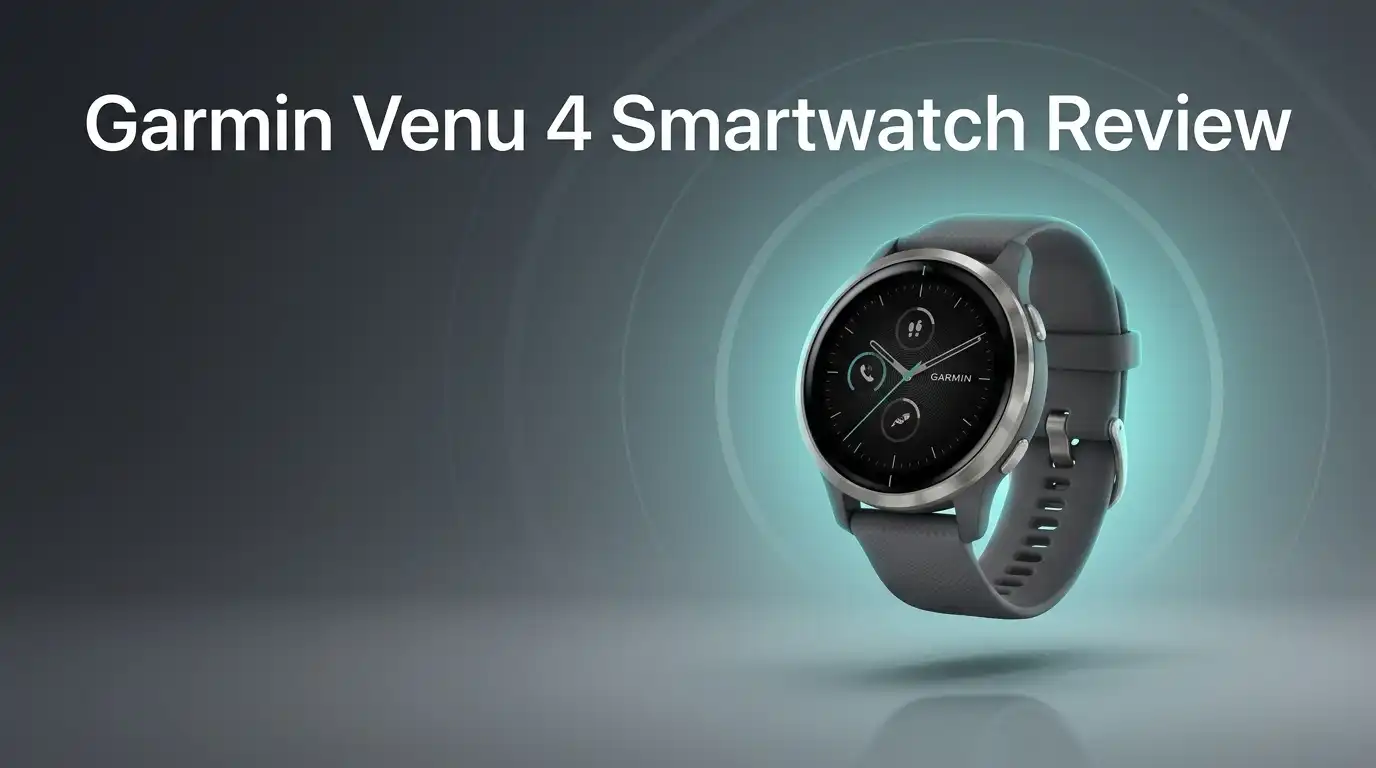
Garmin Venu 4 Smartwatch Review 2026: Worth Buying?
The Garmin Venu 4 arrived with a promise that sounds almost too good. It wants to be a stylish daily watch and a serious fitness tracker at the same time. Most watches pick one side and fail at the other.
I wore this watch every day for several weeks. I slept in it, ran in it, lifted with it, and wore it to dinner. This review covers what impressed me, what annoyed me, and who should skip it.
Garmin sells the Venu 4 in 41mm and 45mm sizes for the same price. Both pack an AMOLED screen, an LED flashlight, and a deep stack of health tools. The question is whether the asking price makes sense in 2026.
In A Nutshell:
- Price and sizing: The Venu 4 costs around $549.99 in both 41mm and 45mm versions. That is roughly $100 more than the Venu 3 at launch. Smaller wrists should pick the 41mm, but it trades away some battery life.
- Battery performance: The 45mm model reaches about 12 days in smartwatch mode and close to 20 hours with GPS running. The 41mm drops to about 10 days and 15 hours. Real world use with daily workouts landed closer to six days for me.
- Health tracking is the star: Health Status, Sleep Alignment, Lifestyle Logging, Body Battery, HRV status, and ECG make this one of the most complete wellness watches Garmin sells.
- Training depth surprised me: You get training load, training readiness, lactate threshold, PacePro, hill score, race predictor, and over 90 activity profiles. This is close to Forerunner territory.
- The weak spots are real: Breadcrumb navigation replaces full maps. Two buttons force heavy touchscreen use. The silicone strap feels loose during hard running.
- Best fit: Buy it if you want a handsome daily smartwatch with genuine fitness power. Skip it if you run ultras, hike remote trails, or need offline topographic maps.
Garmin Venu 4 Smartwatch Overview


Last update on 2026-11-12 / Affiliate links / Images from Amazon Product Advertising API
The Venu 4 sits at the top of Garmin’s lifestyle smartwatch line. It targets people who care about health data but do not want a chunky adventure watch on their wrist.
Garmin gave it a metal design, a Corning Gorilla Glass 3 lens, and a 5 ATM water rating. You can shower with it, swim laps with it, and snorkel in it without worry.
The screen is a bright AMOLED panel that looks closer to a phone display than a sport watch. Two flush buttons sit on the right side, and the rest runs through touch gestures.
Garmin clearly studied the Apple Watch here. The shape, the finish, and the softer edges all push toward everyday style. The difference is that Garmin kept its training engine underneath that polished shell.
Unboxing The Garmin Venu 4
The box is small, flat, and plain in the way Garmin boxes usually are. No fancy magnetic flaps, no theatrical reveal. You lift the lid and the watch sits face up in a molded tray.
Underneath the tray you find the proprietary charging cable, a short quick start leaflet, and warranty paperwork. That is the entire contents. No extra strap, no charging block, no screen protector.
The watch arrives with a plastic film over the display and a tiny sticker on the sensor array. Peel both before you wear it, because the sensor sticker blocks heart rate readings.
Setup took me about eight minutes. The watch powers on, asks you to scan a code with the Garmin Connect app, and pulls your profile across. The first charge from the box sat around 60 percent.
Design, Comfort, And Build Quality
The Venu 4 feels light for a metal watch. I barely noticed it during the day, and I forgot about it entirely overnight. That matters because sleep tracking only works when you actually keep the watch on.
The case uses fiber reinforced polymer with a metal bezel and metal buttons. The finish resists scuffs well. After weeks of normal use, my review unit showed no visible scratches.
The silicone strap is soft and flexible, which helps comfort. It also costs you security. The band lacks the textured grip found on Forerunner and Fenix straps, so the watch shifted slightly during fast running.
I tested the 45mm size. Even on the tightest notch it wobbled a little on my wrist. If your wrist measures under 160mm, the 41mm version will fit far better. Garmin also sells leather bands for about $50 extra.
Top 3 Alternative for Garmin Venu 4

Last update on 2026-11-12 / Affiliate links / Images from Amazon Product Advertising API
Garmin Venu 3

Last update on 2026-11-11 / Affiliate links / Images from Amazon Product Advertising API
Garmin Forerunner 570

Last update on 2026-11-12 / Affiliate links / Images from Amazon Product Advertising API
Garmin vivoactive 6
AMOLED Display And Everyday Readability
The display is one of the strongest parts of this watch. Colors look rich, text looks crisp, and the blacks stay deep. Watch faces with photos actually look good here.
Outdoor brightness handled direct summer sun without trouble. I never once cupped my hand over the screen to read a pace figure. Indoor brightness drops low enough that it will not blind you at 2am.
You can run the screen in gesture mode or always on mode. Gesture mode wakes the display when you raise your wrist, and it responded quickly for me. Always on mode looks better but cuts battery life roughly in half.
Touch response feels smooth and accurate. Swipes register the first time, and the bubbly widget animations move without lag. Sweaty fingers and rain do cause occasional mistaps, which is where the two button layout starts to hurt.
Health And Recovery Tracking Features
Health tracking is the main reason to buy this watch. Garmin stacked almost everything it offers into the Venu 4.
You get 24/7 heart rate, HRV status, Body Battery energy monitoring, all day stress tracking, Pulse Ox, skin temperature, respiration, and an ECG app. Health Status pulls several of those signals together and tells you whether your averages sit inside your normal range.
The morning report became my favorite screen. It gives a plain summary of sleep, recovery, HRV, and the day ahead in a few seconds of reading.
Training readiness proved the most useful number day to day. When it read low, my legs genuinely felt heavy. The data tracked my real feelings closely enough that I started trusting it for workout decisions.
Sleep Alignment And Lifestyle Logging
These two features are new to the Venu line and they separate the Venu 4 from older models.
Sleep Alignment looks at when you sleep rather than just how long. It compares your schedule against your circadian rhythm and tells you whether your bedtime suits your body. Night shift workers and frequent travelers will find this genuinely useful.
Sleep consistency sits alongside it and shows your average bedtime across the past seven days. Seeing that number in writing changed my habits more than any sleep score ever did.
Lifestyle Logging lets you record behaviors such as late caffeine, alcohol, big meals, or high stress days. Garmin Connect then shows how those choices moved your sleep, HRV, and stress.
The feature only works if you log consistently. Skip a few days and the reports lose meaning fast.
Sports Modes And Training Tools
Garmin loaded over 90 activity profiles onto this watch. That covers running, cycling, swimming, strength, HIIT, Pilates, yoga, rowing, golf, trail running, and plenty of niche options.
The training stack runs deeper than the lifestyle styling suggests. You get training load, training effect, heat and altitude acclimation, lactate threshold, hill score, race predictor, and PacePro pacing strategies.
Daily suggested workouts adjust based on your recovery. Garmin Coach plans cover running, cycling, strength, and general fitness, and the adaptive plans shift when you miss sessions.
Animated strength and HIIT workouts play right on the screen, which helps in the gym. A new mixed session profile lets you log a swim and a lift inside one activity.
Most users will touch maybe a quarter of these tools, but the depth is there when you want it.
GPS Accuracy And Navigation Limits
GPS performance impressed me. The Venu 4 uses multiband positioning, and my tracks matched known routes closely, even under tree cover and between tall buildings.
Satellite lock happened in under ten seconds in open areas. Distance readings on a measured track stayed within a few meters of truth across repeated runs.
Navigation is a different story. The Venu 4 offers breadcrumb navigation only, with no offline topographic maps. You see a line and your position on a blank screen, with no trail names, contours, or landmarks.
You can load courses through Garmin Connect and follow them. Back to start worked reliably when I tested it on unfamiliar trails.
For city running and known routes this is fine. For backcountry hiking it falls short of what the Forerunner 970 and Fenix lines provide.
Battery Life In Real Use
Garmin rates the 45mm Venu 4 at up to 12 days in smartwatch mode and about 20 hours in GPS mode. The 41mm model claims 10 days and 15 hours.
My testing matched those claims reasonably well. With daily wear, sleep tracking, notifications, and roughly 90 minutes of GPS activity each day, I reached about six days before the low battery warning.
Drop the workouts and keep only health tracking, and the 12 day figure holds up. Turn on the always on display and you will land near four days.
Charging is quick and painless. The proprietary cable took my watch from 10 percent to nearly full in under an hour.
Battery life here is solid but not special. Watches built for endurance athletes still last two or three times longer.
Smart Features, Calls, And Music
The Venu 4 handles smartwatch duties better than most fitness watches. Notifications arrive instantly and show full message previews.
A built in speaker and microphone let you take calls from your wrist when your phone sits nearby. Call quality was clear enough for short conversations in quiet rooms. It struggles outdoors with wind or traffic noise.
Music storage holds offline playlists from Spotify, Amazon Music, and Deezer with a premium subscription. Pair Bluetooth earbuds and you can run without your phone.
Garmin Pay handles contactless payments at supported terminals. Bank support remains hit or miss depending on your country.
Android users get slightly more, including text reply options that iPhone users cannot access. That gap has existed for years and Garmin has not closed it.
LED Flashlight And Accessibility Upgrades
The LED flashlight arrives on both sizes this generation, and I used it more than expected. Finding keys, checking on a sleeping kid, and walking a dark driveway all became easier.
It offers multiple brightness levels and a red light mode that preserves night vision. Runners get a strobe setting that syncs to cadence.
Accessibility saw real investment too. A spoken watch face reads out the time, health data, and more directly from the speaker. You can also set spoken alerts at the top of every hour.
Users with color blindness can switch the display to gray scale, red/green, green/red, or blue/yellow palettes. Wheelchair mode returns with push tracking, weight shift alerts, and wheelchair specific sports apps.
These features cost nothing extra and make the watch usable for far more people.
Garmin Connect App Experience
Garmin Connect remains one of the better fitness apps available. Pairing took seconds and syncing stayed fast throughout my testing.
The home screen arranges your data into cards you can reorder. Sleep, Body Battery, training readiness, and steps all sit within one swipe.
Reports go deep when you want them. You can compare weeks, study HRV trends, and read full breakdowns of every logged activity.
Third party integration works well. Strava, TrainingPeaks, and MyFitnessPal connections all pushed data automatically without manual steps.
No subscription is required, which stands out against competitors charging monthly for recovery insights. Garmin Connect Plus exists as an optional paid tier, but the core features stay free.
What The Garmin Venu 4 Does Not Do Well
Honest reviews name the flaws, so here they are.
Navigation is the biggest gap. Breadcrumb trails cannot replace real maps, and anyone heading into unfamiliar terrain will feel that limit immediately.
The two button layout slows you down mid workout. Changing a data screen with sweaty fingers on a touchscreen is harder than pressing a dedicated button.
The strap does not grip well. Running with the 45mm model produced noticeable movement, which can affect wrist heart rate accuracy during intervals.
Price is the other sticking point. At around $549.99 it costs as much as the Forerunner 570, which offers better running ergonomics.
Build materials sit mid range too. You get Gorilla Glass rather than sapphire, so rough environments will eventually leave marks.
Garmin Venu 4 vs Garmin Venu 3
The Venu 3 remains on sale and costs noticeably less. That makes this comparison important.
The Venu 4 adds a metal design, an LED flashlight on both sizes, multiband GPS, and an ECG app. It also brings Health Status, Sleep Alignment, Lifestyle Logging, and sleep consistency.
Training gains matter for athletes. Training load, training effect, lactate threshold, hill score, PacePro, race predictor, and acclimation tracking all arrive new.
The Venu 3 actually wins on paper for battery, offering up to 14 days against 12 days on the larger Venu 4.
Choose the Venu 3 if you want core wellness tracking at a lower price. Choose the Venu 4 if structured training, better GPS, and the newer sleep tools appeal to you.
Garmin Venu 4 41mm: The Smaller Option

Last update on 2026-11-12 / Affiliate links / Images from Amazon Product Advertising API
The 41mm version costs the same as the 45mm and suits smaller wrists far better. I would have preferred it during testing.
You lose some battery life in the trade. Garmin rates it at roughly 10 days in smartwatch mode and 15 hours in GPS mode, against 12 days and 20 hours on the larger model.
The display is physically smaller, so data fields show fewer characters. Reading three metrics at a glance works fine, but six field layouts get cramped.
Everything else stays identical. Same sensors, same flashlight, same software, same materials, same color choices in silicone.
Pick this size if comfort and fit matter more than squeezing out extra days between charges. A watch that fits properly also reads your heart rate more accurately.
Pros And Cons
Pros
- Excellent health and recovery tracking with clear, actionable insights that normal people can understand
- Bright AMOLED display that stays readable in direct sunlight and looks premium on the wrist
- Accurate multiband GPS performance that matches Garmin’s dedicated running watches
- Deep training tools including training readiness, lactate threshold, PacePro, and adaptive coaching plans
- Built in LED flashlight on both sizes with red light and strobe modes
- Strong accessibility features including spoken watch face and color blindness display options
- Lightweight and comfortable enough for 24/7 wear including overnight sleep tracking
- Garmin Connect app requires no subscription for core data and syncs reliably
Cons
- Breadcrumb navigation only, with no offline topographic maps for backcountry use
- Two button design forces heavy reliance on the touchscreen during workouts
- Silicone strap feels loose and shifts during running, especially on the 45mm model
- Battery life trails performance focused watches by a wide margin
- Price sits high at around $549.99, roughly $100 above the Venu 3 at launch
- Gorilla Glass rather than sapphire means scratches remain possible in rough conditions
- iPhone users miss some notification reply features that Android users receive
Price And Value In 2026
At roughly $549.99, the Venu 4 sits at the premium end of the lifestyle smartwatch category. Both sizes carry the same price.
Discounts have already appeared. I have seen the watch drop below $450 during sales events, which changes the value equation considerably.
Compare that against the Forerunner 570 at the same list price. The Forerunner gives better running ergonomics, while the Venu 4 gives better looks and the ECG app.
The Coros Apex 4 undercuts both and delivers far longer battery plus full offline maps. It simply does not look as good at a dinner table.
Value here depends on your priorities. If you want one watch for workouts and work meetings, the Venu 4 justifies its price. If you only train, cheaper options serve you better.
Final Verdict: Who Should Buy It
The Garmin Venu 4 earns a strong recommendation with clear limits attached.
Buy it if you want a sleek daily watch that tracks your health seriously. The sleep tools, recovery metrics, and training readiness data genuinely change how you plan your days.
Buy it if you mix gym sessions, walks, casual runs, and a normal social life. This watch handles all of that without looking like sports equipment.
Skip it if you run long trail races or hike remote routes. The missing maps and shorter battery will frustrate you.
Skip it if you train seriously and want fast button control mid session. The Forerunner line costs the same and serves you better.
For everyone in between, the Venu 4 strikes a genuinely good balance.
Frequently Asked Questions
Is the Garmin Venu 4 waterproof?
The Venu 4 carries a 5 ATM water rating. That covers showering, rain, snow, pool swimming, and snorkeling. It is not suitable for scuba diving or high speed water sports.
How long does the Garmin Venu 4 battery last?
The 45mm model reaches up to 12 days in smartwatch mode and about 20 hours with GPS active. The 41mm model reaches about 10 days and 15 hours. Always on display cuts those figures roughly in half.
Does the Garmin Venu 4 have offline maps?
No. The Venu 4 offers breadcrumb navigation only. You can follow courses loaded through Garmin Connect, but you will not see topographic detail, trail names, or landmarks.
Can you make phone calls on the Garmin Venu 4?
Yes. A built in speaker and microphone let you take and make calls when your paired phone sits within Bluetooth range. The watch has no cellular connection of its own.
Does the Garmin Venu 4 need a subscription?
No subscription is required. Garmin Connect provides sleep scores, Body Battery, training readiness, and full activity history for free. Garmin Connect Plus exists as an optional paid tier.
Is the Garmin Venu 4 good for running?
Yes, with a caveat. GPS accuracy and running metrics match Garmin’s dedicated running watches. The two button layout and looser strap make it less comfortable than a Forerunner during hard efforts.
Should I upgrade from the Venu 3 to the Venu 4?
Upgrade if you want the LED flashlight, ECG, multiband GPS, and the new training and sleep features. Stay with the Venu 3 if you mainly track steps, sleep, and basic workouts.

Hi, I’m Lucy Jones, a dedicated watch enthusiast and reviewer. I spend my time hunting down, testing, and evaluating the most intriguing wristwatches on the market. My goal is to guide you through the overwhelming choices with honest, hands-on insights into every timepiece.