Redmi Watch 5 Active Review 2026: Still Worth It?
Budget smartwatches are everywhere in 2026, and most of them promise the same things. Big screen. Long battery. Calling support. Very few deliver all three for under fifty dollars. The Redmi Watch 5 Active tries to do exactly that, and it has quietly become one of the best selling cheap wearables on Amazon.
I wore this watch daily for several weeks. I slept with it, swam with it, took calls on it, and charged it far less often than my phone.
This review shares what I found, including the parts Xiaomi would rather you skip over. No marketing fluff. Just honest observations about a watch that costs less than a dinner for two.
In a Nutshell:
- The battery is the star. Xiaomi claims 18 days on typical usage. In real life with heart rate tracking on, sleep monitoring active, and notifications flowing all day, I averaged nine to eleven days. That is still excellent for a watch at this price.
- The 2.0 inch screen is big but basic. It is an IPS LCD panel with 500 nits peak brightness and a 320 x 385 resolution. Text looks clear indoors. Outdoors in strong sunlight, you will squint.
- There is no built in GPS. This is the biggest limitation. Your runs and rides rely entirely on your phone’s GPS through connected tracking. Runners who leave their phone at home should look elsewhere.
- Bluetooth calling actually works well. The speaker and microphone handle indoor calls clearly. Noisy streets are another story.
- Health tracking is useful but not medical grade. Heart rate, SpO2, sleep, and stress readings give you trends, not precision. Treat the numbers as guidance.
- Value is the real selling point. At roughly thirty to forty dollars, nothing else offers this combination of screen size, battery life, and calling support. You accept compromises, and you know that going in.
What Is the Redmi Watch 5 Active?

Last update on 2026-11-12 / Affiliate links / Images from Amazon Product Advertising API
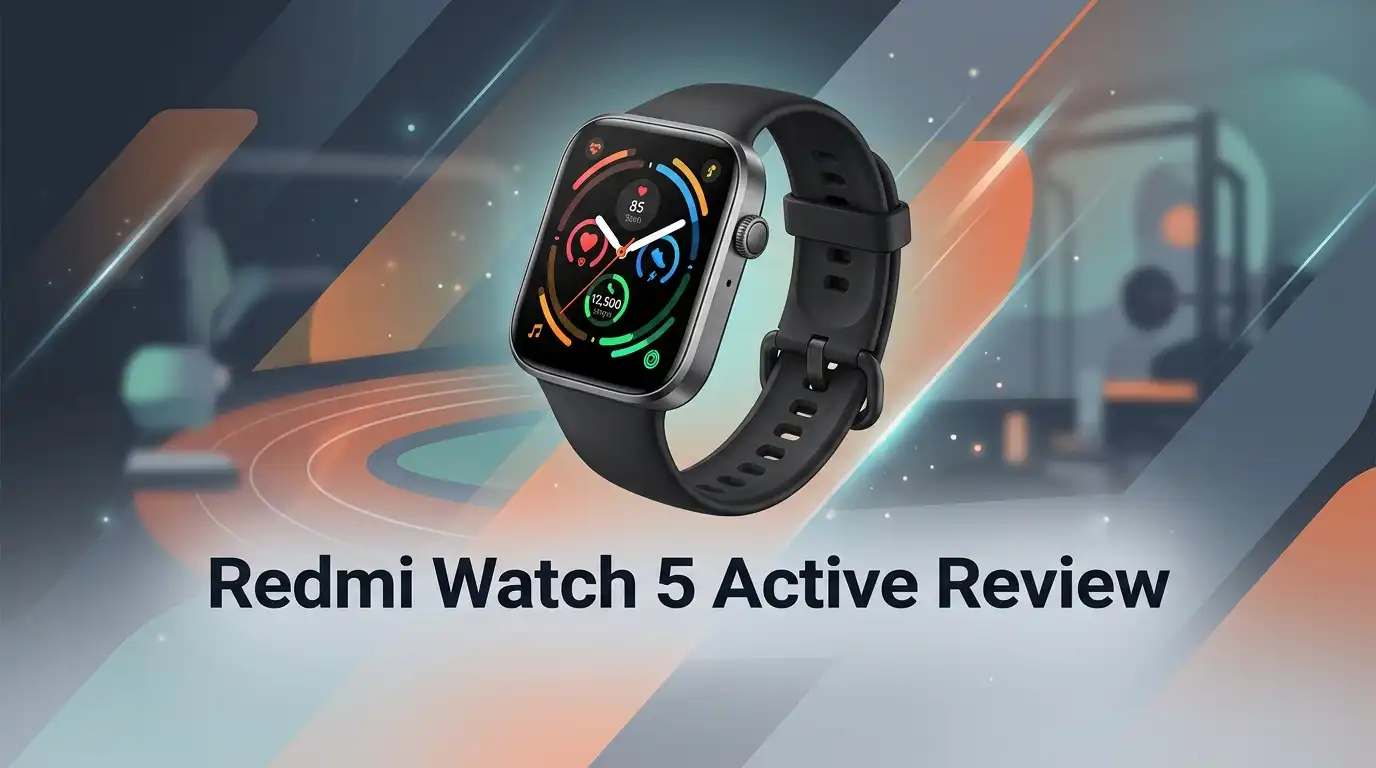
The Redmi Watch 5 Active is the entry level model in Xiaomi’s Redmi Watch 5 family. Xiaomi announced it in August 2024, and it remains widely available in 2026 because the price keeps falling. It sits below the Redmi Watch 5 Lite and the standard Redmi Watch 5.
The watch uses a rectangular polycarbonate case measuring 49.1 x 40.4 x 11.4 mm. It weighs just 42.2 grams with the strap. Inside sits a 470 mAh battery, a 2.0 inch LCD display, and Bluetooth 5.3 for phone pairing.
Xiaomi targets first time smartwatch buyers with this model. You get the essentials: step counting, heart rate monitoring, sleep tracking, 140 plus sports modes, notifications, and calling. You skip the premium extras like AMOLED panels, NFC payments, and satellite positioning. It is a tool, not a status symbol.
Unboxing Experience: What Sits Inside the Box
The packaging is small and plain. A white cardboard box with a product photo on the front and specifications printed on the back. Nothing fancy, which fits the price.
Lifting the lid reveals the watch resting in a cardboard tray with the strap already attached. Underneath sits a thin envelope holding the quick start guide and warranty leaflet. A magnetic charging cable hides in a separate compartment.
There is no power adapter in the box. You supply your own USB brick or plug the cable into a laptop. The cable measures about 45 centimetres and snaps onto the back of the watch with a satisfying click.
My first reaction on holding the watch was surprise at how light it feels. It weighs almost nothing on the wrist. The screen protector film peels off easily. Pairing took under two minutes through the Mi Fitness app.
Design and Build Quality
The Redmi Watch 5 Active looks familiar. A rectangular body with rounded corners, a single physical button on the right edge, and a flat glass front. You have seen this shape on dozens of budget watches.
The case is plastic, and it feels like plastic. There is no metal frame, no ceramic back, and no rotating crown. Xiaomi offers two colours: Midnight Black and Matte Silver. The silver version hides scratches better than the black one.
The silicone strap is soft and breathable. It uses a standard quick release mechanism, so third party bands fit easily. I wore it overnight without irritation, which matters for sleep tracking.
Water resistance is rated at 5ATM, meaning you can swim in a pool or shower with it. I took it into the pool several times with no issues. Do not take it into a sauna or hot tub.
Display Quality: Is the LCD Good Enough?
This is where expectations need adjusting. The 2.0 inch IPS LCD panel offers 320 x 385 pixels and roughly 250 pixels per inch. Peak brightness reaches 500 nits.
Indoors, the screen looks fine. Colours are reasonable, text reads clearly, and the large size makes notifications easy to scan. The generous screen area is genuinely useful for reading messages.
Outdoors is the problem. In direct sunlight, the display washes out noticeably. You will tilt your wrist to find a readable angle. An AMOLED panel would fix this, but AMOLED does not exist at this price from Xiaomi.
The bezels around the screen are thick and obvious. Black watch faces help disguise them, but you notice them on lighter designs. There is no always on display option worth using either, since it drains battery quickly. Raise to wake works reliably.
Top 3 Alternative for Redmi Watch 5 Active

Last update on 2026-11-12 / Affiliate links / Images from Amazon Product Advertising API
Xiaomi Redmi Watch 5 Lite

Last update on 2026-11-12 / Affiliate links / Images from Amazon Product Advertising API
Xiaomi Smart Band 9 Active


Last update on 2026-11-12 / Affiliate links / Images from Amazon Product Advertising API
Amazfit Bip 6
Battery Life in Real Use
Xiaomi advertises 18 days of battery life in typical usage mode. That figure assumes light use with most sensors disabled. Real world numbers differ.
With continuous heart rate monitoring, sleep tracking, SpO2 spot checks, and about sixty notifications a day, I averaged nine to eleven days per charge. Turning off continuous heart rate pushed that closer to fourteen days.
Some owners report shorter figures, around seven days, with heavy notification loads and frequent workouts. Battery performance varies with settings, brightness, and how often the screen wakes.
Charging takes roughly two hours from empty using the magnetic puck. There is no fast charging. A ten minute top up adds about one day of use, which is handy before travel.
Compared to an Apple Watch that needs nightly charging, this feels liberating. You genuinely forget about the charger for over a week.
Bluetooth Calling and Speaker Quality
The watch includes a speaker and microphone, which is uncommon at this price. You can answer calls directly from your wrist and hear the caller through the built in speaker.
In a quiet room or office, call quality is clear. The person on the other end could hear me without asking me to repeat myself. Volume is loud enough for indoor use.
Outdoors, results drop. Wind, traffic, and background chatter interfere with the microphone. The caller hears noise alongside your voice. Xiaomi includes noise reduction, and it helps a little, but it does not work miracles.
You can store contacts on the watch and dial out directly. The dial pad is small but usable. Treat this as a convenience feature for short calls, not a phone replacement. It shines when your phone is charging in another room.
Health Tracking: Heart Rate, SpO2 and Sleep
The sensor array covers heart rate, blood oxygen, and sleep. There is also a stress estimate and a breathing exercise feature.
Resting heart rate readings matched my chest strap within two or three beats per minute. Steady state readings are reasonably accurate. During intense intervals, the optical sensor lags behind real changes, which is normal for wrist based tracking.
SpO2 readings hovered between 95 and 99 percent, which aligns with my fingertip pulse oximeter. Occasional outliers appear when your wrist moves during measurement.
Sleep tracking logs duration, sleep stages, and a nightly score. Total sleep time was usually accurate within ten minutes. Deep sleep and REM breakdowns should be viewed as rough estimates rather than clinical data.
None of these features replace medical devices. Use them to spot patterns over weeks, not to diagnose anything.
Sports Modes and Workout Accuracy
Xiaomi lists more than 140 sports modes. In practice, about six of them get regular use: walking, running, cycling, swimming, strength training, and yoga. The rest are variations with similar tracking behind them.
Step counting was consistent across my testing, landing within three percent of my phone’s count. Calorie estimates run slightly optimistic, which is common on budget wearables.
The missing GPS changes everything for outdoor athletes. Without your phone nearby, distance comes from the accelerometer, and accuracy suffers. Carry your phone and connected GPS works fine, producing solid route maps in the app.
Pool swimming tracking counts laps reasonably well. Strength training mode is basic, logging only time and heart rate rather than reps.
If your workouts happen indoors or alongside your phone, this watch handles them adequately. Dedicated runners need a model with satellite positioning.
Software, Watch Faces and the Mi Fitness App
The watch runs Xiaomi’s HyperOS wearable interface. Navigation uses swipes and the single side button. Swipe down for quick settings, swipe up for notifications, and swipe sideways for widget cards.
The interface is smooth. Animations do not stutter, and menus load instantly. Simplicity is the strength here. You will not get lost.
The Mi Fitness app handles setup, data history, and watch face downloads. Over 200 watch faces are available, many of them free. Some are attractive and some look like clip art from 2009.
Notifications arrive reliably on Android. You can read messages but cannot reply with text on most apps. iPhone users get fewer features, including limited notification control.
The app itself is functional but cluttered. Finding specific settings sometimes requires hunting through menus.
What the Redmi Watch 5 Active Does Not Do Well
Honesty matters, so here are the real weaknesses.
No built in GPS. This is the single biggest limitation, and it excludes serious outdoor runners and cyclists who train without a phone.
No NFC payments. You cannot tap the watch to pay. Every transaction still needs your wallet or phone.
Screen visibility in sunlight is poor. The LCD panel simply cannot compete with AMOLED rivals now available at similar prices.
No music storage or playback control depth. You can pause and skip tracks on your phone, but you cannot store songs on the watch.
Limited third party app support. There is no app store. What ships is what you get, permanently.
Battery claims are optimistic. Eighteen days requires disabling the features you bought the watch for. Expect around ten days with normal settings.
Pros and Cons
Pros
- Excellent battery life that lasts nine days or more with normal settings
- Large 2.0 inch display makes notifications and stats easy to read
- Bluetooth calling with a clear speaker works surprisingly well indoors
- Very light at 42.2 grams, comfortable enough for overnight wear
- 5ATM water resistance covers swimming and showering
- Smooth software with no lag or stutter during daily use
- Outstanding price, often available under forty dollars
- Quick release straps allow cheap customisation
Cons
- No built in GPS limits outdoor workout accuracy
- LCD panel washes out badly in direct sunlight
- No NFC payments or music storage
- Thick bezels look dated next to newer rivals
- Calorie and stress data should be treated as estimates
- Advertised battery figures require disabling key features
- iOS functionality is more limited than Android
- Plastic build feels cheap in the hand
Redmi Watch 5 Active vs Redmi Watch 5 Lite
These two watches sit close together, so the comparison matters.
The Redmi Watch 5 Lite uses a 1.96 inch AMOLED display instead of LCD. Colours pop, blacks are true black, and sunlight visibility improves dramatically. The Lite also includes built in GNSS positioning, so outdoor runs work without your phone.
The Lite adds 5ATM water resistance, similar battery claims, and a slightly more refined body. It typically costs twenty to thirty dollars more.
The Active counters with a marginally larger screen and a lower price. That is essentially its whole argument.
If your budget stretches, the Lite is the better watch by a clear margin. Choose the Active when price is the deciding factor or when you only need notifications, step counting, and sleep data. Both share the same app and similar sensors.
Price and Value in 2026
The Redmi Watch 5 Active launched around 50 euros. In 2026, street prices frequently drop to the thirty dollar range during sales, and it rarely exceeds forty five dollars.
At that price, the value argument becomes strong. You are paying roughly the cost of a fitness band and receiving a full smartwatch experience with calling, a large screen, and multi day battery life.
Competition has intensified. Amazfit and Xiaomi’s own band lineup now offer AMOLED screens for slightly more money. The Active survives on price alone.
Buy it when you see it discounted. At full price, the Redmi Watch 5 Lite or a Smart Band 9 Active makes more sense. Value here depends entirely on what you pay.
Who Should Buy the Redmi Watch 5 Active?
This watch suits specific people very well and disappoints others.
Buy it if you want your first smartwatch, you hate charging devices daily, you need a large readable screen, or you mainly track steps and sleep. Older users often appreciate the big text and simple interface.
Buy it if you work indoors, take calls at a desk, and want notifications without reaching for your phone.
Skip it if you run or cycle outdoors without a phone. The missing GPS will frustrate you within a week.
Skip it if you want contactless payments, offline music, or a screen that stays readable at the beach.
It is a competent budget companion, not a fitness instrument. Match your expectations to that description and you will enjoy it.
Final Verdict: Is the Redmi Watch 5 Active Worth Buying?

Last update on 2026-11-12 / Affiliate links / Images from Amazon Product Advertising API
After weeks of daily use, my conclusion is straightforward. The Redmi Watch 5 Active delivers exactly what its price suggests, and occasionally a little more.
The battery life and calling feature genuinely impress at this cost. The big screen helps daily readability. The build feels cheap because it is cheap, and the LCD panel shows its limits outdoors.
The missing GPS is the deal breaker for athletes and a non issue for everyone else. Be honest about which group you belong to before ordering.
I would score it around 7.5 out of 10 as a budget purchase. It does the basics well and skips the extras entirely.
If you want a reliable notification screen and step counter that lasts over a week per charge, this watch earns its place on your wrist.
Frequently Asked Questions
Does the Redmi Watch 5 Active have GPS?
No. The watch has no built in satellite positioning. It relies on connected GPS from your paired phone during outdoor workouts. You must carry your phone for accurate route and distance data.
How long does the battery really last?
Xiaomi claims 18 days in typical usage mode. With continuous heart rate, sleep tracking, and regular notifications enabled, most owners see nine to eleven days. Heavy users report around seven days.
Can I swim with the Redmi Watch 5 Active?
Yes. The watch carries a 5ATM water resistance rating, which covers pool swimming, showering, and rain. Avoid hot tubs, saunas, and high pressure water jets.
Does it work with iPhone?
Yes, it pairs with iOS through the Mi Fitness app. However, iPhone users get fewer notification controls and less app integration than Android users receive.
Can I reply to messages from the watch?
No. You can read incoming notifications but cannot type replies. Some quick reply presets exist on Android for specific apps, though support is inconsistent.
Does it support contactless payments?
No. The watch has no NFC chip, so payments through the watch are not possible. You still need your phone or card.
Can I change the strap?
Yes. The watch uses a quick release strap mechanism, and compatible third party bands are widely available and inexpensive.
Is it good for sleep tracking?
It records total sleep duration accurately within about ten minutes. Sleep stage breakdowns are estimates. Use the data to spot weekly patterns rather than nightly precision.

Hi, I’m Lucy Jones, a dedicated watch enthusiast and reviewer. I spend my time hunting down, testing, and evaluating the most intriguing wristwatches on the market. My goal is to guide you through the overwhelming choices with honest, hands-on insights into every timepiece.