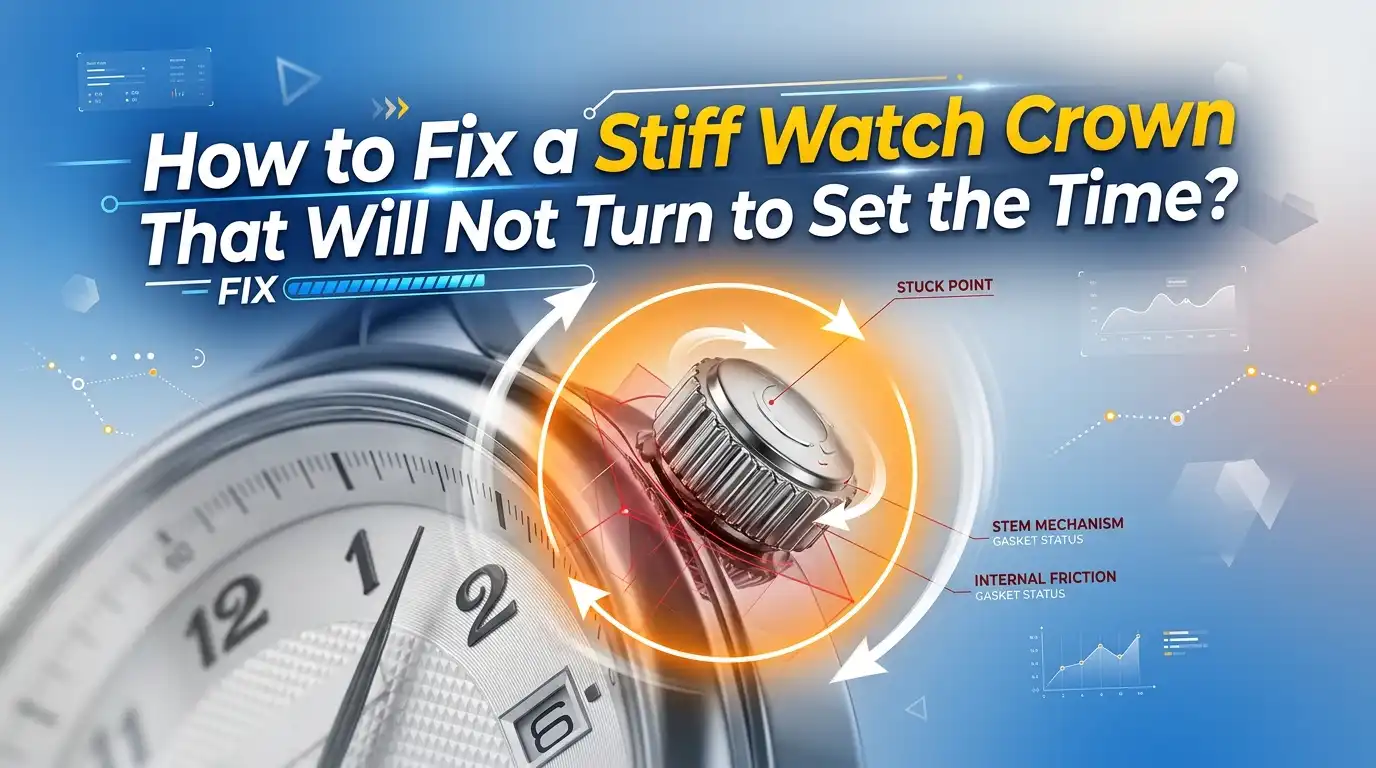
How to Fix a Stiff Watch Crown That Will Not Turn to Set the Time?
A watch crown that will not turn can feel like a tiny problem at first. Then it becomes a real headache the moment your watch stops, runs late, or shows the wrong time. You try to turn the crown, but it feels stuck, gritty, or locked in place.
That is when many people make the same mistake. They force it. Sadly, force can turn a small issue into a bent stem, damaged threads, or a repair that costs far more than it should.
The good news is that a stiff crown does not always mean a serious failure. Dirt, dried sweat, salt, thread pressure, or simple user error can all make a crown feel frozen.
In a Nutshell
- A stiff crown is a warning sign. It may point to dirt, salt, dried oil, a locked screw down crown, damaged threads, or a bent stem. Do not treat it like a stubborn lid on a jar. Gentle handling protects the movement.
- Find out what type of crown you have first. Some crowns pull out. Some must be unscrewed before they can move. If you skip this step, you may think the crown is stuck when it is simply locked. That is a very common mistake.
- Start with the safest checks. Dry the watch, inspect the crown area, and look for dirt, moisture, or a crooked crown. A simple outside issue can often explain the problem. A wet watch or fog under the crystal means you should stop right away.
- Cleaning can help if the problem is outside the case. Dirt, skin oil, and salt can build up around the crown tube. A soft brush and careful surface cleaning may free the crown. But this only helps if the trouble is external. It will not fix worn gears or dried oil inside the movement.
- Never force the crown during date change hours. Many watches have a date system that is partly engaged at night. If you turn or change the date at the wrong time, you can damage that system. If you are not sure, move the hands to a safe position first.
- Know when to stop. If the crown feels gritty, wobbly, crooked, or very tight in every position, or if the watch shows moisture, the safest move is professional service. A small repair is better than a full movement rebuild.
What a stiff watch crown usually means
A stiff crown is usually a symptom, not the real problem. The crown is just the part you touch. The real issue may be outside the case, inside the crown tube, or deeper in the movement.
Dirt, dried sweat, salt, old gasket material, or thread pressure can make the crown hard to move from the outside. Dried oil, worn setting parts, or a bent stem can cause the same feeling from the inside.
That is why guessing can be risky. If you twist harder without knowing the cause, you may strip threads or bend parts that were still usable. A crown should feel controlled and smooth, even if it has some light resistance.
Pros: This mindset keeps you calm and helps you avoid damage.
Cons: It takes patience, and many people want a fast fix right away.
Before you do anything else, treat the crown like a precision part. Gentle hands save watches.
Identify your crown type before you touch it
The first real fix is simple. You need to know what kind of crown your watch has. A push pull crown pulls straight out.
A screw down crown stays locked until you turn it counterclockwise and release it from the case. Many people try to pull a screw down crown straight out and think it is jammed.
Look closely at how the crown sits against the case. If it feels sealed tight and will not pull out easily, it may be a screw down crown. If the watch is a diver style watch or has strong water resistance, a screw down crown is very common.
This one check can save you stress and prevent force. Correct identification is the safest first step.
Pros: Fast, free, and often solves the mystery at once.
Cons: It does not repair actual damage if the crown is truly stuck.
If you are unsure, assume the crown may lock first. That is much safer than pulling hard.
Do the first safety checks before any fix
Slow down before you start turning anything. Put the watch on a soft cloth. Dry your hands. Check whether the watch was near water, sweat, soap, dust, or salt recently. Ask yourself one simple question. Did the crown become stiff all at once, or did it get worse over time?
A sudden problem after swimming or beach use often points to salt, moisture, or dirt. A slow change over weeks can point to dried oil, gasket wear, or thread wear. Also look at the crystal. If you see fog, stop. Moisture inside the watch changes the job from simple troubleshooting to urgent service.
Check whether the crown sits straight. A crooked crown can mean cross threading or a bent stem.
Pros: Very low risk and highly useful.
Cons: It will not free the crown on its own.
These checks tell you whether home care is still a safe option.
Unlock a screw down crown the right way
A locked crown often feels like a stuck crown. If your watch has a screw down crown, do not pull first. Rest your fingers on the crown and apply very light inward pressure.
Then turn it counterclockwise. In many cases, this small inward pressure helps release thread tension. After a few turns, the crown should pop free and move to its normal winding position.
If it releases, do not celebrate too early. Test it gently. Pull it to the correct setting position and turn it with a light touch. If it still feels rough or hard, there may be dirt or internal wear.
Never use pliers, rubber grips, or sharp tools. That can crush the crown or damage the case.
Pros: This solves many cases where the crown was only locked.
Cons: It only helps when thread pressure is the main issue.
Gentle pressure and the correct direction matter more than strength.
Clean dirt, salt, and skin buildup around the crown
Outside dirt can make a crown feel far worse than it is. Sweat dries. Salt hardens. Dust sticks to skin oil. All of that can collect where the crown meets the case.
If the crown is closed and the watch is dry, use a soft dry brush to clean around the crown guards and the edge of the crown. A wooden toothpick can help lift visible dirt, but keep the touch very light.
If the watch is not wet and the crown is fully sealed, you can use a barely damp cotton swab on the outside area only, then dry it right away. Do not clean an open crown with liquid. Do not spray anything into the crown tube.
Pros: Cheap, safe, and often useful for surface buildup.
Cons: It does nothing for damage inside the case.
If the crown feels smoother after cleaning, that is a good sign that the problem was external.
Dry the watch if moisture may be involved
Water changes everything. If the watch got wet and the crown soon became stiff, stop trying to set the time. Do not operate the crown while the watch is wet. Water can move deeper into the case when the crown is open or under pressure.
First, dry the outside with a soft cloth. Keep the crown closed. Place the watch in a dry room at normal temperature. Avoid hair dryers, radiators, or direct heat. Too much heat can harm gaskets and dial parts. If you see fog under the crystal, treat that as a service warning, not a home fix.
A little outside moisture is manageable. Internal moisture is not. Once water reaches the setting parts, rust and sticky residue can follow.
Pros: Safe first aid after surface moisture.
Cons: It cannot remove water already inside the movement.
If you see fog, stop and send it in.
Use the safest hand position before setting time
Sometimes the crown feels stiff because the watch is in a risky setting window. On many watches with a date, the date gears begin to engage during the night. If you try to change the date or force the time during that period, the crown may feel heavy, and damage can happen.
If you do not know whether your watch is in that zone, move the hands carefully to about 6:30 before changing the date. That position is widely used as a safe place because the date parts are usually away from the change point. Then set the previous date, and move the hands forward until the date flips at midnight. After that, set the correct time.
Pros: Very good protection for the date mechanism.
Cons: It does not fix an already damaged setting system.
This method reduces risk and helps you tell the difference between normal resistance and a real fault.
Try gentle movement without forcing the crown
If the crown moves a little, do not rush it. A crown that gives slight movement may respond to tiny controlled turns rather than one big twist. Hold the watch steady and try a very small turn in the correct direction. Then return to the starting point. Use slow, short motion. If the crown begins to free up, stop often and feel for smoothness.
This is useful when dried surface dirt or light thread tension is the issue. It is not safe if the crown feels solidly blocked, gritty like sand, or painful to turn with your fingers. Heavy resistance is a stop sign.
Pros: Helpful for mild stiffness and low risk when done gently.
Cons: Dangerous if you use force or keep trying through hard resistance.
A crown should feel smoother with each small move. If it feels worse, stop at once.
Check for cross threading on a screw down crown
Cross threading can make a crown feel jammed even when the movement is fine. This happens when the crown and case threads do not meet cleanly. The crown may sit slightly crooked. It may start to screw in, then grind or stop. It may also feel rough when you try to unlock it.
If you are locking the crown and it resists, do not force it clockwise. Push the crown in gently, then turn it counterclockwise very slowly until you feel a tiny drop or click. That often means the threads have lined up. After that, turn clockwise with light pressure.
If the crown is already stuck in a bad thread position, stop. Repeated attempts can damage the tube and crown threads.
Pros: This trick often fixes thread alignment safely.
Cons: It will not help if the threads are already worn or damaged.
Smooth thread engagement should feel clean, never gritty.
Spot signs of a bent stem, worn tube, or bad gasket
Some clues are easy to see once you know what to look for. If the crown wobbles from side to side, pops out too easily, or will not sit flush, the stem or crown tube may be worn. If the crown feels scratchy and loose at the same time, the tube may be damaged. If you notice fog, dirt, or sticky residue near the crown, the gasket may be worn or broken.
These problems matter because the crown does more than set time. It also helps seal the case. A weak gasket or worn tube can let in dust and moisture. That means a stiff crown today can become rust tomorrow.
Pros: A simple inspection can reveal serious warning signs early.
Cons: You cannot confirm every part without opening the watch.
Do not add household oil or grease. It attracts dirt and can make the problem worse.
Know when dried oil or gear wear is the real cause
Sometimes the problem is fully internal. If the crown is hard to turn in every position, or if it pulls out but the hands barely move, the issue may be dried oil, worn setting wheels, or trouble in the keyless works. This is more common in older watches, watches that sat unused for a long time, or watches overdue for service.
You may also notice extra clues. The date may fail to change correctly. The hands may jump. The crown may click without driving the hands as it should. Those are strong signs that cleaning the outside will not solve it.
At that point, the fix is service. A watchmaker may clean, lubricate, adjust, and replace worn parts.
Pros: Professional service solves the root cause.
Cons: It costs more and takes time.
Still, this is far better than forcing damaged parts until more parts fail.
Choose between home care and professional repair
This is the decision point that saves money or loses it. Home care makes sense when the watch is dry, the crown looks straight, the stiffness is mild, and the problem clearly started after dirt, sweat, or a crown locking mistake. In those cases, cleaning, correct unlocking, and careful resetting are reasonable first steps.
Professional repair is the right move when the crown is very tight, gritty, crooked, loose, wet, or hard to turn in every position. It is also the best choice for vintage watches, expensive watches, and any watch that shows fog under the crystal. If the crown threads feel damaged, stop right there.
Pros of home care: Fast, simple, and low cost for minor outside issues.
Cons of home care: Easy to go too far if the real problem is inside.
Pros of professional repair: Accurate diagnosis and proper sealing.
Cons of professional repair: More time and more money.
When in doubt, choose the safer path.
FAQs
Why is my watch crown stuck after swimming?
Salt, sand, soap, or moisture may be the reason. If the crown was not fully sealed, water may also have reached the stem or setting parts. Dry the outside and keep the crown closed. If you see fog under the crystal or feel gritty resistance, stop using the crown and get the watch serviced.
Can I use oil to loosen a stiff watch crown?
No. Household oil is a bad idea. It can trap dirt, harm gaskets, and move into the movement where it does not belong. A watch needs the right lubricant in the right place. Random oil creates bigger problems than it solves.
Is it normal for a screw down crown to feel tight?
A little resistance can be normal, especially while locking it. Heavy resistance is not normal. If the crown grinds, sits crooked, or will not release with light counterclockwise turning, do not force it. That can mean thread tension, cross threading, or damage.
Should I pull harder if the crown will not come out?
No. First make sure it is not a screw down crown. If it is, unlock it before pulling. If it still will not move, do not yank it. Pulling hard can bend the stem or damage the setting parts. A careful check is always safer than extra force.
What if the crown turns but the hands do not move?
That usually points to an internal problem. The stem may not be engaging properly, or the setting parts may be worn or damaged. Outside cleaning will not fix that. This is a strong sign that the watch needs service.

Hi, I’m Lucy Jones, a dedicated watch enthusiast and reviewer. I spend my time hunting down, testing, and evaluating the most intriguing wristwatches on the market. My goal is to guide you through the overwhelming choices with honest, hands-on insights into every timepiece.