Garmin Lily 2 Review 2026: Still Worth It?
The Garmin Lily 2 looks like jewelry until you flick your wrist. Then the hidden display wakes up and shows your steps, your heart rate, and your sleep score.
That trick still turns heads in 2026, three years after launch. But a pretty watch needs more than charm to earn space on your wrist.
I wore the Lily 2 daily for several weeks. I slept in it, swam in it, and wore it to dinner. I also tested the Lily 2 Active, the sportier sibling with real GPS inside. This review covers both.
In a Nutshell:
- The design wins. The Lily 2 is tiny at 35mm, weighs almost nothing, and hides its screen behind a patterned lens. It passes as a bracelet in a meeting and as a fitness tracker at the gym. Small wrists finally get a smartwatch that fits.
- Battery life sits near five days for the standard Lily 2 and up to nine days for the Lily 2 Active. Real users often report three to four days with the brightness turned up and sleep tracking on every night.
- Health tracking runs deep for the price. You get Body Battery, sleep score, stress, respiration, blood oxygen at night, menstrual cycle logging, and 24/7 heart rate from Garmin’s Elevate V4 sensor.
- The standard Lily 2 has no GPS chip inside. It borrows your phone’s GPS. The Lily 2 Active fixes this and adds buttons, HRV tracking, golf, structured workouts, and sensor pairing.
- The screen is the weak spot. It is monochrome, small, and hard to read in bright sunlight. There is also no music storage, no ECG, and no stair counting.
- Value depends on the price you pay. At full price the Lily 2 feels expensive. On sale it becomes one of the better small smartwatches you can buy.
Garmin Lily 2 at a Glance


Last update on 2026-11-11 / Affiliate links / Images from Amazon Product Advertising API
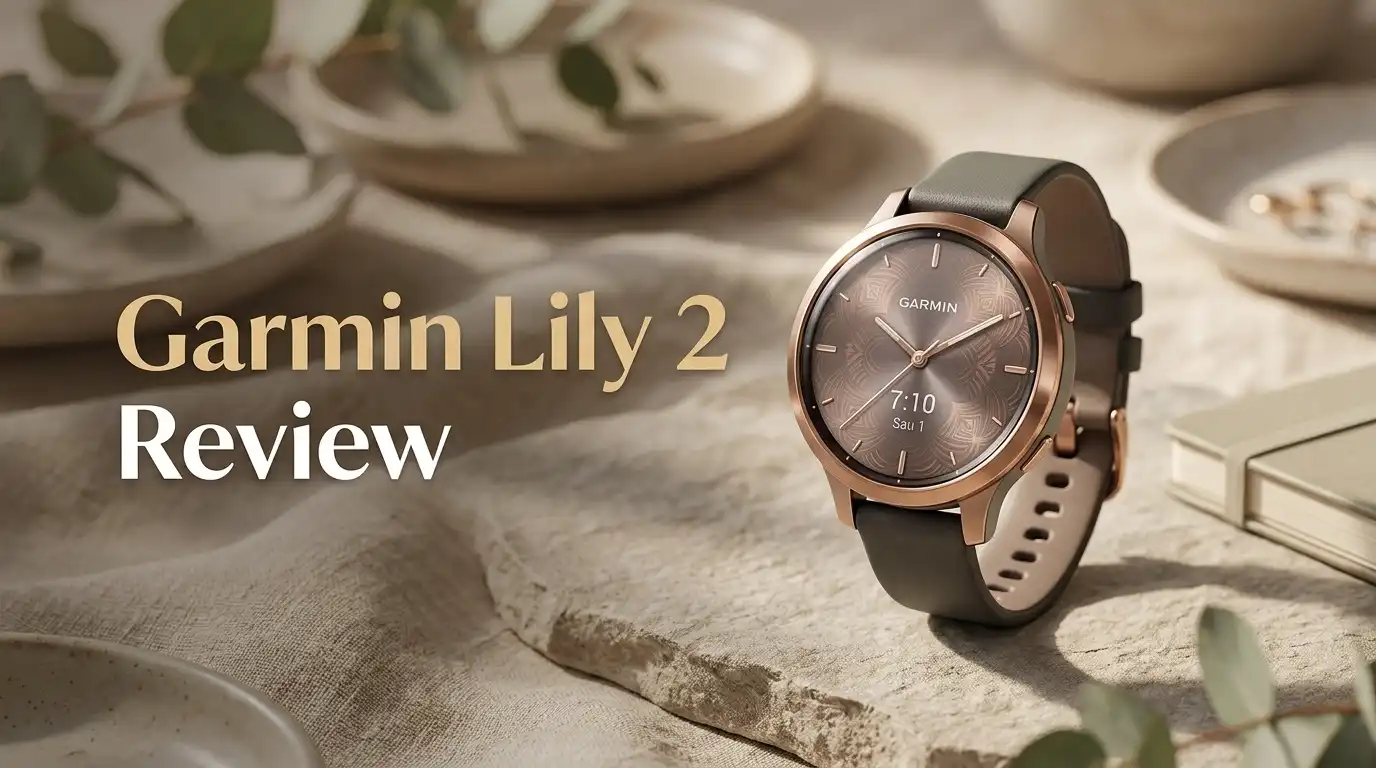
The Lily 2 is Garmin’s smallest smartwatch. The case measures 35mm across and uses metal instead of the plastic shell found on the original Lily.
That change alone makes the watch feel twice as expensive. The band swaps out using a standard 14mm pin, so you can buy silicone, nylon, or leather straps from anywhere.
Inside, you get a touchscreen, an optical heart rate sensor, an accelerometer, and a pulse oximeter. Garmin rates it for swimming at 5 ATM. You can shower and swim laps without worry.
The Classic version adds Garmin Pay and a nicer band. The standard version uses a silicone strap in colors like coconut, lilac, and cream gold.
It pairs with both iPhone and Android through the Garmin Connect app.
Unboxing the Garmin Lily 2
The box is small, square, and light. Garmin uses recycled cardboard now, so there is no plastic window and no foam. You lift the lid and the watch sits face up in a paper tray, screen dark, patterned lens catching the light.
My first reaction was surprise at the weight. It feels like nothing. Around 24 grams with the silicone band. Under the tray you find a short charging cable with a pinch clip, a quick start leaflet, and a safety booklet. That is everything. No extra band, no wall plug.
Setup took about eight minutes. I charged the watch for twenty minutes, downloaded Garmin Connect, and scanned the pairing code. The watch nudged me through a short tutorial on wrist gestures. Simple, clean, and no account hassles beyond the usual email signup.
Design and Comfort on the Wrist
This is the best part of the Lily 2. The 35mm case sits flat and the lugs curve down, so the watch hugs small wrists instead of hovering above them. I wore it to bed for two weeks and forgot it was there. Sleep tracking only works if you actually sleep in the watch, and comfort decides that.
The patterned lens is the signature touch. Garmin etched a subtle floral design into the glass. When the screen is off, you see the pattern. When the screen lights up, the numbers glow through it. It genuinely looks like a piece of jewelry, not a gadget.
The silicone band collects lint and the leather Classic band stains with sweat. I would pick silicone for daily wear and keep leather for evenings out.
How the Hidden Display Works
Flick your wrist and the display wakes. The screen is monochrome, meaning white text on a black background, with a resolution of 240 by 201 pixels. It is sharp enough for numbers and icons but not for photos or colorful watch faces.
Indoors, the display looks crisp. Outdoors in direct sun, it struggles. I had to cup my hand over the watch to read my pace on a sunny run. Pushing brightness to the maximum helps but drains the battery faster.
There is no always on mode on the standard Lily 2. The screen stays dark until you raise your arm or tap it. This saves battery and keeps the jewelry look intact, but it means you cannot glance at the time while typing or driving without a deliberate wrist turn. Some people love this. Others find it annoying within a week.
Top 3 Alternatives for Garmin Lily 2

Last update on 2026-11-11 / Affiliate links / Images from Amazon Product Advertising API
Fitbit Inspire 3

Last update on 2026-11-13 / Affiliate links / Images from Amazon Product Advertising API
Garmin vivomove Sport

Last update on 2026-11-13 / Affiliate links / Images from Amazon Product Advertising API
Garmin Venu Sq 2
Battery Life in Real Use
Garmin claims up to five days in smartwatch mode for the Lily 2. I averaged four days and a few hours with sleep tracking on, notifications on, and brightness at medium. That matches what most owners report online.
Push the brightness higher or track daily workouts and you drop to three days. Turn off blood oxygen tracking at night and you gain close to a full day back. Pulse oximetry is the biggest battery drain on this watch by far.
The Lily 2 Active nearly doubles the claim at nine days, and it holds roughly nine hours with GPS running. Charging takes about an hour from empty using the pinch clip. The clip feels fiddly at first and pops off if you bump the cable, so seat it carefully before you walk away.
Health and Wellness Tracking Features
Garmin loads the Lily 2 with the same health metrics found on watches that cost four times more. You get continuous heart rate, Body Battery energy monitoring, stress scores, respiration rate, and sleep score with stage breakdown.
Body Battery remains the standout feature. It scores your energy from 0 to 100 using heart rate variability, stress, and sleep. After two weeks the number started matching how I actually felt, which surprised me.
Sleep tracking nailed my fall asleep and wake times within a couple of minutes each night. Sleep stage accuracy is less reliable, but that is true of every wearable on the market.
Women’s health tools include menstrual cycle logging, pregnancy tracking, and symptom notes. You log periods from the watch or the app. Hydration logging and mindful breathing sessions round out the wellness side.
Sports and Workout Tracking
The Lily 2 covers more than thirty sport profiles. Running, walking, pool swimming, yoga, pilates, strength, HIIT, cardio, rowing, elliptical, and even dance fitness all appear. The dance mode tracks styles like hip hop, Bollywood, and line dancing, which is a fun touch.
Starting a workout takes two taps on the touchscreen. Here is the catch for the standard model: it has no GPS chip. It borrows your phone’s GPS through connected GPS. Leave the phone at home and your run distance comes from the accelerometer, which overestimates on hills and underestimates on treadmills.
Strength training does not count reps automatically with much precision. Swimming works well for basic lap counting but skips the advanced metrics found on the Active model. For casual exercisers this is plenty. For runners it is a real limitation.
Garmin Lily 2 Active: The Bigger Upgrade
No products found.
The Lily 2 Active arrived less than a year after the Lily 2 and honestly deserves to be called the Lily 3. It adds GPS built into the watch, two physical buttons, a slightly larger 38mm case, and a huge pile of features.
You get heart rate variability status, nap detection, Health Snapshot, a compass, golf courses, Garmin Coach training plans, structured workouts, and sensor pairing for chest straps and cycling sensors. It also broadcasts your heart rate to Peloton and gym equipment.
The two buttons change the experience completely. Touchscreens fail when your fingers are sweaty, and buttons never do. Independent testing found its GPS traces nearly identical to Garmin’s premium Fenix watches, which is impressive for a watch this small.
GPS and Heart Rate Accuracy
The Elevate V4 optical sensor sits on the back of both models. It is a proven sensor that Garmin has used for years. During steady runs and walks, heart rate readings tracked within a few beats of a chest strap. During sudden pace changes on hills, the watch lagged by five to ten seconds before catching up.
Interval workouts show the sensor’s limits. If your sessions involve rapid sprints, wear a chest strap and pair it to the Lily 2 Active.
GPS on the Active model performed well in open parks and under tree cover. Traces matched higher end Garmin watches closely. The standard Lily 2 depends on your phone signal, so accuracy swings with phone quality and pocket placement. Some owners report distance errors on the standard model, and that complaint shows up often in community forums.
The Garmin Connect App Experience
Garmin Connect is powerful and crowded at the same time. The home screen shows cards for steps, sleep, Body Battery, heart rate, and stress. You can rearrange them, which helps.
The data depth is excellent. You can view months of trends, compare weeks, and export workouts to Strava, TrainingPeaks, and Apple Health. Nothing sits behind a paywall. Garmin charges no subscription, which separates it from several rivals.
The downside is the learning curve. Settings hide inside nested menus, and finding the option to disable a single notification type takes patience. New users often describe the app as overwhelming for the first week. Syncing is usually fast over Bluetooth, though occasional pairing drops require a restart of the phone’s Bluetooth.
Pros and Cons of the Garmin Lily 2
Pros
- Genuinely small and light. At 35mm and roughly 24 grams, it fits wrists that no other smartwatch suits.
- The hidden display looks beautiful. The patterned lens makes it pass as jewelry in formal settings.
- No subscription fee. Every health metric and every app feature stays free forever.
- Deep health data for the price, including Body Battery, sleep score, stress, and cycle tracking.
- Standard 14mm bands mean cheap and endless strap options.
- Swim safe at 5 ATM with basic pool swim tracking included.
Cons
- No GPS chip in the standard model. You must carry your phone for accurate outdoor distance.
- The monochrome screen washes out in sunlight and offers no always on option.
- Battery often falls short of five days with blood oxygen tracking enabled.
- No music storage, no speaker, no microphone, and no voice assistant.
- No stair counting because there is no barometric altimeter.
- No ECG and no wrist temperature sensor, both of which newer Garmin sensors offer.
What the Garmin Lily 2 Does Not Do Well
Let me be direct about the weak points, because reviews that skip this part help nobody.
Outdoor readability is the biggest flaw. On a bright afternoon I could barely see my step count. If you exercise outside often, this will frustrate you.
The touchscreen only interface on the standard model is fussy. Wet fingers, sweaty skin, or gloves all break it. Swipes register as taps and you end up in the wrong menu mid workout.
Notification handling is basic. You can read messages but you cannot reply on an iPhone, and Android replies are limited to canned responses. There is no speaker, so no calls.
Strength training rep counting is unreliable. Sleep stage data should be treated as a rough guide. And the proprietary pinch charger means one more cable you cannot replace at a gas station.
Who Should Buy the Garmin Lily 2
This watch fits a specific person very well. Buy the standard Lily 2 if you want a discreet health tracker that looks like jewelry, you exercise casually, and you always carry your phone outdoors. Walkers, yoga practitioners, gym goers, and anyone who hated bulky smartwatches will enjoy it.
Buy the Lily 2 Active instead if you run, cycle, hike, or golf. The GPS chip and the two buttons justify the price difference several times over. It is the model I recommend to most readers.
Skip the Lily line entirely if you want music on your wrist, voice calls, ECG readings, or a bright color screen. Those buyers should look at the Garmin Venu line or an Apple Watch. Also skip it if you need an always visible display for quick time checks.
Price and Value in 2026
The Lily 2 launched at 249 dollars, the Classic at 279 or 299 depending on the band, and the Lily 2 Active at 299. Those numbers have softened a lot. In 2026 you can often find the standard Lily 2 near 200 dollars and the Active closer to 230 or 250 during sales.
At full price the value argument gets shaky. Rivals like the Fitbit Inspire 3 cost under 100 dollars and the Garmin Venu Sq 2 offers a color AMOLED screen for similar money.
At sale prices the Lily 2 becomes easy to recommend, especially for the design and the subscription free data. Watch for discounts around major shopping events. Prices change constantly, so check the current listing before you decide.
Final Verdict on the Garmin Lily 2
The Garmin Lily 2 solves a problem that most brands ignore. Small wrists deserve a smartwatch that does not look like a gadget strapped to the arm. Garmin nailed the form, the comfort, and the health data depth.
The compromises are real though. The dim monochrome screen, the missing GPS chip on the base model, and the battery that rarely hits its five day promise all count against it.
My recommendation is simple. Choose the Lily 2 Active if your budget allows it. The GPS, the buttons, and the longer battery make it a far better watch for roughly the same money. Choose the standard Lily 2 only if you find a strong discount and your activity stays indoors or close to your phone.
Frequently Asked Questions
Does the Garmin Lily 2 have GPS?
The standard Lily 2 does not have a GPS chip. It uses connected GPS, which borrows the signal from your phone. The Lily 2 Active includes GPS inside the watch and tracks outdoor routes without a phone nearby.
How long does the Garmin Lily 2 battery last?
Garmin rates it at five days in smartwatch mode. Real world use lands closer to three or four days with sleep tracking and blood oxygen monitoring enabled. Turning off nightly pulse oximetry adds roughly a day.
Can you swim with the Garmin Lily 2?
Yes. The watch carries a 5 ATM water rating. You can shower, swim laps in a pool, and wear it in the rain. It includes a pool swim profile that counts lengths and strokes.
Does the Garmin Lily 2 require a subscription?
No. Every feature on the watch and inside the Garmin Connect app stays free. There are no locked metrics and no premium tier for health insights.
Does the Garmin Lily 2 work with iPhone?
Yes. It pairs with both iPhone and Android through Garmin Connect. iPhone users can read notifications but cannot send text replies from the watch due to Apple restrictions.
Is the Garmin Lily 2 good for small wrists?
Yes, and this is its strongest selling point. The 35mm case and curved lugs sit flat on wrists as small as 110mm. It remains one of the smallest full featured smartwatches available.

Hi, I’m Lucy Jones, a dedicated watch enthusiast and reviewer. I spend my time hunting down, testing, and evaluating the most intriguing wristwatches on the market. My goal is to guide you through the overwhelming choices with honest, hands-on insights into every timepiece.