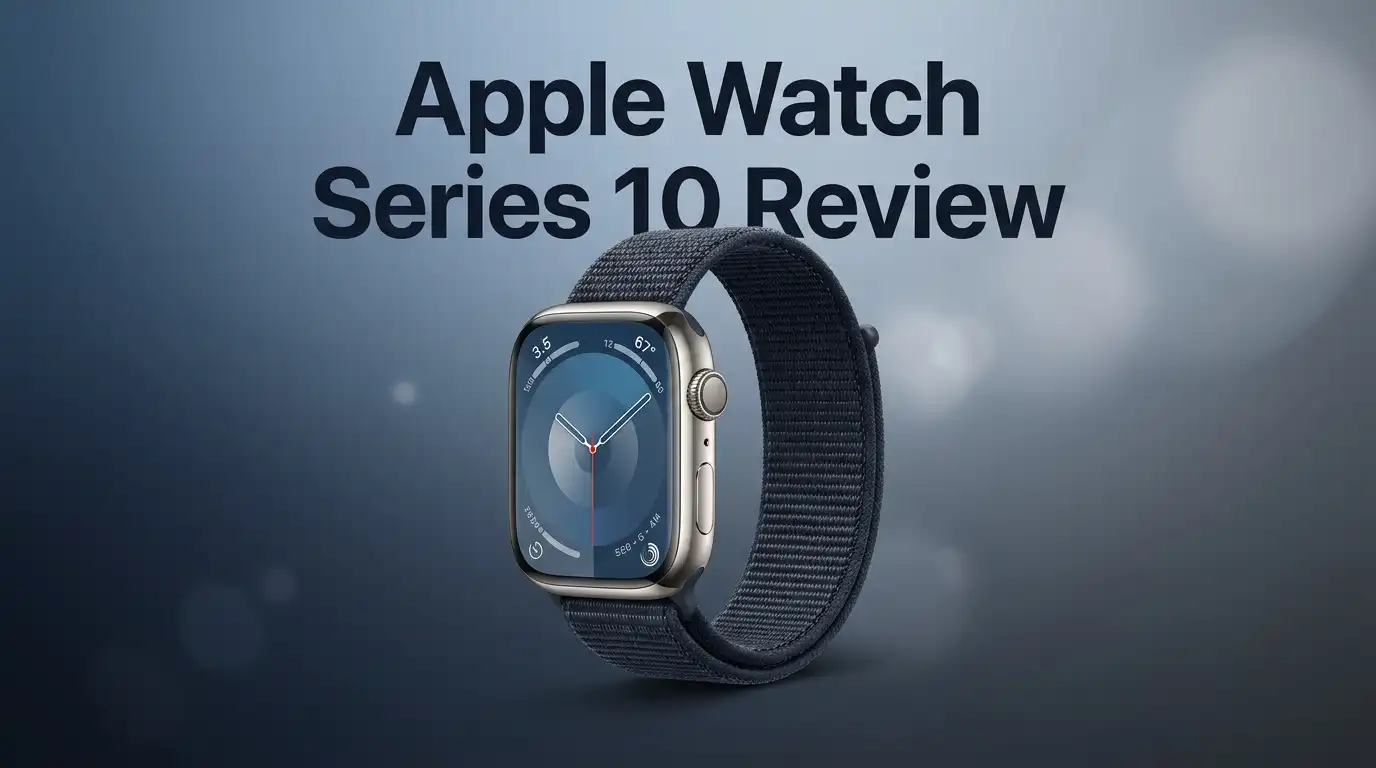
Apple Watch Series 10 Review 2026: Still Worth It?
The Apple Watch Series 10 launched in late 2024. Two watch generations have arrived since then. Yet this model keeps showing up in shopping carts, and the reason is simple.
Prices dropped hard, the hardware aged well, and watchOS keeps feeding it new features. I have worn this watch daily for months, through gym sessions, pool laps, airport runs, and plenty of lazy Sundays. This review covers the real experience, not the spec sheet.
You will read about the thin case, the bright screen, the fast charging, and the parts that annoy me. By the end, you will know if the Series 10 deserves your money in 2026 or if you should spend a bit more on something newer.
In a Nutshell:
- The design still feels modern. The Series 10 measures 9.7mm thick and weighs as little as 30 grams in aluminum. It disappears on your wrist during sleep and workouts, which older models never managed.
- The display is the standout feature. The LTPO3 wide angle OLED panel hits 2000 nits and stays readable at a glance. The always on mode now ticks seconds and refreshes once per second, so the watch feels alive even at rest.
- Battery life lands at 18 hours officially, but real use often stretches further. Most days I ended near 40 percent. Fast charging fills 80 percent in about 30 minutes, and 8 minutes buys a full night of sleep tracking.
- Health tracking covers a lot of ground. You get ECG, blood oxygen, sleep apnea notifications, wrist temperature, water depth, and water temperature sensing. watchOS updates added sleep score and hypertension notifications to this model too.
- The value in 2026 is excellent. Series 10 units now sell far below their $399 launch price, and refurbished stock drops even lower. You get roughly 90 percent of a current Apple Watch for around half the cost.
- It is not perfect. Battery life trails rival smartwatches, the blood oxygen feature works differently on newer US units, and there is no satellite messaging.
Apple Watch Series 10 Overview
![Apple Watch Series 10 [GPS 46mm case] Smartwatch with Jet Black Aluminum Case with Black Sport Band - M/L. Fitness Tracker, ECG App, Always-On Retina Display, Water Resistant](https://smartwristvault.com/wp-content/plugins/aawp/public/image.php?url=YUhSMGNITTZMeTl0TG0xbFpHbGhMV0Z0WVhwdmJpNWpiMjB2YVcxaFoyVnpMMGt2TXpGRGRXUXlWMjV6ZWt3dWFuQm58MTc5MDUwMjM1Mw=)

Last update on 2026-09-25 / Affiliate links / Images from Amazon Product Advertising API
The Series 10 was Apple’s tenth anniversary watch. Apple used that moment to rebuild the case rather than repeat it. The aluminum version comes in Jet Black, Rose Gold, and Silver.
A polished titanium version replaced the old stainless steel line and shed real weight. Sizes grew to 42mm and 46mm, and the screen area jumped to 1220 square millimeters on the larger model. Inside sits the S10 chip with a four core Neural Engine and 64GB of storage.
Water resistance reaches 50 meters, and dust resistance sits at IP6X. Apple also added a speaker that plays music, podcasts, and phone calls without headphones. This was the first Apple Watch where the hardware felt genuinely rethought instead of lightly refreshed.
Unboxing Experience
The box is small, white, and made entirely from fiber. No plastic wrap, no foam. You lift the lid and the watch sits in a molded tray with the band already attached in the box beside it. Underneath you find the magnetic fast charger cable with a USB C end.
There is no power brick in the box, so keep an old iPhone adapter handy or buy a 20W one. Pairing took me under four minutes. You hold the watch near your iPhone, a swirling animation appears on screen, and the camera does the rest.
Apps and settings transfer from your old watch backup automatically. The first thing I noticed was the weight, or rather the lack of it. Picking it up felt like holding a large coin with a strap.
Design and Comfort on the Wrist
Apple shaved the case down to 9.7mm and rounded the edges. The aluminum 42mm model weighs 30 grams. My previous watch felt like a small brick by comparison. Sleep tracking is where the thin case pays off most. I stopped noticing the watch under a pillow or against a mattress.
The back cover switched to a metal design that spreads heat and improves antenna performance. Titanium models use sapphire glass, while aluminum models use Ion X glass. Ion X scratches more easily, and mine picked up two faint marks near the crown after several months.
The band release button still works smoothly, and every band from 2015 onward still fits. Comfort is the quiet upgrade nobody puts on a spec sheet.
Display Quality and Brightness
This screen remains the best reason to buy a Series 10. Apple used a wide angle OLED panel that stays up to 40 percent brighter when you view it from the side. That sounds like marketing until you glance at your wrist while typing or driving.
You no longer need to twist your arm to read the time. Peak brightness reaches 2000 nits, so direct sunlight never washes it out. The minimum drops to 1 nit for dark rooms. Pixel density sits at 326 pixels per inch, and the bezels shrank noticeably.
The always on mode refreshes every second now, which means the second hand keeps moving on analog faces. Small change, big emotional difference. The screen simply looks like a watch instead of a paused screenshot.
Top 3 Alternative for Apple Watch Series 10
![Apple Watch Series 11 [GPS 46mm] Smartwatch with Jet Black Aluminum Case with Black Sport Band - M/L. Sleep Score, Fitness Tracker, Health Monitoring, Always-On Display, Water Resistant](https://smartwristvault.com/wp-content/plugins/aawp/public/image.php?url=YUhSMGNITTZMeTl0TG0xbFpHbGhMV0Z0WVhwdmJpNWpiMjB2YVcxaFoyVnpMMGt2TkRFMlVsRXdjblJ6VlV3dWFuQm58MTc5MDUwMjM1Mw=)
Last update on 2026-09-25 / Affiliate links / Images from Amazon Product Advertising API
Apple Watch Series 11
![Apple Watch SE 3 [GPS 40mm] Smartwatch with Midnight Aluminum Case with Midnight Sport Band - S/M. Fitness and Sleep Trackers, Heart Rate Monitor, Always-On Display, Water Resistant](https://smartwristvault.com/wp-content/plugins/aawp/public/image.php?url=YUhSMGNITTZMeTl0TG0xbFpHbGhMV0Z0WVhwdmJpNWpiMjB2YVcxaFoyVnpMMGt2TXpGSGNUaFRWRzlHU2t3dWFuQm58MTc5MDUwMjM1Mw=)
Last update on 2026-09-25 / Affiliate links / Images from Amazon Product Advertising API
Apple Watch SE 3
![Apple Watch Ultra 3 [GPS + Cellular 49mm] Running & Multisport Smartwatch w/Rugged Titanium Case w/Black Ocean Band. Satellite Communications, Advanced Health & Fitness Tracking](https://smartwristvault.com/wp-content/plugins/aawp/public/image.php?url=YUhSMGNITTZMeTl0TG0xbFpHbGhMV0Z0WVhwdmJpNWpiMjB2YVcxaFoyVnpMMGt2TkRGSU5sTTNkbXBqSzB3dWFuQm58MTc5MDUwMjM1Mw=)
Last update on 2026-09-25 / Affiliate links / Images from Amazon Product Advertising API
Apple Watch Ultra 3
Performance and Daily Speed
The S10 chip powers the Series 10, and here is the interesting part. Apple reused that same S10 silicon in the Series 11 and the Ultra 3. So the Series 10 runs at the speed of watches sold two years later. Apps open instantly.
Siri processes requests on device, so setting timers or starting workouts works without a network. The double tap gesture responds reliably, and I use it daily to silence alarms and answer calls. Scrolling feels smooth across watchOS.
The second generation Ultra Wideband chip makes iPhone Precision Finding accurate down to a few feet. In months of use I never once felt the watch stutter or lag. Storage sits at 64GB, which holds plenty of offline music and podcasts.
Battery Life in Real Use
Apple rates the Series 10 at 18 hours of normal use and 36 hours in Low Power Mode. Those numbers are conservative. My typical day with a 45 minute workout ended somewhere between 35 and 45 percent. A night of sleep tracking costs roughly 10 percent.
That means one short charge each day keeps the watch running without thought. Heavy GPS use changes the math quickly. A two hour outdoor run with music streaming pulled battery down fast. Cellular models drain faster still when away from your iPhone.
This is the clearest area where the Series 10 shows its age, because the Series 11 and later models push past 24 hours on a charge. If multiday battery life matters to you, look elsewhere.
Charging Speed That Changes Habits
Fast charging is the feature that rescues the battery complaint. Fifteen minutes on the magnetic charger gives you about 8 hours of normal use. Eight minutes covers a full night of sleep tracking. Thirty minutes takes you to 80 percent.
I built a simple routine around this. The watch charges while I shower and make coffee, then goes back on my wrist for the rest of the day and night. No overnight charging, no missed sleep data.
The included cable is one meter long with a USB C plug, so it works with laptop chargers and car adapters. Charging speed matters more than raw capacity when your habit fits the hardware. This is the single feature I would miss most.
Health Tracking Features
The sensor list is long. You get an electrical heart sensor for ECG, a third generation optical heart sensor, a blood oxygen sensor, a wrist temperature sensor, a depth gauge, and a water temperature sensor.
Sleep apnea notifications arrived with this generation and analyze breathing disturbances over 30 day periods. The watch flags high heart rate, low heart rate, and irregular rhythm patterns. Cycle tracking uses wrist temperature for retrospective ovulation estimates.
Later watchOS updates added hypertension notifications to Series 10, which scan for patterns of chronic high blood pressure over 30 days. None of these replace a doctor. They work as early warnings. Two friends of mine booked medical appointments because of watch alerts, and both were glad they did.
Fitness and Workout Tracking
Workout tracking covers running, cycling, swimming, hiking, strength training, yoga, rowing, and dozens more. Runners get Training Load, Heart Rate Zones, Race Route, Pacer, and running form metrics like ground contact time and vertical oscillation.
Swimmers benefit most from the new sensors, because the depth gauge and water temperature reading turn this into a light snorkeling tool rated to 6 meters. Cyclists can pair power meters over Bluetooth and see Functional Threshold Power.
GPS uses L1 signals with GLONASS, Galileo, QZSS, and BeiDou support. Accuracy was solid on open roads but drifted slightly between tall buildings. Serious trail runners should note that dual frequency GPS is missing here. For gym users and casual runners, the tracking is more than enough.
Sleep Tracking and Sleep Score
Sleep tracking improved through software. The watch logs sleep stages covering awake, REM, core, and deep sleep. watchOS added a Sleep Score that rates your night from 0 to 100 using duration, bedtime consistency, and interruptions.
I found the score useful as a trend rather than a daily verdict. Bad scores usually matched bad nights. The thin case makes wearing the watch overnight practical, and the 8 minute charge window removes the main excuse for taking it off.
Wrist temperature readings build over several nights and reveal patterns during illness. Sleep apnea notifications run quietly in the background. The data quality holds up well against dedicated sleep trackers, and you get it without wearing a second device.
Software Support and watchOS Updates
The Series 10 runs current watchOS releases, and Apple has continued support through watchOS 27. That matters enormously for a used purchase. Buying a Series 10 today does not mean buying an abandoned device.
Recent software added Workout Buddy, the Liquid Glass interface, a wrist flick gesture to dismiss notifications, smarter Smart Stack widgets, and Live Translation. Some newer features skip this model because they need updated sensors, and that gap will widen over time.
Based on Apple’s history, expect several more years of updates. One requirement to check first: the Series 10 needs an iPhone Xs or newer running iOS 18 or later. Older iPhones will not pair with it at all.
What the Series 10 Does Not Do Well
Honest reviews list the flaws. Battery life is the biggest one. Eighteen hours means daily charging, and competing Android smartwatches run for days. Blood oxygen works differently on US units sold after early 2024 because of a patent dispute, so readings calculate on your iPhone rather than the watch itself.
There is no satellite messaging, no 5G, and Wi‑Fi tops out at the older 802.11n standard. Aluminum models scratch more easily than titanium. The always on display, while gorgeous, eats power noticeably.
Speaker volume during calls struggles in loud streets. Third party app selection on watchOS keeps shrinking as developers abandon the platform. None of these ruin the watch, but pretending they do not exist would be dishonest.
Pros and Cons
Pros
- Thinnest and lightest full size Apple Watch, which makes overnight wear comfortable
- Brightest and largest display Apple had shipped at launch, readable from any angle
- Same S10 chip found in much newer and pricier Apple Watch models
- Fast charging delivers 80 percent in roughly 30 minutes and 8 hours of use in 15 minutes
- Deep health sensor suite including ECG, sleep apnea alerts, and hypertension notifications
- Water depth and temperature sensors add real snorkeling ability
- Prices in 2026 sit far below current models
Cons
- Battery life of 18 hours forces daily charging
- Blood oxygen behaves differently on US units due to the patent dispute
- No satellite communication or emergency messaging away from networks
- Wi‑Fi 4 only, which feels dated in 2026
- Ion X glass on aluminum models picks up scratches
- Dual frequency GPS is absent, so accuracy drops in dense cities
- Requires iPhone Xs or newer, and it does not work with Android at all
Price and Value in 2026
The Series 10 launched at $399 for the 42mm GPS model. That price has collapsed. New old stock frequently appears in the low $200s, and certified refurbished units drop below $200 at major retailers.
Compare that to the $399 asking price of the current Series 12, and the math becomes obvious. You give up a newer chip, better battery life, faster charging, and the latest heart sensors. You keep the same screen quality, the same thin case, and most health features.
Apple refurbished units carry a one year warranty, which removes most of the risk. Buying last generation Apple hardware has always been the smart play, and this is one of the clearest examples. Check listings carefully and confirm the model year before paying.
Who Should Buy the Series 10
Buy this watch if you own a compatible iPhone and want full Apple Watch features without paying full price. It suits first time smartwatch buyers, gym regulars, swimmers, and anyone upgrading from a Series 6 or older.
The jump from an older model feels dramatic. It also suits people who care about sleep tracking, because the thin case and fast charging solve the two biggest overnight problems. Skip it if you hike remote trails and need satellite messaging, because the Ultra line exists for that.
Skip it if you currently own a Series 9, since the gains are modest. Android users should ignore this watch entirely, because it will never pair with their phone. Everyone else gets a genuinely great deal.
Final Verdict
The Apple Watch Series 10 aged into a bargain. The design still looks current, the screen still beats most rivals, and the chip still matches watches sold today. Battery life remains the weak point, and fast charging only partly covers for it.
Missing satellite features and older Wi‑Fi show the generational gap. At half the price of a new model, those tradeoffs feel fair. I would happily recommend this watch to a friend buying their first Apple Watch.
I would also tell them to buy refurbished from a seller with a warranty and to expect a charging habit rather than a charging chore. The Series 10 is not the best Apple Watch anymore. It might still be the smartest one to buy.
Frequently Asked Questions
Is the Apple Watch Series 10 still worth buying in 2026?
Yes, for most buyers. The price has fallen well below current models while the core experience stayed intact. You keep the bright wide angle display, the S10 chip, fast charging, and nearly all health sensors. You give up newer battery life and satellite messaging.
Does the Series 10 still get software updates?
Yes. Apple supported the Series 10 through watchOS 27, and history suggests several more years of updates. Some sensor dependent features will skip this model, but security updates and interface changes continue to arrive.
How long does the Series 10 battery actually last?
Apple rates it at 18 hours. In practice, a normal day with one workout ends around 35 to 45 percent. Sleep tracking costs roughly 10 percent per night. Heavy GPS use drains it much faster.
Can the Apple Watch Series 10 work with Android phones?
No. The Apple Watch pairs only with iPhones. You need an iPhone Xs or newer running iOS 18 or later for setup and daily use.
Should I buy the Series 10 or the Series 11?
Buy the Series 11 if battery life and scratch resistance matter most, since it lasts around 24 hours and uses tougher glass. Buy the Series 10 if you want the same chip and screen quality for significantly less money.

Hi, I’m Lucy Jones, a dedicated watch enthusiast and reviewer. I spend my time hunting down, testing, and evaluating the most intriguing wristwatches on the market. My goal is to guide you through the overwhelming choices with honest, hands-on insights into every timepiece.