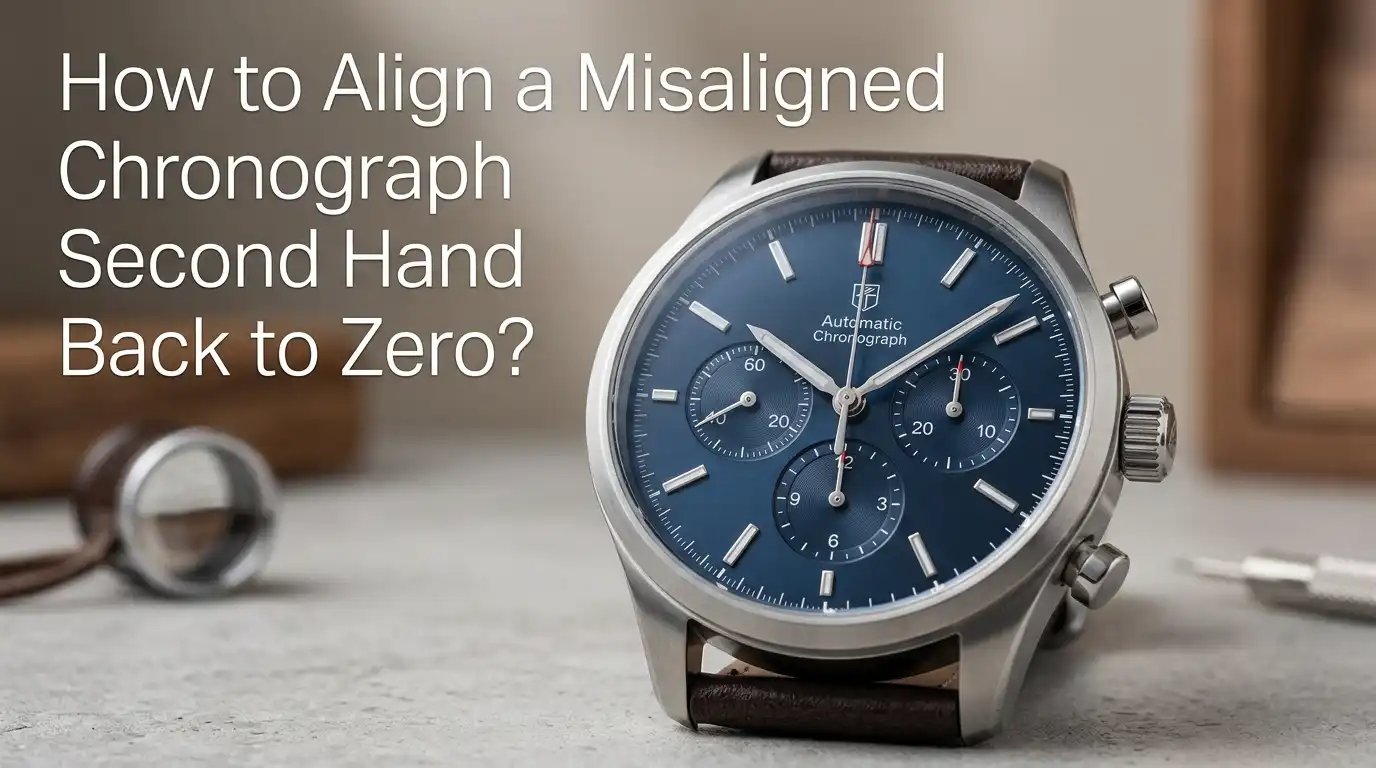
How to Align a Misaligned Chronograph Second Hand Back to Zero?
You glance at your chronograph watch and notice something off. The big sweeping second hand does not rest perfectly on the 12 after a reset. It sits one tick before or after zero. That tiny gap feels huge, and it bothers you every time you check the dial.
The good news is simple. You do not need a watchmaker for this fix. Most chronograph watches let you recalibrate the hands at home in a few minutes. You only need patience, steady hands, and the right button sequence.
This guide walks you through every step. You will learn why the hand drifts, how to bring it back to zero, and how to avoid the problem in the future.
Key Takeaways
- Misalignment is common after a battery change, a hard knock, or repeated stopwatch use. It rarely signals a broken movement.
- The fix needs no tools for most quartz chronographs. You only use the crown and the two pushers.
- The standard method involves three steps: pull the crown out, hold a pusher to select the hand, then tap the other pusher to move it.
- Each chronograph hand (central second, minute counter, hour counter) gets adjusted one at a time in a set order.
- Mechanical chronographs work differently. They often need a hand puller tool or a professional service.
- Always push the crown back in after the fix and test a stopwatch run to confirm the hands return to zero cleanly.
Why Does a Chronograph Second Hand Drift Off Zero?
A chronograph second hand can drift for several reasons. The most common cause is a battery change. When the watchmaker installs a new cell, the movement loses memory of the zero position. The hand then stops wherever it landed.
A hard impact can also knock the hand off its reference point. Dropping the watch or banging your wrist against a wall sometimes shifts the gear train by a single step. Repeated long stopwatch runs add tiny friction errors too.
Quartz chronographs use stepper motors, and these motors can skip a tick under stress. That single skipped step is enough to leave the hand parked a hair off the 12. The fix is always a manual recalibration.
How to Tell if Your Chronograph Hand Is Truly Misaligned
Before you start any reset procedure, confirm the problem. Run the chronograph for ten seconds, then press the reset pusher. Watch where the central second hand lands. If it stops short of the 12 or overshoots it, you have a misalignment.
Check the subdial hands too. The minute counter at the 12 or 9 position and the hour counter should also point to their zero markers. A single hand off zero confirms a calibration issue, not a mechanical fault.
Do not confuse the chronograph second hand with the small running second hand in a subdial. The big sweeping hand from the centre is the one tied to the stopwatch. The small ticking subdial hand shows live seconds and does not need alignment.
Tools You Need Before Starting the Reset
Most quartz chronographs need no tools at all. You work with the crown and the two pushers built into the case. That makes this repair friendly for beginners with no watch experience.
A soft cloth helps you grip the case without leaving fingerprints. A good desk lamp makes the dial easier to read while you nudge the hand one step at a time. A loupe or magnifier helps you see when the hand sits exactly on the 12 marker.
If your watch is a mechanical chronograph, you may need a hand puller, hand setting tweezers, and a movement holder. These tools belong in a watchmaker’s kit. For most readers, the quartz method below is enough.
The Universal Quartz Chronograph Reset Method
Most modern quartz chronographs share a common reset routine. The exact button labels differ between brands, but the logic is the same. You enter a calibration mode, pick a hand, move it, and exit.
Start with the crown pulled out two clicks to the deepest position. The watch should stop running. Next, press and hold one of the pushers (often the top one) for about two to five seconds. The central second hand will spin or jump, showing the movement has entered calibration mode.
Tap the other pusher to move the hand one step at a time. Hold it down for fast motion. Once the hand sits on the 12, push the crown back in. The chronograph will now reset to zero every time.
Pros: Free, fast, works on most modern quartz chronographs.
Cons: Button sequences vary by movement, so you may need to check your specific manual.
How to Reset a Seiko Quartz Chronograph (7T62, 7T92, V172, V175)
Seiko movements are some of the most common quartz chronograph calibres in the world. The reset method is well documented and easy. Start by pulling the crown out to its second position. The seconds hand stops, and the watch enters setup mode.
Press and hold the top pusher (pusher A) for two seconds. The central chronograph second hand will spin one full turn. That confirms you are now adjusting it. Hold the top pusher again to cycle through the other hands.
The order is usually central second, then minute subdial, then hour subdial. Use the bottom pusher (pusher B) to nudge each hand. A short press moves one step. A long press moves the hand quickly around the dial.
Pros: Reliable, repeatable, no tools required.
Cons: You must remember the cycling order to avoid mixing up which hand is active.
How to Reset a Citizen or Casio Chronograph
Citizen and Casio movements follow a similar logic but with small button changes. For most Citizen calibres, pull the crown out fully. Then press both pushers at the same time for about two seconds. The hands enter alignment mode.
Use the top pusher to select which hand you are adjusting. Use the bottom pusher to move it. Some Citizen Eco Drive models cycle through the central second hand, the minute counter, and the 24 hour subdial in sequence.
Casio chronographs sometimes use the mode button instead of a pusher. Check the back of the case for the model number, then look up the calibration routine for that specific calibre. The principle stays the same.
Pros: Works without disassembly, free to do.
Cons: Some Casio digital analog hybrids need a more involved menu sequence.
How to Fix a Tissot, Swatch, or Swiss Quartz Chronograph
Swiss quartz chronographs from Tissot, Swatch, and Hamilton often use ETA or Ronda movements. These also support hand alignment, but the exact button hold time can be longer. You may need to hold a pusher for five seconds or more before the movement enters setup mode.
Pull the crown to position two. Press and hold the reset pusher (often the bottom one) until the central second hand jumps. That signals you have entered calibration. Then tap the start pusher to move the hand step by step.
Some Swiss movements adjust only the central second hand through the pushers. The subdials may need a watchmaker to open the case. Always check your specific calibre before forcing buttons.
Pros: Standardised across many Swiss brands.
Cons: Some calibres limit DIY alignment to the main hand only.
What to Do for a Mechanical Chronograph
Mechanical chronographs do not have an electronic calibration mode. The second hand is friction fit on a pinion, and to move it, you need to lift it off and reseat it. This is delicate work.
You would open the case back, remove the movement, and carefully lift the chronograph second hand with a hand puller tool. Then you reposition the hand on the 12 marker and press it back down with hand setting tweezers. One wrong move can damage the dial or the pinion.
For most owners, a mechanical chronograph alignment is a job for a watchmaker. The cost is usually modest, and you avoid the risk of scratching the dial or bending the hand.
Pros: A professional fix preserves the value of high end pieces.
Cons: Service fees add up, and turnaround can take a week or longer.
Step by Step Walkthrough for a Stuck Reset
Sometimes the hand will not return to zero even after a normal chronograph reset. This points to a deeper alignment fault. Begin by running the chronograph through one full minute, then press reset. Note where the hand stops.
Now pull the crown out. Enter the calibration mode using the method for your brand. Move the hand to the exact 12 marker. Push the crown back in and run a fresh stopwatch test. The hand should now return to zero cleanly each time.
If the hand still misses zero, repeat the calibration but pay attention to overshoot. Sometimes the pusher sends the hand one step too far. Cycle the hand all the way around and approach the 12 marker slowly.
Common Mistakes That Make the Problem Worse
A few habits can turn a small drift into a bigger headache. The first is pressing buttons while the chronograph is running. Some movements lock out alignment while the stopwatch is active. Always reset first, then start the calibration routine.
Another mistake is forcing the crown into a position it does not want to reach. If the crown feels stiff, stop and check the manual. You may be in the wrong setup mode entirely.
Do not adjust the time or date while the watch is in chronograph calibration mode. That can scramble both settings. Finish the hand alignment, push the crown in, then handle time and date separately if needed.
When to Visit a Watchmaker Instead
DIY fixes work for most modern quartz chronographs. But some situations call for a professional. If your watch is a vintage piece, a high value Swiss chronograph, or a mechanical movement, a watchmaker is the safer choice.
You should also visit a pro if the hand still drifts after a clean calibration. That points to a worn stepper motor, a bent pinion, or internal debris. None of these can be fixed with the pushers alone.
A trained watchmaker has the tools and the parts to open the case, inspect the gear train, and reseat the hand without damage. The cost is usually fair compared to the price of replacing the movement.
Pros: Safer for valuable or vintage watches, deeper repairs possible.
Cons: Costs money, takes time, requires shipping for some brands.
How to Prevent Chronograph Misalignment in the Future
Prevention is easier than repair. After every battery change, ask the technician to recalibrate the chronograph hands before handing the watch back. A good shop does this without being asked, but a quick reminder never hurts.
Avoid pressing the chronograph pushers underwater unless your watch is rated for it. Water pressure can stress the gaskets and the stepper motor. Also try not to leave the stopwatch running for days at a time, since long runs add unnecessary wear.
Store your watch in a stable, dry place when you are not wearing it. Magnets, heat, and hard impacts all shorten the life of a chronograph movement. With care, your chronograph can stay perfectly aligned for years.
Frequently Asked Questions
Why does my chronograph second hand land just before or after the 12?
This usually means the movement lost its zero reference. A battery change, a hard knock, or a stepper motor skip is the most likely cause. A simple recalibration through the pushers brings the hand back to the 12 marker.
Can I damage my watch by pressing the pushers too often?
Light, normal use does not harm a chronograph. The pushers are built to handle thousands of presses. The only real risk is pressing them underwater on a watch that is not rated for it, since that can let water past the seals.
Do I need to set the time again after recalibrating the hands?
No. Hand alignment only adjusts the chronograph hands, not the main time or date. Once you push the crown back in, your time and date remain exactly as they were before the procedure.
Why does the chronograph hand still miss zero after a reset?
This points to a stored alignment error, not a current run error. You need to enter the calibration mode and move the hand manually back to the 12. After that, every future reset will return the hand to zero.
How long does a typical chronograph alignment take?
A full alignment of all chronograph hands takes about five to ten minutes at home. If only the central second hand needs a fix, the job is often done in under two minutes once you know the button sequence for your watch.
Is this fix safe for an automatic chronograph?
Automatic chronographs do not use electronic calibration. You should not try this pusher method on a mechanical movement. Take an automatic chronograph to a watchmaker for hand resetting to avoid damage to the dial or pinion.

Hi, I’m Lucy Jones, a dedicated watch enthusiast and reviewer. I spend my time hunting down, testing, and evaluating the most intriguing wristwatches on the market. My goal is to guide you through the overwhelming choices with honest, hands-on insights into every timepiece.