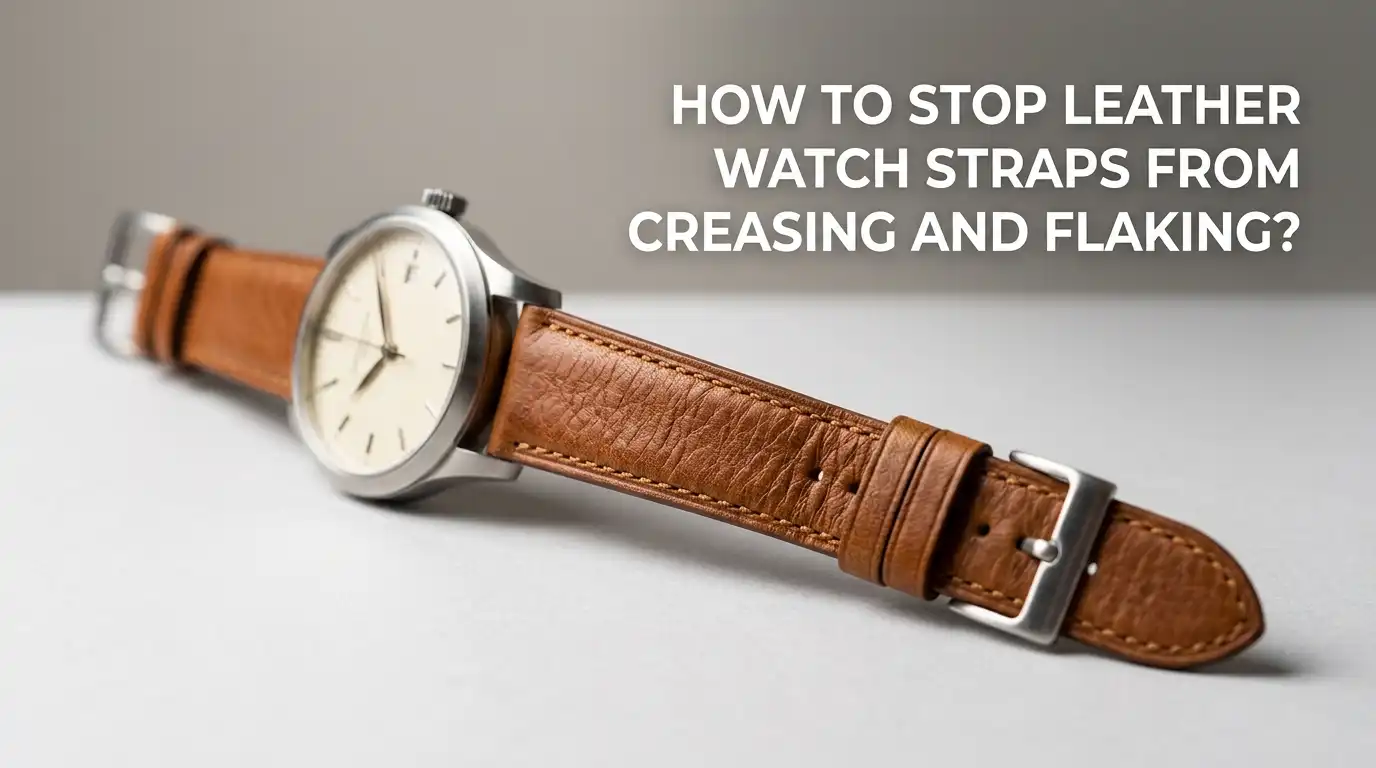
How to Stop Leather Watch Straps From Creasing and Flaking?
You glance at your wrist and notice something unsettling. The leather strap on your favorite watch shows tiny cracks near the buckle holes.
A faint white line runs along the fold where you fasten it every morning. Maybe the edges have started peeling. Your heart drops. You spent good money on that strap. Now it looks tired. What went wrong?
Leather watch straps are a joy to own. They feel warm, look elegant, and age with character. But leather is organic. It breathes, absorbs moisture, and responds to the world around it.
Key Takeaways
- Moisture is the number one enemy of leather straps. Sweat, rain, and humidity break down leather fibers from the inside. Always keep your strap dry by wiping it after wear and never showering or swimming with it on.
- Regular conditioning every four to eight weeks restores natural oils that daily wear strips away. Conditioner keeps leather supple, prevents cracks, and maintains color. Apply a tiny amount only on the backside of the strap for best results.
- Buying full grain leather instead of genuine or bonded leather makes a world of difference. Full grain leather lasts for years and develops a rich patina. Bonded and genuine leather crack and peel within months because they use weak leftovers coated in plastic.
- Switching from a pin buckle to a deployment clasp eliminates the sharp daily fold that causes creasing. The leather stays in a smooth loop without constant bending at the buckle holes.
- Rotating between two or three straps and storing them in a cool dry place gives each strap time to recover. This simple habit can double the lifespan of your leather straps.
- Wear your strap slightly loose and never overtighten it. A tightly worn strap stretches, creases faster, and traps more sweat against the leather.
Why Leather Watch Straps Crease and Flake So Quickly
Leather is skin. Think of your strap like the skin on your hands. When your skin gets dry, it cracks. When it stays wet too long, it gets soft and peels. When you bend it the same way repeatedly, it develops deep lines.
Your watch strap behaves the same way. The creasing you see around the buckle holes comes from the sharp fold you make every time you put the watch on or take it off.
You bend the leather at almost a right angle twice daily. Over weeks and months, those fibers compress and weaken. The fold becomes permanent. That is creasing.
Flaking and peeling happen for a different reason. Many straps sold today use bonded leather or genuine leather. These are not solid pieces of hide. They are leftover scraps glued together and coated with a plastic layer that looks like leather grain.
That coating sits on top of weak fibers. Sweat and friction cause the coating to separate. The result is flaking. Even good quality leather flakes if it dries out completely. Natural oils keep leather fibers elastic and bonded. When those oils vanish, the surface turns brittle.
Understanding Leather Grades Before You Buy Your Next Strap
You cannot fix what you do not understand. The leather grade of your strap determines almost everything about its lifespan. Let me break down the four main grades you will see. Full grain leather sits at the top.
It comes from the outermost layer of the animal hide. It keeps all the natural grain, pores, and character marks. Tanners do not sand or buff this layer. The fibers are dense, tight, and incredibly strong.
A full grain strap breathes, absorbs oils evenly, and develops a rich patina over time. It does not crack. It wears in, not out. This grade alone can last five to ten years with basic care.
Top grain leather comes next. It also comes from the top layer, but manufacturers sand away the natural surface to remove scars or blemishes. They then stamp a fake grain pattern onto it and seal it with a finish.
It looks clean and uniform. But that sealed finish cannot breathe and cannot absorb conditioner. Over time, the finish cracks and chips, especially at stress points. Genuine leather sounds impressive, but the name tricks most buyers.
The Pin Buckle Problem and How a Deployment Clasp Helps
Think about what you do every single morning. You grab your watch. You thread the long end of the strap through the metal buckle. You pull it tight. You push the pin through a hole. You tuck the tail into the keepers.
Every step forces the leather to bend sharply at the same spot. The pin puts constant pressure on that hole. Over a year, you repeat this motion over 700 times. The leather at the hole compresses, stretches, and eventually splits. This is why most straps fail at the buckle hole first.
A deployment clasp solves this problem completely. You fit the strap into the clasp once. The leather stays in a fixed, smooth loop. To wear the watch, you open the clasp, slide your hand through, and close it.
The leather never bends sharply. It curves gently around your wrist all day. The buckle holes experience zero stress because you never use them after the initial setup. Watch collectors report that deployment clasps extend strap life by two to three times compared to pin buckles.
Pros of Deployment Clasp: eliminates creasing at buckle holes, preserves strap for years, adds security with a mechanical lock, distributes wrist pressure evenly, looks refined. Cons: costs more than a basic pin buckle, can feel bulkier on smaller wrists, requires precise sizing during initial setup, some butterfly clasps pinch arm hair.
The Cleaning Routine That Actually Protects Your Strap
Most people overclean the wrong parts and underclean the right ones. Let me give you a simple system that works. First, understand that the front of your strap rarely needs cleaning. If your strap is matte, leave the front alone.
Matte leather ages naturally and looks better with minimal interference. If it is glossy, you can occasionally use a tiny amount of leather polish, but do this sparingly. Overpolishing softens the leather too much and makes it weak.
The backside of the strap matters most. This is the side pressed against your wrist all day. It absorbs sweat, skin oils, and dead skin cells. That mixture becomes acidic over time and eats into the leather fibers.
This is where cracking starts. Wipe the backside every evening with a dry microfiber cloth. Make this a habit, just like brushing your teeth. A deep clean every four to six weeks keeps everything fresh. Remove the strap from the watch case.
Conditioning Your Strap the Right Way Without Overdoing It
Think of leather conditioner like moisturizer for your skin. Your skin produces natural oils. Sweat, sun, and washing strip those oils away. Without moisturizer, your skin gets dry, tight, and flaky.
Leather works exactly the same way. Natural oils inside the leather keep the fibers lubricated and flexible. Daily wear, friction, and body heat slowly pull those oils out. The fibers rub against each other without lubrication. They fray and snap. That is cracking.
Condition every four to eight weeks for a strap worn daily. Use a product designed for fine leather. Lexol, Bick 4, and Chamberlain’s Leather Milk are all reliable choices. Apply a very small amount. A pea sized drop works for the entire strap.
Rub it into the backside only, using a soft cloth and circular motions. Let it absorb for five to ten minutes. Wipe off any excess. Do not condition the front unless it feels noticeably dry. Overconditioning saturates the leather, makes it too soft, and attracts dirt like a magnet.
Pros of Conditioning: keeps leather supple and crack free, restores natural color depth, maintains comfortable flexibility, protects against sweat damage. Cons: overconditioning darkens lighter leathers, too much product attracts grime, some conditioners leave a greasy feel if not wiped properly.
How to Store Leather Straps to Prevent Damage When Not in Use
Storage sounds boring. But poor storage ruins more straps than daily wear ever will. The worst place for a leather strap is a hot car glove box. Temperatures inside a parked car can exceed 60 degrees Celsius.
That heat bakes the oils out of leather in hours. The strap comes out stiff, shrunken, and permanently damaged. Bathrooms are another terrible storage spot.
Steam from showers fills the air with moisture. Leather absorbs that moisture and swells. It dries, shrinks, and the cycle repeats. Mold grows in the pores. The strap develops a musty smell that never leaves.
Pros of Proper Storage: prevents mold and mildew, maintains the strap’s natural shape, protects against UV fading, keeps leather fibers strong during downtime. Cons: requires some dedicated space, silica gel packets need occasional replacement.
Why Rotating Straps Makes Each One Last Twice as Long
Imagine wearing the same pair of leather shoes every single day. They never dry out between wears. Sweat soaks into the insole. The leather stretches and never rebounds. They fall apart in six months.
Now imagine having three pairs you rotate. Each pair gets two days to rest and air out. They last years. Your watch straps are the same. Wearing one leather strap daily gives it no recovery time.
The sweat from Tuesday soaks in before Monday’s moisture has fully evaporated. The bacteria multiply. The leather stays perpetually damp from the inside. This constant moisture is the perfect environment for fiber breakdown.
Rotate between at least two, ideally three, leather straps. Swap them every two to three days. Let each strap rest in open air for at least 24 hours between wears. During that rest period, residual moisture evaporates naturally.
Pros of Rotation: each strap lasts far longer, moisture fully evaporates between wears, reduces bacterial growth and odors, adds style variety to your collection. Cons: requires buying multiple straps upfront, takes a moment to swap straps between watches.
Keeping Moisture and Sweat Away From Your Leather Strap
Moisture is leather’s greatest enemy. Sweat is the most common source, and it is far more damaging than most people realize. Human sweat contains salt, urea, and lactic acid. Salt draws moisture out of leather through osmosis.
The acid slowly eats at the protein structure of the hide. This double attack dries out the fibers while chemically weakening them. You cannot stop sweating. But you can manage the damage.
Remove your watch before exercise, yard work, or any activity that makes you perspire heavily. If you must wear a watch during physical activity, switch to a rubber or nylon strap for those hours.
Rain and accidental splashes need immediate action. If your strap gets wet, take the watch off right away. Pat the strap gently with a soft, absorbent cloth. Do not rub hard. Rubbing pushes moisture deeper into the leather pores.
Pros of Keeping Straps Dry: prevents fiber breakdown, stops mold and mildew, maintains color and texture, avoids the stiff crunchy feel of water damaged leather. Cons: requires mindfulness during wet weather, means taking your watch off for certain activities.
Protecting Leather Straps From Sunlight, Heat, and Chemicals
UV rays destroy leather just as they damage your skin. Prolonged sunlight exposure fades the color and breaks down the molecular bonds that hold leather fibers together.
A strap worn every summer day on a driving commute will show visible fading and surface cracking within one season. The left wrist, exposed through the car window, takes the worst beating. Cover your wrist with a long sleeve during long drives or simply swap to a metal bracelet for sunny days.
Chemicals sneak into daily life unnoticed. Hand sanitizer contains alcohol that strips leather oils on contact. Perfume and cologne sprayed near the wrist settle onto the strap surface and degrade the finish.
Household cleaning sprays, insect repellent, and even scented lotions contain solvents that weaken leather over time. Apply lotions and fragrances first. Let them fully dry. Then put on your watch. This simple sequence prevents direct chemical transfer.
Pros of Protecting From Heat and Chemicals: prevents premature fading, avoids chemical burns on leather surface, maintains strap structure, keeps finish intact for years. Cons: requires small behavioral changes like applying fragrance before wearing the watch.
Waterproofing Sprays and Protectants: Do They Work on Watch Straps?
Leather protectant sprays promise a waterproof barrier against moisture and stains. The truth sits somewhere between helpful and overhyped. These sprays apply a thin silicone or polymer coating to the strap surface.
That coating repels light moisture like accidental splashes or a few minutes of light rain. Beads of water sit on top instead of soaking in immediately. This gives you time to wipe the strap dry before damage starts.
But no spray makes leather truly waterproof. Leather has millions of microscopic pores. No surface coating seals all of them. Prolonged exposure to water still penetrates the barrier eventually. The spray buys you minutes, not immunity.
Beeswax based creams offer a more natural protective layer. They condition the leather while adding mild water resistance. Apply a tiny amount, work it in gently, and buff off the excess.
Pros of Protectants: adds a light water repellent layer, reduces stain absorption, easy to apply, extends time before moisture damage starts. Cons: does not make leather waterproof, some sprays contain silicones that clog pores, waxes can darken lighter straps, requires reapplication every few months.
The Right Fit: How Tension Affects Creasing and Wear
A strap worn too tight creates problems you might not connect to fit. Tight straps stretch constantly. The leather fibers stay under tension every waking hour. Over weeks, the strap elongates permanently and loses its original shape.
The constant pull also compresses the leather at the buckle hole, accelerating the crease and eventual tear. Tight straps trap sweat with no airflow. The damp environment against your skin becomes a breeding ground for bacteria and fiber breakdown.
A properly fitted leather strap should allow one finger to slide comfortably between the strap and your wrist. The watch should not spin freely, but it should not press into your skin either.
If your strap leaves deep marks on your wrist when you remove it, it is too tight. Move to the next looser hole. If your watch slides up and down your forearm freely, it is too loose. Move one hole tighter. Many straps stretch slightly during the break in period.
Pros of Proper Fit: reduces creasing at buckle holes, allows airflow to keep skin dry, prevents permanent strap stretching, feels comfortable all day. Cons: requires some trial and error, strap may need adjustment during break in period.
Breaking In a New Leather Strap Without Damaging It
New leather straps feel stiff. The fibers are tight and the leather has not yet adapted to the curve of your wrist. Many people rush this process by bending and flexing the strap aggressively with their hands.
This is a mistake. Forcing sharp bends into new leather creates micro tears in the fibers. Those tiny tears become the starting point for future cracks. Treat your new strap gently during the first two weeks.
Start with a light conditioning session. Apply a very small amount of conditioner to the backside and let it absorb. This introduces moisture and lubrication into the stiff fibers and makes them more pliable.
Wear the strap for a few hours on day one. Remove it and let it rest overnight. Wear it a bit longer on day two. Gradually increase the wear time over the first week. The combination of body warmth, natural skin oils, and gentle curvature will mold the strap to your wrist naturally.
Pros of Gentle Break In: preserves leather fibers, creates a natural wrist shaped curve, avoids micro tears, results in a more comfortable long term fit. Cons: takes one to two weeks of patience, new strap feels stiff initially.
What to Do When Your Strap Already Shows Cracks
Finding a crack in your strap feels discouraging. But do not panic. Early stage surface cracks can be managed. If the crack is shallow and the leather still feels supple around it, stop wearing the strap immediately. Clean the area gently with a damp cloth and let it dry fully.
Apply leather conditioner directly to the cracked spot using a cotton swab. Work it into the crack and the surrounding leather. Let it absorb completely. Condition the entire backside. Give the strap two to three days of rest. The conditioner plumps the dried fibers and can prevent the crack from deepening.
If the crack is deep, runs through the full thickness of the leather, or appears near a buckle hole that receives daily stress, the strap is structurally compromised. Continuing to wear it risks the strap snapping at an unpredictable moment.
Pros of Early Crack Treatment: can halt surface cracks from worsening, costs nothing but conditioner and patience, extends the usable life of a strap with minor damage. Cons: cannot reverse deep cracks, does not restore structural integrity at buckle holes, only works on early stage damage.
A Simple Daily and Monthly Care Schedule for Long Lasting Straps
Consistency beats intensity. A one hour deep clean once a year does far less good than tiny daily habits repeated diligently. Here is a realistic schedule you can stick to. Every evening, wipe the backside of your strap with a dry microfiber cloth.
Ten seconds is all it takes. This removes the day’s sweat and skin oils before they penetrate deeper. Once a week, inspect your strap under good light. Look at the buckle holes, the edges, and the area where the strap bends most.
Catching small problems early prevents big problems later. Once a month, do a gentle cleaning with a slightly damp cloth and a dot of saddle soap on the backside only. Let it dry completely and apply conditioner.
Every three months, apply a deeper conditioning session. Let the conditioner sit for 15 minutes this time before wiping excess. This quarterly treatment replenishes oils that monthly quick wipes might miss.
Pros of a Care Schedule: builds habits that protect the strap automatically, prevents problems rather than fixing them, adds months or years of life to every strap. Cons: requires daily consistency, easy to forget during busy periods.
Frequently Asked Questions
How often should I condition my leather watch strap?
Condition your strap every four to eight weeks if you wear it daily. If you rotate between multiple straps, conditioning every three months is enough. Look for signs like stiffness or a dry texture. If the leather feels rough or looks dull, apply conditioner sooner. Always use a tiny amount and wipe off any excess after ten minutes.
Can I wear my leather watch strap while swimming or showering?
No. You should never wear a leather strap in the pool, shower, or ocean. Water, chlorine, salt, and soap all strip the natural oils from leather. The strap will warp, stiffen, and crack quickly. Even straps labeled water resistant only resist light splashes. For any water activity, switch to a rubber, silicone, or metal band.
Why does my leather strap smell bad?
Bad smells come from trapped sweat and bacteria. Leather absorbs moisture and dead skin cells from your wrist. Without regular cleaning and drying, that organic matter breaks down and produces odors. Wipe the backside daily with a dry cloth. Let the strap air out overnight away from your watch box. A monthly gentle cleaning with mild soap removes the buildup causing the smell.
What is the difference between genuine leather and full grain leather?
Full grain leather comes from the topmost layer of the animal hide. It keeps its natural grain, strength, and breathability. It lasts for years and develops a rich patina. Genuine leather is often the bottom split layer of the hide coated with paint and an artificial grain pattern. It is weak, cannot breathe, and flakes within months. Full grain is the real investment. Genuine leather is marketing language designed to mislead.
How do I prevent creasing at the buckle holes?
The most effective solution is switching to a deployment clasp. The clasp keeps the strap in a fixed smooth loop so it never bends sharply at the hole. If you prefer a pin buckle, try not to overtighten the strap. Unfasten it carefully instead of yanking. Rotate between two or three straps so each one rests and recovers between wears.
Is it worth buying an expensive leather strap?
Yes, if you value longevity. A high quality full grain leather strap costs more upfront but can last five years or longer with proper care. Cheap bonded or genuine leather straps often fail within six to twelve months and cannot be repaired. Over five years, buying one quality strap costs less than repeatedly replacing cheap ones. Your watch also looks and feels better on premium leather at all times.

Hi, I’m Lucy Jones, a dedicated watch enthusiast and reviewer. I spend my time hunting down, testing, and evaluating the most intriguing wristwatches on the market. My goal is to guide you through the overwhelming choices with honest, hands-on insights into every timepiece.