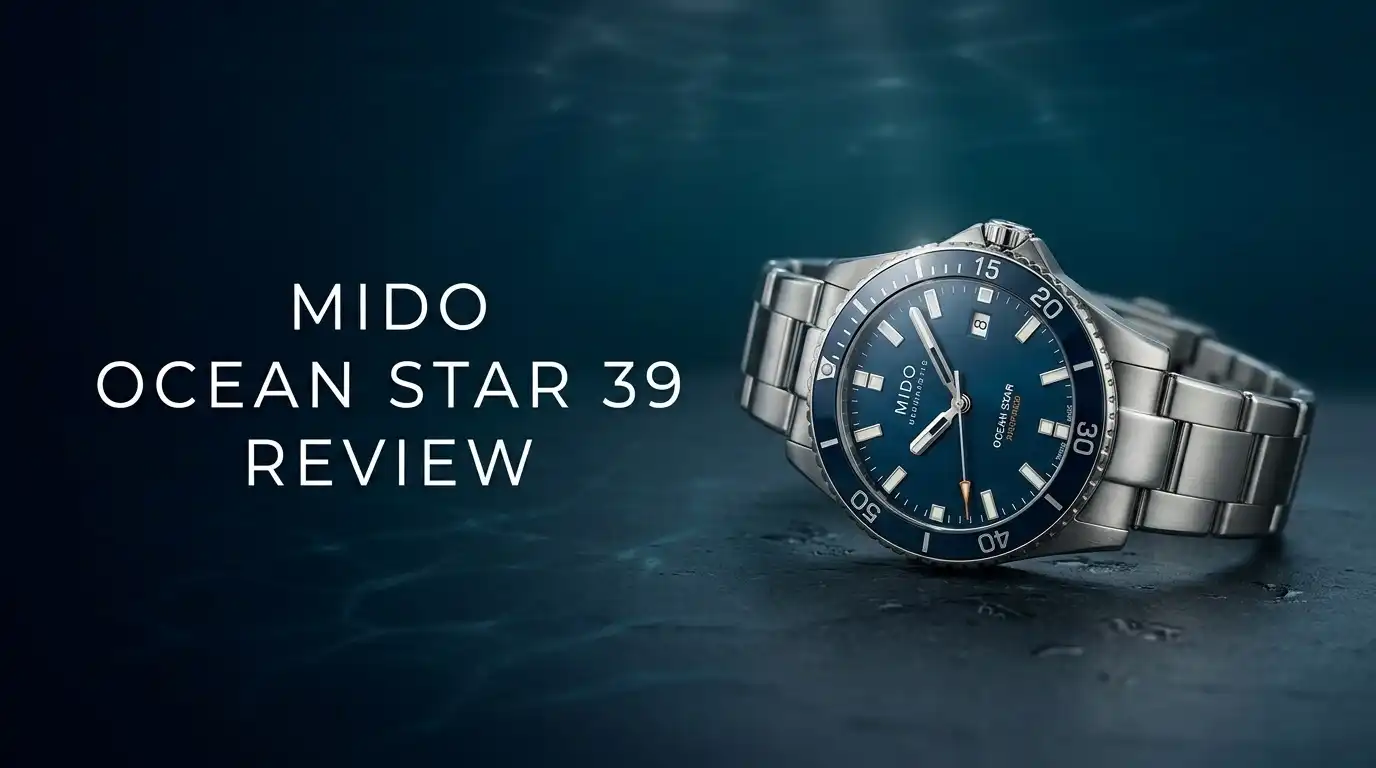
MIDO Ocean Star 39 Review 2026: Worth Buying?
Swiss dive watches usually force a choice. You either get solid specs or you get comfortable proportions. The MIDO Ocean Star 39 refuses that trade.
It packs 200 metres of water resistance, a sapphire crystal, and a three day movement into a case that measures only 10.5mm thick. That number alone makes watch collectors pause.
I wore this watch daily for several weeks. I slept in it, swam in it, and wore it under dress shirts. This review covers the good parts, the annoying parts, and the things MIDO quietly got wrong. By the end, you will know whether the Ocean Star 39 deserves a spot on your wrist in 2026.
In a Nutshell:
- The size is the main selling point. A 39mm diameter, a 46mm lug to lug span, and a 10.5mm case height make this one of the slimmest 200m divers you can buy under $1,500. It slides under a cuff without fighting the fabric.
- The Caliber 72 movement is a genuine upgrade. MIDO skipped its usual Powermatic 80 here. Instead you get the Caliber 72, based on the ETA A31.111, which runs at 25,200 vibrations per hour and holds a 72 hour power reserve. It also uses a Nivachron balance spring for magnetic resistance.
- The wave dial splits opinion. The embossed undulating pattern with a gradient finish looks stunning in sunlight. Some buyers want a flat matte black dial instead, and MIDO does not offer one in this reference.
- Build quality punches above the price. You get a 120 click unidirectional bezel, a screw down crown, antireflective sapphire on both sides, and a bracelet with a diver extension plus quick release.
- It is not flawless. The aluminium bezel insert scratches more easily than ceramic. The solid caseback hides the movement. Resale value on MIDO watches stays soft compared to Seiko or Tudor.
- Price sits near $1,100 to $1,250 depending on the dial variant and retailer.
First Impressions of the MIDO Ocean Star 39

Last update on 2026-11-21 / Affiliate links / Images from Amazon Product Advertising API
The watch feels smaller in person than photos suggest. That is a compliment. Modern divers often bloat past 42mm, so strapping on a 39mm case feels like relief. The weight sits around 130 grams on the bracelet, which reads as substantial without turning into a wrist weight.
My first thought was about the finishing. MIDO alternates satin brushed surfaces with polished bevels along the case flanks. That contrast catches light in a way that belongs on a watch costing twice as much. The polished edges run clean and sharp, with no soft or rounded spots.
The starfish emblem stamped on the caseback adds a nice heritage touch. This is a watch that looks expensive from one metre away. That matters more than spec sheets for most owners.
The Unboxing Experience
MIDO ships the Ocean Star 39 in a rigid rectangular box with a textured outer sleeve. Lift the lid and the watch sits on a firm cushion, wrapped in protective film across the bracelet and crystal. Nothing feels cheap, though the packaging stays practical rather than theatrical.
Underneath the cushion you find the instruction booklet, the international warranty card, and a small tool for bracelet adjustment on some retail versions. The warranty runs two years from most authorised dealers, and MIDO has extended coverage in certain markets when you register online.
Peeling the plastic off the bracelet is oddly satisfying. The polished centre link bevels appear suddenly, and the watch transforms. One small gripe: the box offers no spare strap, even though the lugs use a quick release system that begs for a rubber option.
Case Design and Wrist Proportions
The case measures 39mm across, 10.5mm tall, and 46mm from lug tip to lug tip. Those three numbers explain almost everything good about this watch. For comparison, the Tudor Black Bay 54 sits at 11.2mm, and that model earns praise for being slim.
MIDO used 316L stainless steel, the standard grade for corrosion resistance and skin compatibility. The case runs symmetrical with no crown guards, which keeps the silhouette clean and classic rather than aggressive.
On my 7 inch wrist the lugs curve down and the caseback sits flat. No overhang appears. This case shape works on wrists from 6 inches to 7.5 inches, which covers most buyers. Anyone with a very large wrist may find it too dainty.
The Wave Dial Up Close
The dial carries an embossed undulating motif in relief. MIDO pairs that texture with a colour gradient that shifts from navy blue at the centre to near black at the edges. Under direct sun the waves ripple. Under office lighting the dial reads almost solid.
The applied markers sit slightly recessed into the texture. That small detail creates real depth. The hands use diamond cut surfaces with satin finished grooves, so they flash brightly as your wrist moves.
Legibility stays strong despite the busy surface. The white Super LumiNova plots contrast hard against the dark background. A date window sits at 3 o’clock, cut cleanly into the dial without a printed frame.
Some buyers will call this dial too fussy for a tool diver. That opinion is fair. This is a style driven dial, not a purist one.
Top 3 Alternative for MIDO Ocean Star 39


Last update on 2026-11-21 / Affiliate links / Images from Amazon Product Advertising API
MIDO Ocean Star 200C

Last update on 2026-11-21 / Affiliate links / Images from Amazon Product Advertising API
Certina DS Action Diver 38mm

Last update on 2026-11-21 / Affiliate links / Images from Amazon Product Advertising API
Tissot Seastar 1000 Automatic
Caliber 72 Movement Explained
Most MIDO watches run the Caliber 80, better known as the Powermatic 80. The Ocean Star 39 breaks that pattern. It uses the Caliber 72, which traces back to the ETA A31.111, itself an evolution of the slim ETA 2892.
The specs read well. The movement beats at 3.5Hz, equal to 25,200 vibrations per hour, which gives a smoother sweeping seconds hand than the Powermatic 80. Power reserve reaches 72 hours. The balance spring uses Nivachron, a titanium based alloy that resists magnetic fields and improves shock resistance.
The movement also gets adjusted in four positions at the factory. That level of regulation is rare at this price. The faster beat rate and the thinner architecture are the real reasons this case stays so slim. Twenty one jewels handle the friction points.
Bezel Action and Build Quality
The unidirectional bezel clicks through 120 positions. Each click lands firmly with almost no back play. I tested the alignment across three units at a retailer, and all three lined up correctly at the 12 o’clock pip.
The insert uses anodised aluminium rather than ceramic. MIDO chose a two tone treatment, splitting the first fifteen minutes in navy blue against a black remainder. The markings print in silver and stay crisp.
Aluminium brings a trade. It looks warmer and more vintage than ceramic, and it keeps the watch thin. It also scratches. My test unit picked up two small marks within three weeks of normal wear. Buyers who want a bezel that stays perfect should look at the ceramic Ocean Star 200C instead. The screw down crown threads smoothly with no grinding.
Bracelet and Clasp Comfort
The bracelet uses a three link design in satin brushed steel with polished bevels running along the centre links. It tapers from 20mm at the lugs down to 18mm at the clasp, which helps comfort.
The clasp deserves attention. MIDO fitted a double folding clasp with a diver extension that adds up to 15mm of length. That extension works for wetsuits, but it also helps on hot days when wrists swell. Deploying it takes one hand.
The lugs include a quick interchange system. You can swap to a rubber or leather strap without tools in about ten seconds. This single feature saves you from scratched spring bar holes.
The one weakness is the half link situation. Sizing lands close but rarely perfect, and micro adjustment holes in the clasp are limited.
Lume Performance in Low Light
MIDO applies white Super LumiNova to the hour markers, the hour hand, the minute hand, the seconds hand, and the pip at 12 o’clock. The glow reads blue in darkness.
Charging works quickly under direct sunlight or a strong lamp. After a thirty second charge, the lume burns bright for roughly twenty minutes before fading to a usable glow. At the four hour mark you can still read the time in a fully dark room, though you need adjusted eyes.
This is good lume, not class leading lume. Seiko still wins that category with its LumiBrite application, which glows longer and brighter. For night diving or early morning runs, the Ocean Star 39 does the job without complaint. The seconds hand lume helps confirm the watch is running.
Water Resistance and Real Diving Use
The Ocean Star 39 carries a 200 metre rating, equal to 20 bar or 660 feet. The screw down crown seals the case, and the caseback bolts down with screws.
That rating covers recreational scuba diving, snorkelling, surfing, swimming, and showering. Most owners will never approach the limit. I wore mine in a chlorinated pool and in salt water, then rinsed it with fresh water afterward. No fogging appeared under the crystal.
The crown has three positions once unscrewed. Position one winds manually, position two sets the date, and position three sets the time with a hacking seconds function.
One honest caveat: this watch lacks ISO 6425 diver certification. It meets the water resistance standard, but it has not passed the full certification battery. For casual water use, that distinction rarely matters.
Accuracy Results After Two Weeks
I tracked my unit against an atomic clock for fourteen days. The average result landed at roughly plus 4 seconds per day, measured across normal daily wear with overnight rest dial up.
MIDO does not advertise chronometer certification on this reference, so the factory tolerance sits wider than COSC. Most owners report figures between plus 2 and plus 8 seconds per day. Mine fell comfortably inside that band.
Positional variance stayed small. Crown down overnight brought the rate closer to plus 1 second. Dial up pushed it slightly faster.
The Nivachron balance spring earns its keep here. I kept the watch near a laptop, a phone, and magnetic cabinet latches with no accuracy drift. If your current watch keeps gaining time near electronics, this movement solves that problem. Regulation by a watchmaker can tighten the rate further.
What the MIDO Ocean Star 39 Does Not Do Well
Honest reviews need this section. Here are the real weaknesses.
The aluminium bezel scratches. Ceramic competitors at similar prices stay cleaner over years of wear. The solid caseback hides an attractive movement, which feels like a missed opportunity when rivals show theirs through sapphire.
Brand recognition stays low outside watch circles. Nobody at work will recognise MIDO. Resale values sit noticeably below Seiko, Longines, and Tudor equivalents, so expect a real loss if you sell within two years.
The dial texture divides buyers. There is no plain matte black option in the 39mm line, only blue gradient, grey, and sand with gold accents.
Finally, the clasp micro adjustment is basic. Sizing between links can leave the watch slightly loose or slightly tight.
Pros and Cons
Pros
- Excellent proportions at 39mm wide, 10.5mm thick, and 46mm lug to lug, which suits small and medium wrists perfectly.
- Caliber 72 movement delivers a 72 hour power reserve, a 3.5Hz beat rate, and four position regulation.
- Nivachron balance spring resists magnetism from phones, laptops, and speakers.
- Antireflective sapphire crystal on both sides keeps the dial readable at every angle.
- Quick release lugs and a diver extension clasp make strap swapping and sizing easy.
- Strong finishing with alternating brushed and polished surfaces.
Cons
- Aluminium bezel insert marks more easily than ceramic.
- Solid caseback hides the movement from view.
- No ISO 6425 diver certification despite the 200m rating.
- Weak resale value compared to better known dive watch brands.
- No plain black dial option in this 39mm case size.
- Limited clasp micro adjustment for in between wrist sizes.
Price and Value in 2026
MIDO lists the Ocean Star 39 near $1,100 to $1,250 depending on the variant and the market. Authorised dealers sometimes discount, and grey market sellers often go lower.
At that figure the competition is fierce. The Seiko SPB143 line, the Certina DS Action Diver, and the Tissot Seastar all fight for the same buyer. The Ocean Star 39 wins on thinness and movement quality. It loses on brand prestige and bezel material.
Value depends on what you prioritise. If you want the thinnest possible Swiss diver with a three day reserve, nothing in this price bracket matches it. If you want long term resale strength, a Seiko holds money better.
For daily wear satisfaction per dollar, this watch scores very high.
Who Should Buy the MIDO Ocean Star 39
Last update on 2026-11-21 / Affiliate links / Images from Amazon Product Advertising API
Buy this watch if you have a wrist between 6 and 7.5 inches and you are tired of thick divers that catch on shirt cuffs. Buy it if you value movement specifications over logo recognition.
It suits people who want one watch for the office, the weekend, and the pool. The slim case genuinely works with formal clothing, which most 200m divers cannot claim.
Skip it if you need a ceramic bezel that stays pristine. Skip it if resale value sits high on your list. Skip it if you prefer a plain dial without texture.
This is a watch for the enthusiast who already owns something obvious and now wants something better engineered. It rewards the person who knows what an ETA A31.111 is.
Final Verdict
The MIDO Ocean Star 39 is one of the smartest value propositions in Swiss diving watches right now. MIDO solved the thickness problem that plagues this category, then paired the result with a movement that outclasses the usual Powermatic 80.
The flaws are real but small. An aluminium bezel will mark. A solid caseback hides good mechanics. Resale will disappoint anyone treating watches as investments.
None of that stops this watch from being a joy to wear every single day. The wave dial still catches my eye three weeks in.
Rating: 8.7 out of 10. The Ocean Star 39 earns a strong recommendation for anyone shopping under $1,500 who wants proportions right and specifications honest.
Frequently Asked Questions
Is the MIDO Ocean Star 39 a real dive watch?
Yes. It carries a 200 metre water resistance rating, a screw down crown, a unidirectional bezel, and strong lume. It has not received ISO 6425 certification, but it handles recreational diving, snorkelling, and swimming without issue.
What movement powers the MIDO Ocean Star 39?
The Caliber 72, based on the ETA A31.111. It runs at 25,200 vibrations per hour, stores 72 hours of power, and uses a Nivachron balance spring for magnetic resistance.
How thick is the MIDO Ocean Star 39?
The case measures 10.5mm including the caseback and crystal. That makes it one of the slimmest 200m divers available under $1,500.
Does the Ocean Star 39 fit small wrists?
Yes. The 39mm diameter and 46mm lug to lug span work well on wrists from 6 inches upward. The tapering bracelet helps comfort further.
Can you swap the bracelet easily?
Yes. The lugs use a quick interchange system, so you can fit a rubber or leather strap in seconds without any tools.
How accurate is the MIDO Ocean Star 39?
Most owners report between plus 2 and plus 8 seconds per day. My test unit averaged plus 4 seconds daily across two weeks of normal wear.
What colours does the Ocean Star 39 come in?
MIDO offers a navy blue to black gradient, a grey and black version, and a sand dial with PVD gold accents. No plain matte black option exists in this size.

Hi, I’m Lucy Jones, a dedicated watch enthusiast and reviewer. I spend my time hunting down, testing, and evaluating the most intriguing wristwatches on the market. My goal is to guide you through the overwhelming choices with honest, hands-on insights into every timepiece.