MIDO Ocean Star 200C Review 2026: Still Worth It?
Swiss dive watches under $1,200 have become a crowded shelf. The MIDO Ocean Star 200C keeps showing up in that conversation, year after year, and it refuses to go quiet.
It offers a ceramic bezel, a Swiss automatic movement with an 80 hour power reserve, and 200 meters of water resistance for less than many people spend on a phone.
This review answers those questions honestly, including the parts MIDO would rather you skip. If you are deciding between this and a Tissot, a Certina, or a Seiko, read on before you tap buy.
In a Nutshell:
- Strong value Swiss automatic. The Ocean Star 200C pairs the ETA based Caliber 80 movement with a Nivachron balance spring, giving you roughly 80 hours of power reserve and better magnetic resistance than most watches at this price.
- Real dive credentials. You get 200 meters of water resistance, a screw down crown, a screw down caseback, a sapphire crystal with antireflective coating, and a 120 click unidirectional ceramic bezel.
- It wears large. The case measures 42.5mm wide with a lug to lug span near 49mm and 22mm lugs. Wrists under 6.5 inches will feel it.
- Finishing punches above its price. Brushed flanks, polished chamfers, applied indices, and the signature starfish caseback make it look more expensive than it is.
- Accuracy is good, not chronometer grade. Expect somewhere between 0 and +12 seconds per day on most examples, which is fine for daily wear but not certified precision.
- Weak points exist. The bracelet clasp lacks fine adjustment on many references, the watch is thicker than the numbers suggest, and the price has crept upward since launch.
MIDO Ocean Star 200C: Quick Verdict


Last update on 2026-11-21 / Affiliate links / Images from Amazon Product Advertising API
The Ocean Star 200C is one of the easiest Swiss dive watch recommendations under $1,200. It does not chase trends. It delivers a complete package: ceramic bezel insert, ETA based automatic movement, 200 meter rating, sapphire crystal, and a solid steel bracelet. Nothing here feels like a cost cutting compromise.
MIDO sits inside the Swatch Group, which means it shares movement technology with Tissot, Certina, and Hamilton while flying under the radar in the United States. That obscurity is part of the appeal. You wear something recognizably Swiss without the crowd.
The watch suits office days, weekend hikes, pool laps, and casual diving. It is less suited to small wrists and formal cuffs. If you want one automatic sports watch that handles most of your week, this one earns its spot.
The Unboxing Experience
MIDO ships the Ocean Star 200C in a textured presentation box with a starfish motif stamped on the lid. The outer sleeve is plain cardboard. Nothing feels luxurious, and nothing feels cheap either. It is practical packaging that you will store in a closet within a week.
Inside you find the watch on a padded cushion, the warranty booklet, an instruction manual covering the Caliber 80, and a basic cleaning cloth. Some regional sets include an extra rubber strap, though many do not, so check the listing before you assume.
The first thing you notice when you lift it out is weight. The steel bracelet gives the package real heft, around 170 grams on the full bracelet. Peel the protective film off the caseback and bezel slowly. The factory stickers cling tighter than you expect, and the starfish engraving underneath is worth the extra ten seconds.
Dial Design and Everyday Legibility
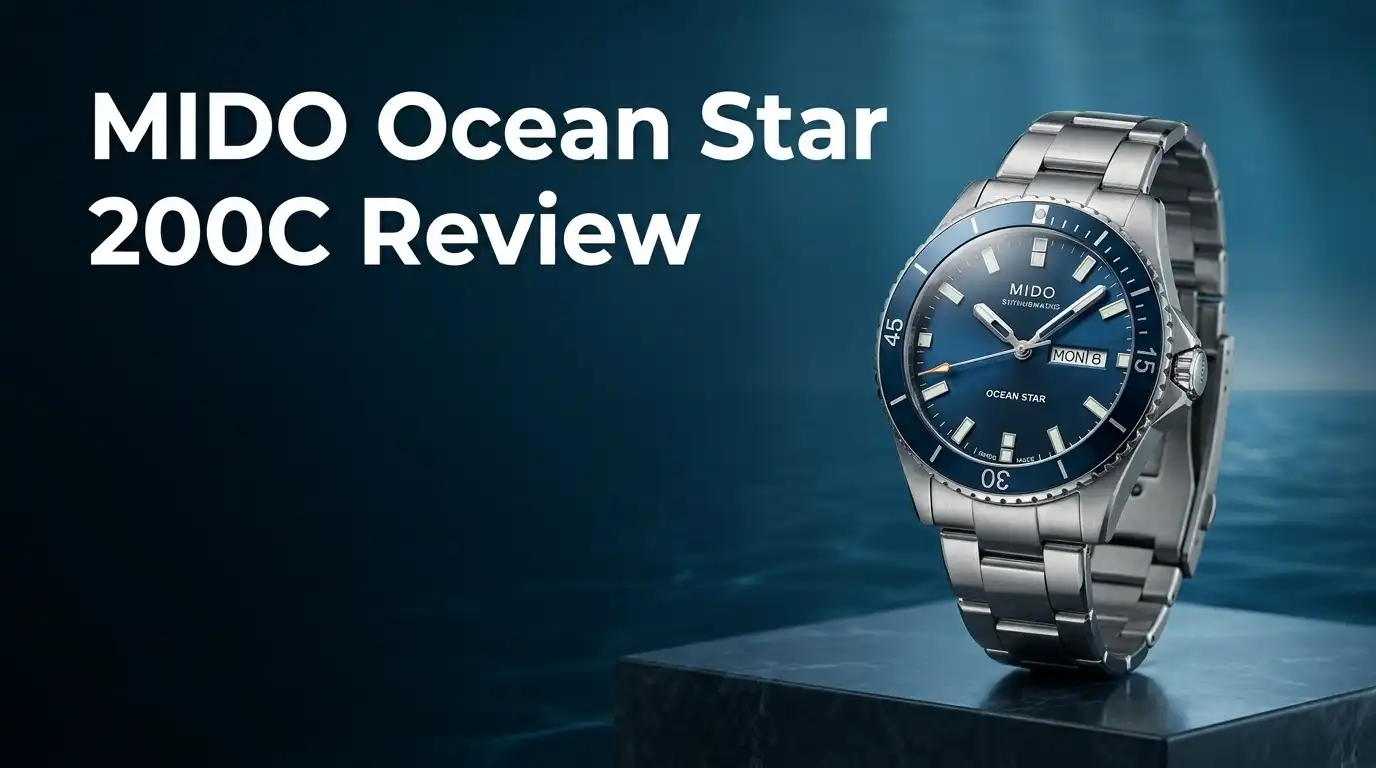
The dial carries a wave pattern that catches light at angles and disappears head on. It is subtle rather than loud. Applied indices filled with white Super LumiNova sit on top, and the handset is wide, flat, and easy to read at a glance.
The day and date window at 3 o’clock splits opinion. Some buyers love the practicality. Others feel the double window crowds the right side of the dial and breaks the symmetry. I land in the middle. The day display is genuinely useful if you wear one watch daily.
Color options matter here. The blue gradient dial is the crowd favorite. Black looks more utilitarian. The red bezel version adds personality without turning into a costume piece. Whichever you choose, legibility stays excellent in daylight, indoors, and underwater.
Top 3 Alternatives for MIDO Ocean Star 200C

Last update on 2026-11-21 / Affiliate links / Images from Amazon Product Advertising API
Certina DS Action Diver

Last update on 2026-11-21 / Affiliate links / Images from Amazon Product Advertising API
Tissot Seastar 1000 Powermatic 80

Last update on 2026-11-21 / Affiliate links / Images from Amazon Product Advertising API
Seiko Prospex Automatic Diver
Case Size, Thickness, and Wrist Feel
Here are the real numbers. The case is 42.5mm wide, roughly 12mm thick, with a lug to lug measurement just over 49mm and 22mm lug width. Those dimensions place it in modern sports watch territory rather than vintage territory.
On a 7 inch wrist it sits comfortably and looks proportional. On a 6.5 inch wrist the lugs reach the edges. On anything smaller, the watch dominates. Try before you buy if your wrist is slim, because photos online flatter it.
The case shape helps. MIDO brushed the top surfaces and polished the bezel edge and case sides, which breaks up the visual bulk. The crown guards protect the screw down crown without adding width. Thickness is managed well, and the watch slides under most shirt cuffs, though not under tight dress shirts.
The Ceramic Bezel Up Close
The ceramic insert is the headline upgrade over the standard Ocean Star 200. Ceramic resists scratches far better than aluminum and keeps its color under sun exposure. After months of wear, the bezel on my sample still looks factory fresh.
Action is unidirectional with 120 clicks. The rotation feels firm with minimal back play. It is not Rolex smooth, and the clicks sound slightly hollow, but alignment on my example was dead on at every mark. That consistency matters more than sound.
The engraved and lacquer filled markings stay sharp. The lume pip at 12 glows alongside the dial markers, which is a nice touch many brands skip at this price. Grip is the weak point. The coin edge teeth are shallow, and wet fingers slip more than you want during actual water use.
Caliber 80 Movement and Real Accuracy
Inside sits the MIDO Caliber 80, based on the ETA C07.621. It beats at 21,600 vibrations per hour and delivers up to 80 hours of power reserve. Set it down Friday evening and it still runs Monday morning.
The movement includes a Nivachron balance spring, which improves resistance to magnetic fields from laptops, speakers, and phone cases. For a watch at this price, that is a meaningful upgrade.
Accuracy in daily use typically lands between 0 and +12 seconds per day depending on position and winding state. That is solid but short of chronometer certification, which competitors like Certina sometimes include. The lower beat rate also means the seconds hand sweeps a little less smoothly than a 4Hz movement. Servicing intervals run roughly every five to seven years, and Swatch Group service centers handle parts without drama.
Bracelet, Clasp, and Strap Swapping
The steel bracelet uses solid links with brushed surfaces and polished center accents. It tapers slightly from 22mm, which helps comfort. Screwed links replace pins, so sizing is cleaner, though a few screws arrive very tight from the factory.
The clasp is where honesty is needed. Many references ship with a basic folding clasp and limited micro adjustment holes. There is no on the fly extension, which competitors now offer. If your wrist swells in heat, you will notice the gap between settings.
Strap swapping is easy thanks to the 22mm lug width. Rubber, NATO, and leather all work well. The rubber option from MIDO fits the case curve nicely. Third party options cost far less and perform almost identically, so experiment freely.
Lume Performance After Dark
Lume is a quiet strength here. MIDO applies white Super LumiNova to the hour markers, both hands, and the bezel pip. After a few minutes under a lamp, the glow is bright blue green and holds through the night.
Legibility at 2am is genuinely good. The hour and minute hands differ clearly in shape, so you will not misread the time half asleep. The seconds hand carries only a small lume dot, which is standard but still worth noting for dive timing purists.
Compared with a Seiko Prospex, the Ocean Star trails slightly in raw brightness. Seiko remains the lume benchmark. Compared with most Swiss rivals in the same bracket, MIDO holds its own and beats several of them outright.
Water Resistance and Actual Diving Use
The 200 meter rating is real. You get a screw down crown, a screw down caseback, and a gasket sealed sapphire crystal. Showering, swimming, snorkeling, and recreational diving all fall comfortably inside the envelope.
One caution matters. The Ocean Star 200C is not ISO 6425 certified as a divers watch in every reference. It performs the job, but certification purists should confirm the exact model code before purchase. For 99 percent of owners, this distinction changes nothing.
Always check the crown is fully screwed down before water contact. The crown threads smoothly, and the crown guards reduce accidental knocks. Rinse the watch with fresh water after saltwater exposure to protect the bracelet and bezel seals. Pressure test the gaskets every two years if you dive regularly.
MIDO Ocean Star 200C Titanium: The Lighter Option

Last update on 2026-11-21 / Affiliate links / Images from Amazon Product Advertising API
If weight bothers you, the titanium version solves it. The case and bracelet drop roughly 30 percent of the mass while keeping the same 42.5mm footprint and 200 meter rating. On the wrist it feels noticeably lighter and warmer against skin.
Titanium brings tradeoffs. The surface scratches more easily than steel, and the matte gray tone reads less dressy. The price also climbs, often several hundred dollars above the steel model depending on the retailer.
Who should pick titanium? Anyone with wrist fatigue, metal sensitivity, or a preference for stealthy finishes. Anyone who wants maximum shine and maximum value should stay with steel. Both versions share the Caliber 80 movement, the ceramic bezel, and the starfish caseback, so the mechanical experience is identical.
What the MIDO Ocean Star 200C Does Not Do Well
Honest reviews name flaws, so here they are. The clasp is the biggest miss. Competitors near this price now include tool free extensions, and MIDO lags behind on several references.
The watch wears big. The 49mm lug to lug and broad bezel make it look larger than 42.5mm suggests. Small wrists will struggle, and no strap swap fixes geometry.
Bezel grip disappoints when wet. The teeth are shallow and the ceramic is slick, so turning it with cold or gloved fingers takes effort.
Brand recognition is low in the United States. Nobody at the office will know what you are wearing, and resale values reflect that reality. Finally, prices have drifted upward since launch, which narrows the value gap against Certina and Tissot rivals.
Pros and Cons
Pros
- Excellent 80 hour power reserve that survives a full weekend off the wrist
- Scratch resistant ceramic bezel with crisp markings and accurate alignment
- Nivachron balance spring improves magnetic resistance at a modest price
- Sapphire crystal with antireflective coating keeps the dial readable in sun
- Strong finishing with brushed and polished surfaces plus applied indices
- Genuine 200 meter water resistance with screw down crown and caseback
- Easy 22mm strap swaps for endless style changes
- Swatch Group service network supports parts and repairs long term
Cons
- Clasp lacks on the fly micro adjustment on most references
- Wears large because of the 49mm lug to lug measurement
- Bezel grip gets slippery when wet
- Lower beat rate gives a slightly choppy seconds sweep
- Low brand awareness hurts resale value
- Price increases have eroded some of the original value advantage
Price and Value in 2026
Street pricing for the steel Ocean Star 200C generally runs between $900 and $1,200, with authorized dealers and grey market sellers splitting the range. Titanium versions push higher, often past $1,300. Sales around major shopping events bring the steel model closer to $800.
Compared with rivals, the picture is competitive but not dominant. Certina offers chronometer certification and deeper water resistance for similar money. Tissot undercuts MIDO on price with the Seastar. Seiko wins on lume and heritage, though Swiss movement fans prefer the Caliber 80.
Value here comes from balance. You get ceramic, sapphire, Swiss automatic power, and strong finishing in one package. Few watches tick every one of those boxes under $1,200 without sacrificing something obvious.
Who Should Buy the MIDO Ocean Star 200C
Buy this watch if you want one automatic sports watch that handles everything. It works at a desk, in a pool, on a trail, and at a casual dinner. The 80 hour reserve suits people who rotate between two or three watches.
It suits buyers with wrists measuring 6.75 inches or larger. It also suits anyone who values Swiss movement engineering but refuses to pay luxury brand markup.
Skip it if you have a small wrist, if you need an on the fly clasp for hot climates, or if you want a watch that draws compliments from strangers. MIDO rewards the owner, not the audience. Collectors chasing resale value should look elsewhere. Everyone else gets a lot of watch for the money.
Final Verdict
The MIDO Ocean Star 200C remains one of the smartest Swiss dive watch purchases available in 2026. It combines a ceramic bezel, a durable Caliber 80 movement, sapphire crystal, and real 200 meter capability at a price that still undercuts the obvious names.
It is not flawless. The clasp needs updating, the case wears big, and the bezel gets slippery when wet. Those complaints are real, and nobody should buy blind.
Weighed against the strengths, though, the flaws stay minor. Build quality, movement performance, and daily comfort all land well above the asking price. For anyone who wants a dependable Swiss automatic diver without the hype tax, the Ocean Star 200C earns a confident recommendation and keeps earning it years into ownership.
Frequently Asked Questions
Is the MIDO Ocean Star 200C a real dive watch?
Yes. It carries 200 meters of water resistance, a screw down crown, a screw down caseback, and a unidirectional bezel. Recreational diving, snorkeling, and swimming are all safe. Confirm the exact reference if you need formal ISO 6425 certification.
How accurate is the Caliber 80 movement?
Most examples run between 0 and +12 seconds per day. The Nivachron balance spring improves magnetic resistance and keeps performance stable over time. A watchmaker can regulate the movement closer to zero if you want tighter accuracy.
Does the Ocean Star 200C fit a 6.5 inch wrist?
It fits, but it looks large. The 49mm lug to lug span reaches the edges of a 6.5 inch wrist. A smaller 39mm or 40.5mm alternative will feel more balanced for slim wrists.
How long does the power reserve actually last?
A fully wound movement runs close to 80 hours. Real world results often land between 72 and 78 hours depending on winding and position. That is enough to cover a full weekend without rewinding.
Is MIDO a good watch brand?
MIDO belongs to the Swatch Group and has produced Swiss watches since 1918. Build quality, movement sourcing, and service support are all solid. Brand recognition in the United States stays low, which keeps prices reasonable for buyers.
Can you swap the bracelet easily?
Yes. The lug width is 22mm, and standard spring bars make changes simple. Rubber, NATO, leather, and mesh straps all fit. A cheap spring bar tool handles the job in under five minutes.

Hi, I’m Lucy Jones, a dedicated watch enthusiast and reviewer. I spend my time hunting down, testing, and evaluating the most intriguing wristwatches on the market. My goal is to guide you through the overwhelming choices with honest, hands-on insights into every timepiece.