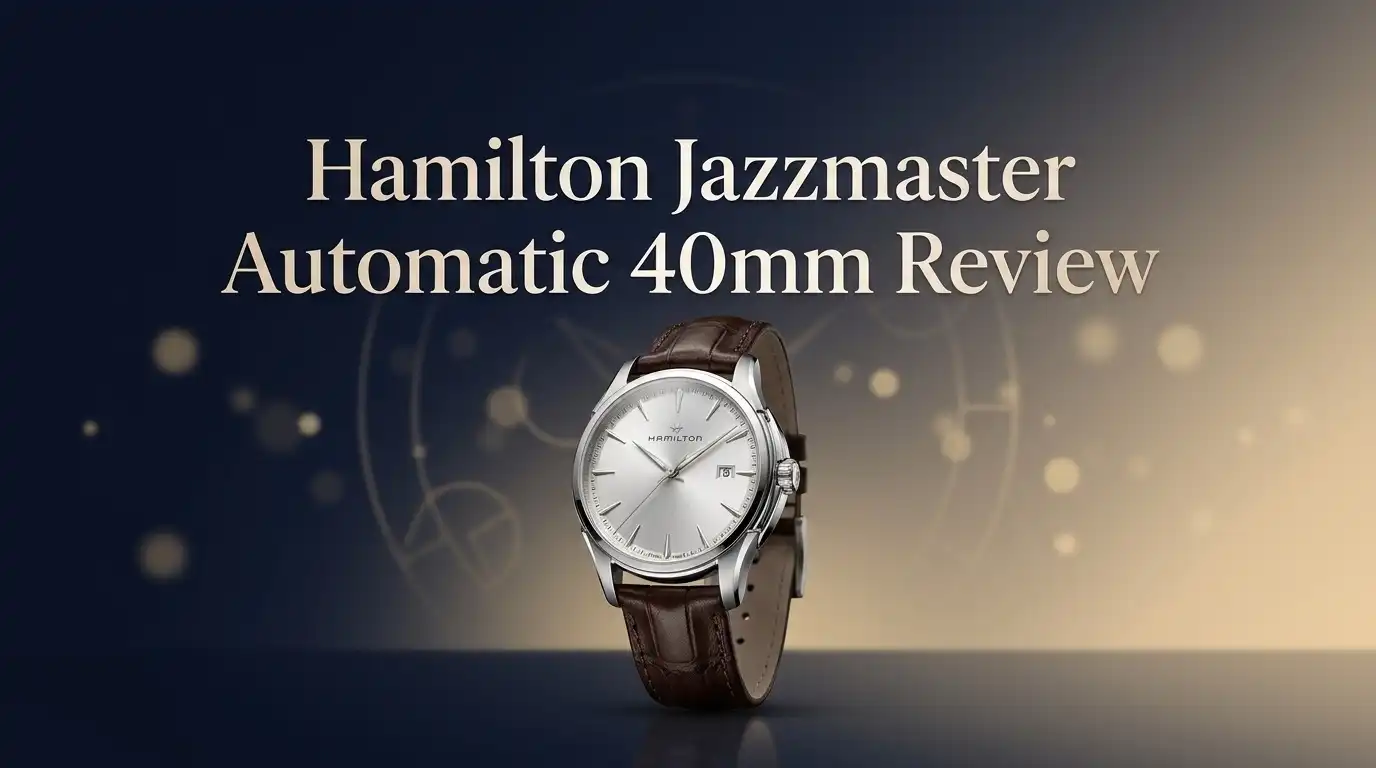
Hamilton Jazzmaster Automatic 40mm Review 2026: Worth Buying?
The Hamilton Jazzmaster Automatic 40mm sits in a strange sweet spot. It costs less than a Swiss luxury watch but delivers a movement that outperforms watches twice its price.
I wore this watch daily for several weeks, slept with it on, wore it to meetings, and knocked it against a door frame more than once. This review covers what the marketing pages skip.
You will read about real accuracy numbers, strap frustrations, the dial finishing that photos exaggerate, and the three places this watch genuinely falls short.
In A Nutshell:
- The H-10 movement is the headline feature. It delivers an 80 hour power reserve, which means you can take the watch off Friday evening and strap it back on Monday morning with the time still running. The hairspring uses Nivachron, an alloy that resists magnetic fields far better than standard steel hairsprings.
- The 40mm case wears smaller than the number suggests. Case thickness sits near 11mm, and the lug span stays conservative. Wrists from 6.5 inches to 7.5 inches handle it comfortably. Anyone with a wrist under 6.25 inches should try the 38mm Performer instead.
- Water resistance stops at 50 meters. That covers rain, hand washing, and an accidental splash. It does not cover swimming laps or diving. This is the single biggest limitation for buyers who want one watch for everything.
- Price in 2026 ranges from roughly $675 to $995 depending on dial, strap, and whether you pick the bracelet. Street prices from authorized dealers often land below list.
- The finishing punches above the price. Sunray dials, polished applied indices, and a sapphire crystal with antireflective coating all feel expensive in person.
- Accuracy runs slightly fast or slightly slow out of the box. Expect somewhere between 5 seconds slow and 10 seconds fast per day. That is acceptable but not chronometer grade.
First Impressions of the Hamilton Jazzmaster Automatic 40mm

Last update on 2026-11-20 / Affiliate links / Images from Amazon Product Advertising API
The first thing you notice is restraint. Hamilton did not load this dial with text, chapter rings, or decoration. You get a clean sunray dial, slim applied markers, and a small date window. It looks like a watch that belongs on a dress shirt cuff.
Pick it up and the weight surprises you. The steel case has real density without feeling heavy. The polished bezel catches light in a way that photos never capture properly. Sunlight turns the blue dial almost black at certain angles, then flips to bright navy when you tilt your wrist.
The crown screws nothing, so winding feels immediate and smooth. The date snaps over cleanly. Nothing about the first handling feels cheap. That matters at this price point, where many competitors cut corners on case finishing.
The Unboxing Experience
Hamilton ships the Jazzmaster in a rectangular box with a textured outer sleeve. Lift the lid and you find the watch mounted on a firm cushion. The presentation feels appropriate rather than luxurious. You are not paying for theatrics here, and that is fine.
Inside the box you get the instruction booklet, the international warranty card, and a small Hamilton branded cloth in some regions. The warranty card needs a dealer stamp, so check this before you leave the store or open the shipping package. Online buyers should confirm the seller is authorized.
The watch arrives unwound and stopped. Give the crown about thirty turns, set the time, and the second hand sweeps to life. The sweep looks smooth at 21,600 vibrations per hour, though sharp eyes notice it is slightly less fluid than a 28,800 movement.
Case Design and Build Quality
The case measures 40mm across and sits around 11mm tall. Hamilton uses stainless steel throughout with a mix of brushed top surfaces and polished flanks. This two texture approach hides scratches better than a fully polished case.
Lug width comes in at 20mm, which is the most common strap size in existence. You can swap straps endlessly without hunting for odd sizes. That alone adds years of enjoyment to ownership.
The lugs curve downward, which keeps the watch planted on the wrist instead of rocking. The sapphire crystal sits slightly raised with an antireflective treatment on the inside surface. Legibility stays strong in sunlight.
The case back on most references is solid steel with the Hamilton logo. Some variants use an exhibition back so you can watch the rotor spin. Both feel equally well machined.
Dial Options and Legibility
Hamilton offers the Jazzmaster Automatic in silver, blue, black, green, and beige. The silver dial reads most formal. The blue dial reads most versatile. Green and beige appeared in more recent releases and give the line a modern feel.
The applied indices carry polished edges with luminous fill on several references. Lume performance is modest, not impressive. It glows for an hour or two after charging, then fades. This is a dress watch, so Hamilton clearly prioritized looks over nighttime visibility.
The date window sits at three o’clock with a matching dial color frame on most models. It blends in rather than shouting. The hands are dauphine or baton depending on the reference.
Reading the time takes a fraction of a second in daylight. In dim restaurant lighting, the polished hands sometimes disappear against a polished dial. That is the tradeoff of elegant design.
Top 3 Alternative for Hamilton Jazzmaster Automatic 40mm
No products found.
Hamilton Khaki Field Automatic 38mm

Last update on 2026-11-19 / Affiliate links / Images from Amazon Product Advertising API
Tissot Gentleman Powermatic 80 Silicium

Last update on 2026-11-19 / Affiliate links / Images from Amazon Product Advertising API
Seiko Presage Cocktail Time Automatic
The H-10 Movement Explained
The H-10 is the reason enthusiasts recommend this watch. Hamilton bases it on the ETA 2824 architecture but reworks the gear train to deliver 80 hours of power reserve instead of the usual 38.
That extra reserve changes how you live with an automatic watch. Office workers who rotate between two or three watches no longer come back to a dead movement. Take the Jazzmaster off Thursday night and it still runs Sunday afternoon.
The movement beats at 21,600 vibrations per hour, which is slower than many rivals. Hamilton slowed the rate deliberately to stretch the reserve. The practical cost is a slightly choppier second hand sweep.
The Nivachron hairspring resists magnetism from laptops, phone cases, and speaker magnets. This genuinely reduces accuracy problems over the years. The movement also hacks and hand winds, which many buyers consider essential.
Accuracy in Real Daily Use
Hamilton rates the H-10 within a tolerance of roughly 10 seconds fast to 10 seconds slow per day. My test sample settled around 6 seconds fast daily when worn and about 3 seconds fast when resting dial up.
Owner reports across forums land in a similar range. Some units run closer to 2 seconds per day. Others drift 12 seconds or more and need regulation. Variation between units is the honest reality of this price bracket.
The good news is that the H-10 regulates easily. A watchmaker can bring most units inside 5 seconds per day for a modest fee. Some authorized dealers adjust it free during the warranty period.
Positional stability stays decent. Leaving the watch crown up overnight slows it slightly, which you can use to balance a fast running unit. That trick alone keeps many owners happy without any service visit.
Strap and Bracelet Comfort
Hamilton sells the Jazzmaster Automatic on leather and on a steel bracelet. The leather strap is genuine calf with a pin buckle and it softens nicely after two weeks. Early on it feels stiff across the lugs.
The steel bracelet uses solid links with brushed surfaces and polished center sections. It drapes well. The clasp, however, is the weakest part of the package. It is a simple folding clasp with no micro adjustment, so sizing relies on removing full links and sometimes a half link.
Hot days make this obvious. Your wrist swells, and without micro adjustment you either live with tightness or a loose fit. Competing brands now include tool free adjustment, and Hamilton lags here.
Swapping straps takes two minutes with a spring bar tool. The 20mm lug width opens a huge aftermarket.
How It Wears on Different Wrist Sizes
Case diameter alone never tells the full story. The Jazzmaster Automatic has a moderate lug to lug measurement near 47mm, which keeps it from overhanging smaller wrists.
On a 7 inch wrist it looks ideal. The dial fills the space without crowding. On a 6.5 inch wrist it still works, especially on leather. Below 6.25 inches the case starts to dominate, and the 38mm Performer becomes the smarter pick.
Wrists above 7.5 inches may find 40mm slightly small for a daily watch. Hamilton sells 42mm and 44mm Jazzmaster versions for that reason.
The 11mm thickness slides under a shirt cuff without catching. This is where the Jazzmaster beats thicker sport watches for office wear. It disappears when you want it to and reappears when you check the time.
Water Resistance and Daily Durability
The Jazzmaster Automatic carries a 50 meter rating, which equals 5 bar. In plain terms, this handles rain, hand washing, and splashes from a sink. It does not handle swimming, showering with hot water, or any diving.
That rating disappoints buyers who want a single watch for all situations. Many rivals at the same price offer 100 meters. Hamilton made a design choice here, prioritizing a slim case and a push pull crown over a screw down crown.
Scratch resistance is strong on the crystal and average on the case. Sapphire shrugs off keys and desk edges. Steel does not. Expect hairline marks on the polished bezel within the first month.
Treat it as a dress watch and it will stay beautiful. Treat it as a tool watch and you will regret the finish choices.
Pros and Cons
Here is the straight summary after weeks of wear.
Pros
- 80 hour power reserve from the H-10 movement, which beats most rivals at this price.
- Nivachron hairspring gives real protection against magnetic fields from daily electronics.
- Swiss Made construction with a two year international warranty.
- Slim 11mm case profile that slides under shirt cuffs easily.
- Sapphire crystal with antireflective coating keeps the dial readable in sunlight.
- 20mm lug width opens unlimited strap options.
- Dial finishing and applied indices look far more expensive than the price tag.
Cons
- Only 50 meters of water resistance, which rules out swimming.
- Bracelet clasp lacks micro adjustment, a real comfort issue in warm weather.
- Luminous material fades quickly and offers weak nighttime visibility.
- Accuracy varies noticeably between individual units.
- The 21,600 beat rate produces a slightly less smooth second hand sweep.
- Resale value stays soft compared to Seiko or Tudor alternatives.
What the Hamilton Jazzmaster Does Not Do Well
Honest reviews name the flaws, so here they are without softening. The clasp is the biggest daily annoyance. At this price, tool free micro adjustment should be standard, and Hamilton has not added it.
The lume is decorative. If you need to read the time in a dark room, you will reach for your phone instead. Hamilton clearly tested the lume for photos rather than for function.
Resale value also disappoints. Jazzmaster models depreciate meaningfully on the secondary market. Buy this watch to wear, never as an investment.
Finally, the polished bezel scratches early. The first mark stings. After that, you stop caring. Owners who want pristine cases should look at fully brushed alternatives.
None of these flaws break the watch. They simply set realistic expectations before you spend money.
Price and Value in 2026
Hamilton lists the Jazzmaster Auto 40mm starting near $675 for leather strap versions, with bracelet and premium dial variants climbing toward $995. Open Heart models reach higher. Authorized dealers frequently discount below list.
At $675, the value equation looks strong. You get a Swiss movement with an 80 hour reserve, a sapphire crystal, and genuine dress watch finishing. Very few competitors match that combination.
At $995, the math tightens. Rivals at that price add 100 meter resistance and better clasps. The sweet spot sits in the $650 to $800 range.
Grey market dealers list the Jazzmaster lower, though warranty coverage changes. Preowned examples in good condition appear regularly and represent the best value of all for patient buyers.
Servicing, Warranty and Long Term Ownership
Hamilton includes a two year international warranty on new purchases. Registering the watch online extends coverage in some regions, so check the terms when you buy.
Service intervals for the H-10 fall around every five to seven years depending on wear. A full service costs roughly $300 to $500 through Hamilton, and often less through an independent watchmaker.
The ETA based architecture is a long term advantage. Parts stay available, and nearly any competent watchmaker can work on it. Compare that to in house movements from boutique brands where service means shipping the watch overseas.
Daily ownership requires almost nothing. Wind it when it stops, set the date at month end, and wipe the case occasionally. Keep the leather strap away from water to avoid cracking.
Who Should Buy It
Buy the Hamilton Jazzmaster Automatic 40mm if you want one elegant automatic watch for office wear, weddings, dinners, and travel. It suits professionals who need something dressier than a field watch but less formal than a gold dress piece.
First time mechanical watch buyers benefit most. The 80 hour reserve forgives the learning curve of automatic ownership. You will not fight a dead watch every Monday.
Skip it if you swim regularly, need strong lume, or want a single watch that handles hiking and the office equally. The Khaki Field serves those buyers better.
Collectors looking for investment pieces should also look elsewhere. This is a wearing watch, and it rewards wearing rather than storing.
Final Verdict

Last update on 2026-11-20 / Affiliate links / Images from Amazon Product Advertising API
The Hamilton Jazzmaster Automatic 40mm earns a confident recommendation with clear boundaries. The H-10 movement, the slim case, and the dial finishing deliver more than the price suggests. Few watches under $1,000 feel this considered.
The flaws are real. Fifty meters of water resistance limits versatility. The clasp needs an update. The lume barely functions. None of these issues appear during normal dress watch use.
Score it an 8.5 out of 10 for buyers who want elegance and reliability. Score it a 6 out of 10 for buyers who want one watch for every activity.
If your wrist measures between 6.5 and 7.5 inches and your main need is a sharp looking automatic for work and events, this watch will serve you well for decades.
Frequently Asked Questions
Is the Hamilton Jazzmaster Automatic a good first luxury watch?
Yes. It offers Swiss construction, an 80 hour power reserve, and classic styling at an accessible price. The ETA based movement makes future servicing simple and affordable almost anywhere.
Can I swim with the Hamilton Jazzmaster Automatic 40mm?
No. The 50 meter rating covers rain and splashes only. Swimming, showering, and diving risk water entry through the push pull crown. Choose a Khaki Navy or a dedicated dive watch for water activities.
How accurate is the H-10 movement?
Hamilton rates it within roughly 10 seconds per day in either direction. Most owners report between 2 and 8 seconds daily. A watchmaker can regulate the movement closer to 3 seconds per day if yours runs outside your comfort zone.
Does the Hamilton Jazzmaster hold its value?
Not strongly. Expect meaningful depreciation on the secondary market. Buy this watch for wear rather than resale. Preowned examples offer excellent value for second hand buyers.
What wrist size fits the 40mm Jazzmaster best?
Wrists between 6.5 inches and 7.5 inches suit it best. Smaller wrists should consider the 38mm Performer. Larger wrists may prefer the 42mm or 44mm Jazzmaster versions.
How often does the Jazzmaster need servicing?
Plan for a full service every five to seven years. Costs usually fall between $300 and $500. Independent watchmakers can service the H-10 since it shares architecture with widely used ETA calibers.

Hi, I’m Lucy Jones, a dedicated watch enthusiast and reviewer. I spend my time hunting down, testing, and evaluating the most intriguing wristwatches on the market. My goal is to guide you through the overwhelming choices with honest, hands-on insights into every timepiece.