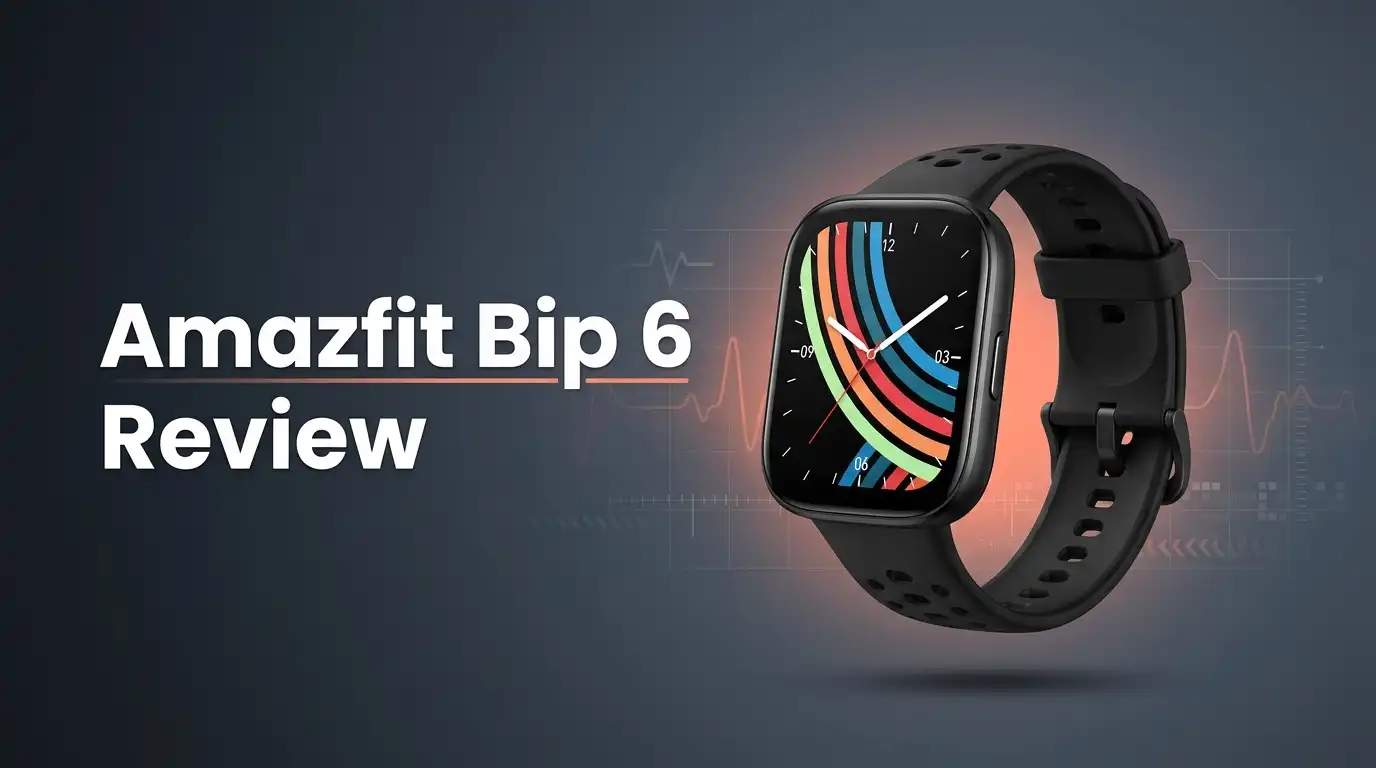
Amazfit Bip 6 Review 2026: Still Worth It?
The budget smartwatch market is crowded in 2026. Most watches under $100 ask you to give up something big, like GPS, a decent screen, or battery life.
The Amazfit Bip 6 refuses to play that game. It packs an AMOLED display, five satellite GPS, offline maps, and a claimed 14 day battery into a package that costs about as much as a nice dinner out.
I wore this watch daily for weeks. I slept in it, swam with it, ran with it, and argued with its AI assistant. This review covers what the Bip 6 nails, where it stumbles, and whether it deserves a spot on your wrist. Spoiler: there are real flaws here, and I will not hide them.
In a Nutshell:
- Price is the headline. The Bip 6 launched at $79, which undercuts the older Bip 5. You get more watch for less money than the previous generation, which almost never happens in wearables.
- The AMOLED upgrade changes everything. The old TFT screen screamed “cheap.” This 1.97 inch AMOLED panel is bright, colorful, and genuinely pleasant to use. It no longer feels like a compromise device.
- Battery life is good, not magical. Amazfit claims 14 days. Real world testing with always on health monitoring lands closer to 10 days, and roughly 4 to 6 days if you enable the always on display.
- Offline maps under $100 is unheard of. You download map regions and get turn by turn directions on your wrist. No subscription required.
- GPS accuracy is the weak link. There is no dual frequency GPS, so tracks wander and distances come in short compared to pricier watches.
- Smart features stay basic. No contactless payments, no onboard music storage, and a limited app library. The Zepp Flow AI assistant is clever but unfinished.
Amazfit Bip 6 Smartwatch Overview


Last update on 2026-10-28 / Affiliate links / Images from Amazon Product Advertising API
The Bip 6 is a 46mm square smartwatch built for people who want serious tracking without a serious price tag. Zepp Health, the company behind Amazfit, positions it as the entry point to its lineup, sitting just under the Amazfit Active 2.
The spec sheet reads like a watch costing twice as much. You get a 1.97 inch AMOLED display, a 340mAh battery, 5ATM water resistance, built in GPS with support for five satellite systems, and over 140 sports modes. There is a microphone and speaker for Bluetooth calls. The BioTracker sensor handles heart rate, blood oxygen, stress, and breathing rate.
The catch is software polish rather than hardware. Zepp gives you plenty of features, then asks you to tolerate a few rough edges. For most buyers at this price, that trade feels fair.
Unboxing the Bip 6: What Arrives in the Box
The box is small, flat, and unfussy. Mine arrived in a compact cardboard sleeve with the watch pictured on the front. No plastic clamshell, no wasted space.
Lift the lid and the watch sits face up in a molded tray. It feels lighter than expected, almost toy like at first touch, until you notice the aluminum trim catching the light. Underneath the tray you find the proprietary magnetic charging puck and a folded quick start leaflet. That is it.
Here is the first small annoyance. The charging puck terminates in a USB C plug, but Zepp does not include a wall adapter. If you do not already own a USB C charger, you need to supply your own.
The silicone strap comes preattached and snaps off with a standard quick release pin. Setup took under four minutes through the Zepp app once I scanned the pairing code.
Design and Build Quality on the Wrist
The Bip 6 keeps the familiar square Bip silhouette but refines it. Zepp swapped some plastic for aluminum around the bezel, and the difference is immediately obvious. It looks like a watch rather than a cheap fitness gadget.
Thickness dropped from 11.2mm on the Bip 5 to 10.45mm here, which is impressive given the bigger battery. It is technically a touch heavier, but I never noticed on the wrist, including overnight.
Zepp added a second physical button this generation. The top button triggers the AI assistant, the lower one jumps straight to workout modes. Physical buttons on a budget watch are a genuine quality of life win, especially with sweaty fingers.
The honest downside is size. At 46mm square, this watch dominates a slim wrist. If you have small wrists, try before you commit. The silicone strap is comfortable but unremarkable.
Top 3 Alternative for Amazfit Bip 6

Last update on 2026-10-28 / Affiliate links / Images from Amazon Product Advertising API
Amazfit Active 2 Smart Watch

Last update on 2026-10-27 / Affiliate links / Images from Amazon Product Advertising API
Amazfit Bip 5 Unity Smart Watch

Last update on 2026-10-27 / Affiliate links / Images from Amazon Product Advertising API
Amazfit Bip 5 Core Smart Watch
Display Quality: The Biggest Upgrade
This is where the Bip 6 earns its keep. The 1.97 inch AMOLED panel replaces the washed out TFT screen of previous Bip watches, and the jump is dramatic.
Blacks are true black, so watch faces with dark backgrounds look like the display disappears into the bezel. Colors pop. Text stays crisp. Outdoor visibility in direct sunlight is good, though you will want brightness cranked up manually since auto brightness reacts slowly.
The large square format genuinely helps. Maps, workout stats, and notifications all get room to breathe. Reading a full text message does not require squinting or scrolling three times.
One trade off deserves mention. Enabling the always on display mode looks great but cuts battery life roughly in half. I turned it off after three days and never missed it. Raise to wake works reliably enough.
Battery Life: Tested in the Real World
Zepp advertises 14 days of typical usage from the 340mAh battery, with 26 days in battery saver mode and up to 32 hours of GPS tracking.
Here is what actually happened. With continuous heart rate monitoring, sleep tracking, notifications, and a few workouts each week, I landed around 10 days per charge. Daily drain sat near 10%, with 3% to 4% overnight.
Turn on always on display and that figure collapses to under a week. Several owners report four to six days with aggressive five minute health sampling intervals, so your settings matter more than the marketing number.
GPS drain was the surprise disappointment. A 30 minute outdoor run consumed 6% of the battery, which extrapolates to roughly 8 hours of GPS rather than 32.
Still, 10 days beats almost every mainstream smartwatch. There is no fast charging, but a full top up takes about 1.5 to 2.5 hours.
GPS Accuracy and Free Offline Maps
The Bip 6 includes built in GPS covering five satellite systems, which is rare at this price. Lock times were quick, usually under 20 seconds in open sky.
Accuracy is the problem. There is no dual frequency GPS, so tracks drift. Running the Bip 6 alongside a dual frequency watch showed it underreporting distance noticeably, and plotted routes sometimes cut corners or veered into neighboring streets. For casual runners this hardly matters. For anyone chasing precise pace data, it will frustrate you.
The redeeming feature is offline maps, and they are free. You download map regions through the Zepp app, then get turn by turn directions on the watch. You can zoom, pan, pick light or dark map styles, and import routes from Komoot.
Storage limits how many regions you keep. Rendering is a bit sluggish. No other sub $100 watch offers this at all.
Health, Sleep, and Recovery Tracking
The Bip 6 monitors heart rate, blood oxygen, stress, and breathing rate continuously. A one tap measurement checks all four in about 45 seconds, which is handy.
Resting heart rate readings tracked within 2 to 3 beats per minute of other wrist devices on most days, with occasional high outliers. That is respectable accuracy for an $79 optical sensor.
Sleep tracking uses Zepp’s RestoreIQ algorithm. Total sleep duration and sleep scores matched other trackers closely, and nap detection works. The watch sometimes takes longer than it should to register that you have fallen asleep, inflating time awake.
Then there is Readiness, a daily recovery score. I found it consistently optimistic. It told me I was ready to train hard on mornings when other devices flagged fatigue. Treat it as a loose suggestion, not gospel. None of these metrics are medical grade.
Sports Tracking and Workout Modes
Over 140 sports profiles ship with the Bip 6, covering running, cycling, pool swimming, tennis, rowing, and even a dedicated Hyrox race mode for individual, doubles, or relay events.
Strength training mode is smarter than expected. It auto detects 25 exercise types and counts reps, sets, and rest periods. Rep counting worked roughly 80% of the time in my testing, which beats manual logging.
Heart rate during steady efforts like easy runs and indoor rowing matched a chest strap well. High intensity intervals exposed the usual wrist sensor lag, so pair an external Bluetooth heart rate strap for serious interval work. The watch supports external heart rate, cadence, and cycling sensors.
Pool swim tracking was accurate against two other swim trackers. Training load, VO2 max estimates, and recovery time suggestions are included. The recovery advice leans conservative.
Zepp Flow AI Assistant: Clever or Gimmick?
Zepp Flow is the voice assistant, summoned by holding the top button. It handles settings changes, timers, workout starts, readiness checks, and calendar entries without requiring exact keyword phrasing.
For simple commands it works well. “Start an outdoor run” or “set a 10 minute timer” execute instantly. On Android you can also dictate message replies, and Flow will tidy up your wording or translate it before sending.
Push it further and the cracks show. I asked for a healthy dinner suggestion and it offered to open an app, which then failed to open. A question about a sporting event prompted it to start a related workout. This assistant is clearly still a work in progress.
There is no Alexa integration this generation, which some Bip 5 owners will miss. Treat Zepp Flow as a useful shortcut tool rather than a real assistant.
Smart Features and Everyday Usability
As a smartwatch, the Bip 6 covers fundamentals and stops there. Notifications arrive reliably and display in full. Bluetooth calling through the built in mic and speaker is clear enough for a quick call, though speaker volume struggles outdoors.
You get music playback control for phone apps, a voice memo recorder, find my phone, weather, alarms, and a modest app store. Morning updates deliver a Garmin style daily briefing to your wrist.
Watch face selection is huge, with hundreds of free options in the app.
What is missing matters. There are no contactless payments, no onboard music storage, no LTE, and no meaningful third party app ecosystem. You cannot leave your phone at home and expect this watch to cover for it. For the money, the omissions are reasonable, but set expectations accordingly.
What the Amazfit Bip 6 Does Not Do Well
Honest reviews name the problems. Here are the Bip 6 weak spots after extended use.
GPS precision is mediocre. Single frequency tracking means wandering routes and short distances. Runners who care about accurate splits will be annoyed.
The Zepp app is cluttered. Recent updates stuffed more cards, prompts, and promotions into the interface. Finding a specific metric takes too many taps. Apple Health and Google Health syncing helps if you prefer another dashboard.
Fitness insights lack credibility. Readiness scores and recovery advice felt generous rather than accurate.
Step counting varies. Some days matched other trackers closely, other days differed by meaningful margins.
No wall charger included, and the charger is proprietary.
The case is large. Small wrists will find 46mm square overwhelming.
None of these are dealbreakers at $79. They would be at $200.
Amazfit Bip 6 Pros and Cons
Pros
- Excellent 1.97 inch AMOLED display that looks far more expensive than the watch costs
- Free offline maps with turn by turn navigation, unmatched in this price bracket
- Roughly 10 days of real world battery life with full health tracking enabled
- Over 140 sports modes including Hyrox, plus smart strength training with rep counting
- 5ATM water resistance suitable for swimming and showering
- Aluminum trim, slimmer profile, and a useful second physical button
- Supports external Bluetooth heart rate and cycling sensors
- Syncs with Strava, Komoot, TrainingPeaks, and Adidas Running
- No subscription required for any feature
Cons
- No dual frequency GPS, leading to inaccurate route tracking and short distances
- Zepp Flow AI assistant frequently misunderstands complex requests
- Always on display mode cuts battery life roughly in half
- No contactless payments or onboard music storage
- Companion app feels cluttered and overwhelming
- 46mm square case is too large for slim wrists
- Readiness and recovery insights are unreliable
- No wall charger in the box
Bip 6 vs Bip 5 vs Active 2: Which Fits You?
The Bip 5 was a 45mm plastic square with a TFT screen, 10 day battery, and Alexa. The Bip 6 improves nearly everything for less money. Upgrading from a Bip 5 makes obvious sense.
Against the Amazfit Active 2 at around $99, the picture shifts. The Active 2 is a round 44mm watch with sapphire glass on the premium model, a smaller 1.32 inch screen, 160 plus sports modes, and two straps in the box. It wins on looks and durability, loses on screen size and price.
The Bip Max sits roughly $20 above the Bip 6 with a larger display and the same core sensors and GPS.
Choose the Bip 6 if you want maximum screen and maximum battery for minimum spend. Choose the Active 2 if you prefer a round, dressier watch and value sapphire glass.
Who Should Buy the Amazfit Bip 6
Last update on 2026-10-28 / Affiliate links / Images from Amazon Product Advertising API
The Bip 6 suits several types of buyer well. First time smartwatch owners get a complete feature set without financial risk. If you hate charging devices, the 10 day battery will feel liberating after a phone or Apple Watch.
Casual runners, gym goers, and hikers benefit most. Offline maps make this a legitimate trail companion. Swimmers get accurate pool tracking at 5ATM.
Parents buying for teenagers will appreciate the durability and the low replacement cost.
Who should skip it? Competitive runners who need precise GPS data should spend more on a dual frequency watch. Anyone who wants wrist payments, offline music, or a rich app ecosystem will feel limited. People with small wrists should consider the Active 2 instead.
Final Verdict: Is the Bip 6 Worth Buying in 2026?
Yes, with clear eyes about its limits. The Amazfit Bip 6 delivers more watch per dollar than almost anything else on the market. The AMOLED display alone justifies the price, and free offline maps under $100 remains remarkable.
The flaws are real. GPS accuracy disappoints. The AI assistant overpromises. The app needs a cleanup. But every single one of those complaints shrinks when you remember this costs $79.
Think of the Bip 6 as a very good fitness and sleep tracker wearing a smartwatch costume. Judged that way, it succeeds comfortably. Judged as an Apple Watch replacement, it falls short, and it was never trying to be one.
My rating: 4.3 out of 5. For budget buyers, it is the easiest recommendation in the category right now.
Frequently Asked Questions
How long does the Amazfit Bip 6 battery really last?
Expect around 10 days with continuous heart rate monitoring, sleep tracking, and notifications active. Amazfit claims 14 days under lighter usage. Enabling the always on display drops this to roughly 4 to 6 days. Battery saver mode reaches 26 days with most features disabled.
Is the Amazfit Bip 6 waterproof for swimming?
Yes. The Bip 6 carries a 5ATM rating, meaning it withstands pressure equivalent to 50 meters depth. You can swim laps, shower, and run in rain safely. It includes a dedicated pool swim mode. Avoid scuba diving and hot showers with steam.
Does the Amazfit Bip 6 work with iPhone?
Yes. The Bip 6 pairs with both iOS and Android through the free Zepp app. iPhone users lose some features, notably the ability to reply to messages from the watch. Health data syncs to Apple Health and Google Health on either platform.
Does the Bip 6 have offline maps and navigation?
Yes, and they cost nothing extra. You download specific map regions through the Zepp app, then access turn by turn directions on the watch. You can also import routes from Komoot. Storage limits how many regions you keep loaded at once.
Can you make phone calls on the Amazfit Bip 6?
Yes. The watch includes a microphone and speaker for Bluetooth calls routed through your paired phone. Call quality is acceptable indoors. Speaker volume struggles in noisy outdoor environments, so treat it as a convenience feature rather than a primary calling device.
Does the Amazfit Bip 6 support contactless payments?
No. There is no NFC payment support on the Bip 6. If wrist payments matter to you, look at higher tier models or competing brands. This remains one of the clearest omissions at this price point.
Is the Bip 6 accurate for running?
Heart rate accuracy during steady runs is good. GPS accuracy is the weak point because the watch lacks dual frequency positioning. Distances often read short and routes can drift. Casual runners will be satisfied. Those tracking precise pace should look elsewhere.

Hi, I’m Lucy Jones, a dedicated watch enthusiast and reviewer. I spend my time hunting down, testing, and evaluating the most intriguing wristwatches on the market. My goal is to guide you through the overwhelming choices with honest, hands-on insights into every timepiece.