Casio MDV106 Duro Review 2026: Any Good?
The Casio MDV106 Duro has one job. It tells the time, survives abuse, and costs less than a decent dinner for two. Yet watch collectors who own Rolex and Omega pieces keep recommending it. That is strange. A watch this cheap should not earn that kind of respect.
I wore the Duro daily for several weeks. I swam with it, banged it against door frames, and checked it against atomic time.
This review covers the unboxing, the real build quality, the parts Casio clearly cut corners on, and whether the hype still holds up in 2026. You will also see honest negatives, because a review without complaints is just an advertisement.
In a Nutshell:
- The value is real. The Duro usually sells between $45 and $60. For that price you get a stainless steel case, a screw down crown, a screw down caseback, and a genuine 200m water resistance rating. Most watches under $100 do not offer all four.
- The build feels heavier than the price suggests. The watch weighs about 92 grams on the stock strap. The case measures roughly 44mm wide, 12mm thick, with a 48.5mm lug to lug span. It feels like a tool, not a toy.
- The lume is the biggest letdown. The luminous paint glows brightly for a few minutes, then fades fast. For an actual dive watch, this is the weakest point by far.
- The stock resin strap is poor. Most owners replace it within a week. The 22mm lug width gives you thousands of cheap strap options, so the fix costs very little.
- Accuracy is excellent for the money. The Casio 2784 quartz movement runs within about 20 seconds per month, and the battery lasts roughly three years.
- It is a big watch. Slim wrists under 6.5 inches may find it clunky. Try before you commit if your wrist is small.
What Is the Casio MDV106 Duro?


Last update on 2026-10-27 / Affiliate links / Images from Amazon Product Advertising API
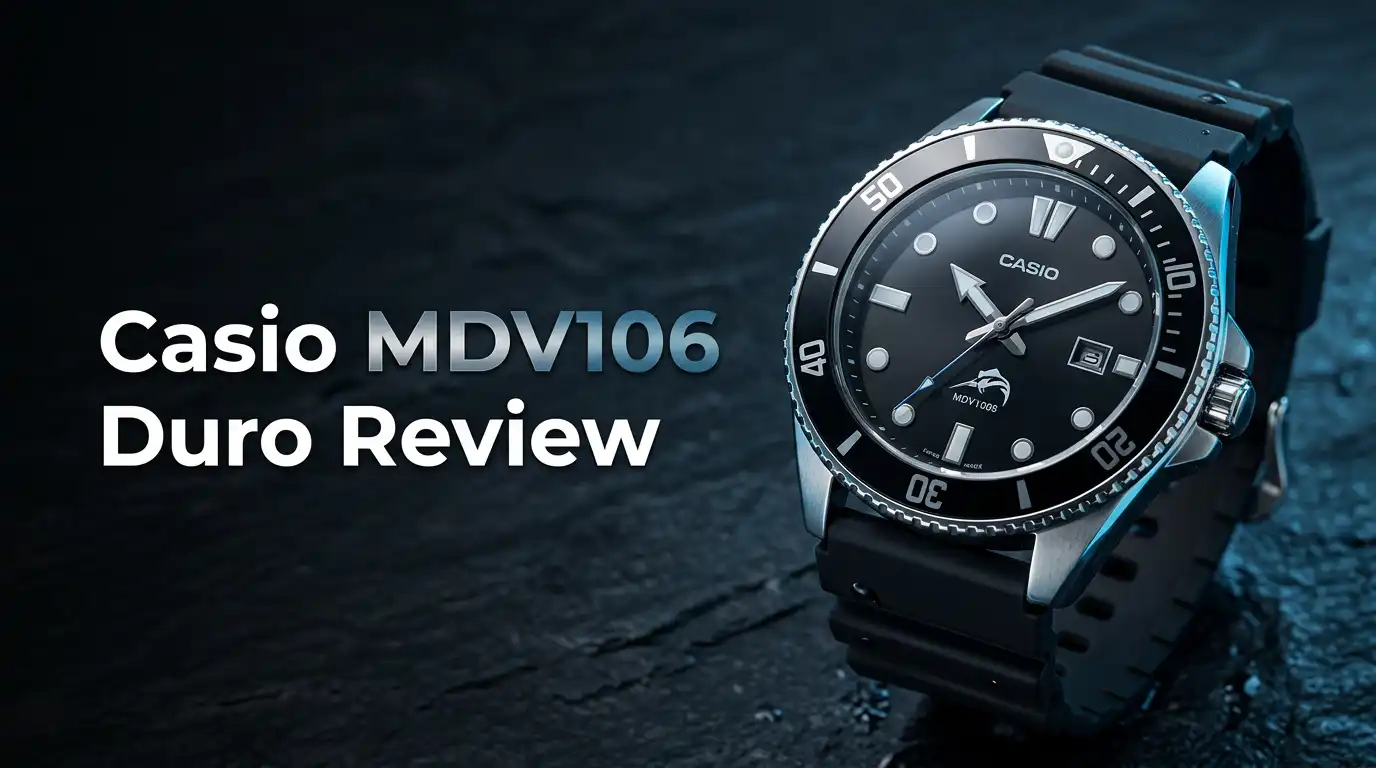
The Casio MDV106 is an analog dive style watch that Casio released years ago and never stopped selling. Fans nicknamed it the “Duro,” which means tough in Italian and Spanish. Others call it the “Marlin” because of the small fish engraved on the caseback and printed on the dial.
The watch follows the classic skin diver formula. It has a black dial, a unidirectional rotating bezel, large luminous markers, and a date window at three o’clock. The design clearly borrows from vintage dive watches, and Casio makes no secret of that.
What sets the Duro apart is the specification sheet. A 200m water resistance rating with a screw down crown at this price point is unusual, and that combination built the watch its reputation.
Unboxing the Casio MDV106 Duro
Do not expect ceremony. The Duro arrives in a small cardboard box with a plain plastic cradle inside. There is no leather pouch, no travel case, and no collector style packaging. You get the watch, a folded instruction sheet, and a warranty card.
The watch itself is wrapped in a thin plastic film across the caseback and crystal. Peeling it off reveals the first surprise. The case has a brighter polish than the photos suggest, and it catches light more than expected for a tool watch. The crown arrives screwed down, so you must unscrew it before setting the time.
The stock strap is curled tightly from packaging. It takes a day or two of wear before it relaxes. The whole unboxing takes about thirty seconds, and that honestly suits the character of the watch.
Casio MDV106 Duro Specifications
Here is what you get on paper. The case measures 44mm in diameter, 12mm thick, and 48.5mm from lug to lug. The lug width is 22mm. Total weight sits near 92 grams on the resin strap, which drops or rises depending on your strap choice.
Inside sits the Casio 2784 quartz movement, a two hand plus sweep second design with a date complication. Expected battery life is about three years. The crystal is flat mineral glass, not sapphire. Water resistance is rated at 200m, or 20 ATM, backed by a screw down crown and a screw down caseback.
The bezel is a unidirectional 120 click aluminum insert. Casio does not list the lume type, which tells you something about its quality. Nothing here is exotic, and that is the point.
Design, Dial, and Legibility
The dial does its job. Large applied markers sit against a dark sunburst background, and the contrast makes reading the time effortless. The hour and minute hands are wide enough to spot from across a room. A red tipped second hand adds a small splash of color and makes the watch feel alive.
The flat mineral crystal helps here. Flat glass produces less distortion than domed crystal, so the dial stays readable at sharp angles. Text on the dial is minimal, which keeps the look clean. The marlin logo above six o’clock is the signature detail, and it is the reason this exact model is hard to find in some European markets.
The date window integrates neatly at three o’clock without cutting into a marker. Small design choices like that explain why the watch punches above its price.
Top 3 Alternatives for Casio MDV106 Duro

Last update on 2026-10-27 / Affiliate links / Images from Amazon Product Advertising API
Casio MDV107 Dive Watch

Last update on 2026-10-27 / Affiliate links / Images from Amazon Product Advertising API
Invicta Pro Diver 8926OB Automatic

Last update on 2026-10-27 / Affiliate links / Images from Amazon Product Advertising API
Seiko 5 Sports SRPD55 Automatic
Case, Bezel, and Build Quality
The stainless steel case feels solid in hand. There is no hollow rattle and no creaking when you squeeze it. Finishing is simple, mostly polished surfaces with light brushing, and it lacks the crisp edges you find on watches costing four times more. That is a fair trade.
The bezel action is the pleasant surprise. Each click lands with a firm snap, and alignment on most units is accurate. Some owners report slight back play, where the bezel wiggles a fraction between clicks. Mine had a small amount, and it never bothered me.
A few buyers report stiff or stuck bezels straight out of the box. Trapped debris or tight tolerances usually cause this. Rinsing the bezel edge under warm water often frees it. If it stays stuck, return it rather than forcing it.
Movement and Timekeeping Accuracy
The Casio 2784 quartz movement handles the heavy lifting. Rated accuracy sits near plus or minus 20 seconds per month, and real world results often beat that. Over three weeks my sample gained roughly four seconds total. That is better than any mechanical watch at ten times the cost.
Quartz brings a second advantage. The second hand hits every marker cleanly, a detail many expensive automatics fail to deliver. It looks sharp and feels precise.
Battery life runs about three years, and replacement costs a few dollars at any watch counter. Because the caseback screws down, ask the technician to reseal it properly if you plan to swim with the watch afterward. Skipping that step is the most common way owners ruin the water resistance.
Water Resistance and Real World Diving
The 200m rating is genuine, backed by the screw down crown and screw down caseback. You can swim, snorkel, shower, and surf without worry. Recreational scuba diving is within the capability of the hardware.
That said, the Duro carries no ISO 6425 dive certification. Professional divers should not rely on it as a primary timing instrument, mostly because of the lume problem covered below. As a backup timer or a beach watch, it performs well.
Always check that the crown is fully screwed down before water contact. An unscrewed crown turns a 200m watch into a paperweight in seconds. Also rinse the watch with fresh water after saltwater exposure, since salt crystals attack the bezel mechanism and the strap springbars over time.
Lume Performance: The Weakest Link
Here is the honest problem. The Duro’s luminous paint charges quickly under bright light and glows well for the first few minutes. Then it fades. By the middle of the night you cannot read the dial at all.
The lume also covers only the center portion of each marker, with bare metal surrounding it. That reduces the glowing surface area and makes the dial look dimmer than the marker size suggests. The bezel pip holds lume, but it suffers the same fade.
For a watch marketed on dive credentials, this is the clearest corner Casio cut. Competing watches from Seiko use LumiBrite, which stays readable for hours. If you need night legibility, the MDV107 version offers noticeably brighter indices, and several owners prefer it for that single reason.
The Stock Strap Problem
Nearly every Duro review mentions the strap, and the complaint is deserved. The supplied resin band is stiff, slightly tacky to the touch, and it attracts dust and lint. It also tends to fold awkwardly around smaller wrists instead of curving smoothly.
Most owners swap it within the first week. The good news is that the 22mm lug width is common, so replacement options are plentiful and cheap. NATO straps, silicone bands, leather, and steel bracelets all work well.
A curved end rubber strap transforms the watch and removes the gap between the lugs and the band. Budget around $15 to $25 for a decent upgrade. When you add that to the watch price, the Duro still lands under $80 total, which remains strong value.
What the Casio MDV106 Duro Does Not Do Well
Let me list the shortcomings plainly, because they matter.
The mineral crystal scratches. It resists everyday scuffs but gouges deeply on hard impacts, and it cannot match sapphire. The case finishing looks cheap under close inspection, with soft edges and uneven polish transitions. The lume fails after minutes rather than hours.
The watch is also genuinely large. At 44mm wide with a 48.5mm lug to lug measurement, it overhangs wrists under about 6.5 inches. Quality control varies too, and bezel alignment or stiffness complaints appear regularly in owner forums.
Finally, the marlin dial version has limited availability in Europe and the UK due to trademark issues, so buyers there often import from the United States or settle for the logo free version.
Casio MDV106 vs MDV107: Which One?
Casio sells two closely related models, and the choice confuses new buyers. The MDV106 carries the marlin logo on the dial and the engraved fish on the caseback. The MDV107 drops the marlin branding and ships with different bezel color options, including the popular black and blue version people call the Batman.
The practical difference is the lume. Owners who compared both side by side report that the MDV107 indices glow noticeably brighter at first. Case dimensions, movement, and water resistance stay identical between the two.
Choose the MDV106 if you want the classic marlin character. Choose the MDV107 if night legibility matters more or if you prefer the two tone bezel. Both sit in the same price bracket, so pick on looks and lume.
Pros and Cons of the Casio MDV106 Duro
Pros
- Genuine 200m water resistance with a screw down crown and caseback, which is rare under $60
- Excellent legibility thanks to high contrast markers and a flat mineral crystal
- Accurate quartz movement rated near 20 seconds per month with roughly three years of battery life
- Satisfying unidirectional bezel with 120 clicks and generally good alignment
- Solid stainless steel case that handles knocks without complaint
- Common 22mm lug width makes strap swaps cheap and easy
- Strong modding community with aftermarket sapphire crystals and bezel inserts available
Cons
- Weak lume that fades within minutes, which undermines its dive watch purpose
- Stiff, lint attracting stock strap that most owners replace immediately
- Mineral crystal gouges on hard impact and cannot match sapphire durability
- Large 44mm case overwhelms wrists under 6.5 inches
- Inconsistent quality control, with occasional stiff bezels or slight misalignment
- No ISO dive certification despite the 200m rating
- The marlin dial version is hard to buy in parts of Europe
Modding Potential and Upgrades
The Duro has become a favorite platform for entry level watch modding. Because the watch costs so little, owners feel comfortable opening it up and experimenting.
The most popular upgrade is a sapphire crystal, often with a blue antireflective coating. It costs around $20 to $30 and removes the scratch worry completely. Owners consistently say it adds visual depth and makes the watch look far more expensive.
The second common mod is a ceramic or aluminum bezel insert. Swapping the stock insert for a blue, green, or Pepsi style version changes the whole personality of the watch. Hand swaps and dial changes are possible too, though they require more skill.
None of this is required. The Duro works perfectly as it arrives. The point is that it rewards tinkering without financial risk.
Who Should Buy the Casio MDV106 Duro?
Last update on 2026-10-27 / Affiliate links / Images from Amazon Product Advertising API
This watch suits several types of buyer. First time collectors get a proper dive style watch without spending real money, and it teaches them what they like before a bigger purchase. Active wearers who garden, fish, work with tools, or swim regularly get a beater they will not mourn.
Travelers also benefit, since losing a $50 watch on a beach stings far less than losing a $500 one. Modders get an affordable canvas.
Who should skip it? People with wrists under 6.5 inches will find it oversized. Anyone who needs reliable night time legibility should look at a Seiko with LumiBrite instead. Buyers who want refined finishing and sapphire glass out of the box should budget more.
Final Verdict: Is It Still Worth It in 2026?
Yes, with clear eyes about the limitations. The Casio MDV106 Duro remains one of the strongest value propositions in watches. The specification sheet alone justifies the price, and the build quality exceeds what the cost suggests.
The hype is mostly earned. This is a watch you can wear without thinking, which is a rare quality. It handles water, impacts, and daily abuse without drama.
The lume failure is the one flaw that genuinely matters, and the stock strap is an annoyance you will fix within a week. Neither problem is expensive to work around.
Buy it, swap the strap, and enjoy it. For somewhere around $50, nothing else delivers this combination of toughness, accuracy, and honest dive watch character.
Frequently Asked Questions
Is the Casio MDV106 Duro a real dive watch?
It has genuine 200m water resistance with a screw down crown and caseback, so it handles swimming, snorkeling, and recreational diving. It lacks ISO 6425 certification, and the weak lume makes it unsuitable as a professional diving instrument. Treat it as a capable water sports watch rather than certified dive equipment.
How long does the Casio Duro battery last?
Expect roughly three years from the standard battery. Replacement costs only a few dollars, but ask a technician to properly reseal the screw down caseback and test the gaskets if you plan to keep swimming with it afterward.
What size wrist fits the Casio MDV106?
The case measures 44mm wide with a 48.5mm lug to lug span. Wrists measuring 6.75 inches and above wear it comfortably. Smaller wrists will find it noticeably oversized, and the stock strap makes that worse.
Can I replace the strap on the Casio Duro?
Yes, easily. The lug width is 22mm, which is a common size. NATO straps, silicone bands, leather, and steel bracelets all fit. Most owners consider a strap swap the single best upgrade for the watch.
Does the Casio MDV106 have sapphire crystal?
No. It ships with flat mineral glass, which resists light scratches but gouges on hard impact. Aftermarket sapphire crystals cost around $20 to $30 and are a popular upgrade among owners.
Why is the Casio MDV106 hard to find in Europe?
The marlin logo on the dial creates a trademark conflict in certain markets, so the branded version is not officially distributed there. European buyers often import from the United States or choose the logo free MDV107 instead.

Hi, I’m Lucy Jones, a dedicated watch enthusiast and reviewer. I spend my time hunting down, testing, and evaluating the most intriguing wristwatches on the market. My goal is to guide you through the overwhelming choices with honest, hands-on insights into every timepiece.