Withings ScanWatch 2 Review 2026: Still Worth It?
The smartwatch shelf in 2026 is crowded with bright screens that beg for a charger every night. The Withings ScanWatch 2 ignores that trend completely.
It looks like a proper analog watch, it hides a tiny grayscale screen inside the dial, and it runs for roughly a month between charges. That combination still feels rare, and it still turns heads at the dinner table.
This review covers the unboxing, the daily wear, the sleep data, the honest weak spots, and the alternatives worth a second look. Read on before you tap buy.
In a Nutshell:
- Battery life is the headline. Withings now rates the watch at up to 35 days on a single charge, and real users commonly report around 25 to 30 days with normal use. A full recharge takes roughly two hours.
- The health sensor list is genuinely deep. You get a 1 lead ECG cleared by the FDA for atrial fibrillation detection, SpO2 readings, 24/7 body temperature through the TempTech24/7 module, overnight HRV, respiratory tracking, and cycle tracking.
- Build quality punches above the price. Stainless steel case, sapphire crystal glass, a tactile steel crown, and 5 ATM water resistance in 38mm and 42mm sizes.
- Smart features are deliberately thin. No touchscreen, no music control, no contactless payments, no onboard GPS, and no way to reply to messages. Notifications scroll across a tiny 0.63 inch grayscale OLED panel.
- Step counting and sleep detection are not flawless. Several owners report undercounted steps and occasional missed sleep sessions, so treat the numbers as trends rather than gospel.
- Withings+ costs extra. The core app is free. Coaching, readiness scoring, and cardiologist ECG review sit behind a $9.95 monthly or $99.50 yearly plan.
Withings ScanWatch 2


Last update on 2026-10-27 / Affiliate links / Images from Amazon Product Advertising API
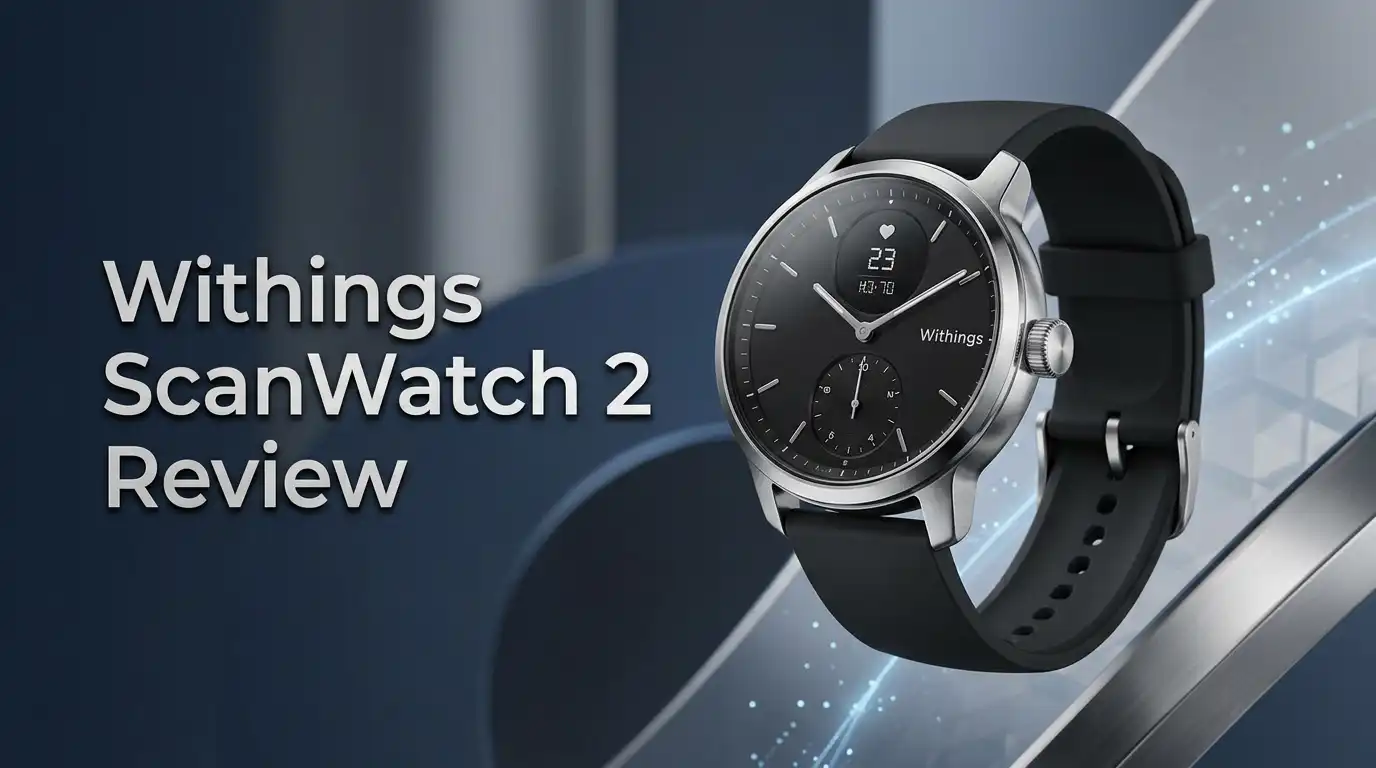
The ScanWatch 2 is a hybrid smartwatch built around a classic watch body. Two physical hands sweep across a domed dial. A small subdial tracks your daily step goal as a percentage. Above the center sits a round grayscale OLED window measuring 0.63 inches with 282 PPI, which wakes when you twist the crown or raise your wrist.
Withings built this watch in Paris, and the attention to proportion shows. The case comes in 38mm and 42mm, weighing 34.6 grams and 52.6 grams without the strap. Sensors include a 16 channel multi wavelength PPG array, a high dynamic range accelerometer, an altimeter, and the temperature module.
Bluetooth Low Energy handles syncing, and the watch pairs with iOS 18 or Android 12 and newer. There is no Wi Fi and no cellular radio, which is exactly how it stretches the battery so far.
The Unboxing Experience
The box is small, flat, and white, with a clean product photo on the lid. Lifting it reveals the watch seated face up in a molded tray, hands already ticking in demo mode. It feels more like opening a jewelry purchase than a gadget, and that first impression matters at this price.
Underneath the tray you find the charging dock, a USB cable, a quick start leaflet, and the fluoroelastomer sport strap already fitted. The strap uses 20mm quick release pins, so swapping it for leather or a metal link takes about ten seconds and no tools.
Setup took me under five minutes. You download the Withings app, scan the code shown on the tiny screen, and follow a short tutorial. The watch then syncs and starts tracking immediately. No account juggling, no firmware wait of any real length.
Design and Build Quality on the Wrist
This is where the ScanWatch 2 earns its keep. The stainless steel case has brushed sides and polished edges, so it reads as a real timepiece from any distance. Sapphire crystal covers the dial, and after weeks of desk edges and door frames mine stayed free of scratches.
The watch sits flatter than the original ScanWatch, which makes a real difference under a shirt cuff. The 38mm version suits slim wrists beautifully, while the 42mm feels substantial without being heavy. Water resistance is rated at 5 ATM, or 50 meters.
Withings says that covers swimming. Still, a number of owners have reported condensation inside the case after hot showers, so I keep mine off in the bathroom. Steam and seals rarely get along, regardless of the rating on the spec sheet.
Top 3 Alternative for Withings ScanWatch 2
No products found.
Withings ScanWatch Nova

Last update on 2026-10-27 / Affiliate links / Images from Amazon Product Advertising API
Withings ScanWatch Light
No products found.
Garmin vivomove Trend
Display and Daily Controls
The grayscale OLED panel is small by design. It shows the date, heart rate, step count, SpO2 result, timers, and incoming notifications in crisp white text. Brightness holds up in sunlight, which surprised me.
Control happens entirely through the crown. Twist to scroll, press to select, hold for the menu. There is no touchscreen at all. Haptic feedback is firm and easy to feel through a sleeve. You can also assign shortcuts so your favorite measurement sits one click away.
The system is simple enough that my father figured it out without instructions, which says something. The honest downside is speed.
Scrolling a long notification feels slow, and reading more than two lines of a message is tedious. This watch tells you something arrived. It does not let you deal with it.
Health Sensors: ECG, SpO2 and Temperature
The medical side is the real reason people choose Withings. The ECG app is cleared by the FDA under 510(k) K240795 to detect atrial fibrillation from a single lead reading.
In classifiable recordings it identifies AFib with 99.7% sensitivity and normal sinus rhythm with 99.8% specificity. You take a reading by resting two fingers on the bezel for 30 seconds.
SpO2 spot checks run on demand or overnight. The TempTech24/7 module uses multiple sensors to log skin and ambient temperature continuously, then plots deviations from your personal baseline.
That baseline approach is the right one, because absolute skin temperature means very little on its own. Withings states clearly that this is not a clinical thermometer and should not be used to detect fever. Treat the data as an early signal that something feels off, then confirm it properly.
Sleep Tracking Performance
Sleep is where the ScanWatch 2 produces its most useful output. It logs duration, regularity, sleep stages, interruptions, overnight heart rate, HRV, breathing disturbances, and a nightly sleep score. The morning summary in the app is clean and quick to read.
Accuracy against my own notes was reasonable for duration and bedtime, though stage detection drifts, as it does on nearly every wrist worn device. The bigger complaint comes from owners who report the watch occasionally stopping sleep tracking in the early hours, producing a short or missing night.
It has happened to me twice in several weeks. Comfort is another factor. A steel watch is bulkier in bed than a smart ring, and side sleepers will notice it. Swapping to the soft sport strap helps more than you might expect.
Fitness and Workout Tracking
Set expectations here. The ScanWatch 2 counts steps, active minutes, elevation, calories, and estimates VO2 max as a fitness level score. It recognizes walking, running, and swimming automatically, and it offers a modest list of workout modes you start from the crown.
There is no onboard GPS. The watch borrows your phone signal for distance, pace, and route, which works fine on a jog with your phone in a pocket and not at all without it. Step counting is the weakest link.
Some users report counts well below reality, especially during pushing motions like a stroller or a shopping cart. Serious runners and cyclists will find the data shallow compared with a Garmin or a Polar. For everyday movement goals and general activity trends, though, it does the job without fuss.
Battery Life and Charging
This is the specification that sells the watch. Withings now advertises up to 35 days per charge after recent firmware improvements. My experience landed closer to 26 days with frequent notifications, nightly tracking, and a few connected GPS runs. That is still extraordinary.
Charging runs through a small docking station with a USB cable, and a full top up takes about two hours. The dock is the weak point. It is light, the magnetic hold is gentle, and a nudge can knock the watch loose halfway through. Place it somewhere stable and check it.
There is also a battery saver mode that strips back sensors when you are running low. Compared with a daily charge routine, going a month without thinking about power genuinely changes how you live with a watch.
Withings App and the Withings+ Subscription
The Withings app is one of the better health apps available. The layout splits into Home, Measure, and Achieve. Data loads fast, charts are readable, and the app shares cleanly with Apple Health, Google Health Connect, Strava, and others.
You do not need a subscription. All core measurements, history, and exports stay free forever, which deserves applause in 2026. Withings+ costs $9.95 monthly or $99.50 yearly and adds a Health Assistant, a readiness score, guided programs, a nutritionist consultation, and cardiologist review of your ECG recordings within 24 hours.
The cardiology review is the standout feature for anyone with a heart rhythm concern. For everyone else, the extras feel pleasant rather than necessary. Try the free month, then decide honestly whether you opened those screens.
Pros and Cons
Pros
- Outstanding battery life of roughly 25 to 35 days per charge, with a two hour recharge.
- Genuinely elegant design using stainless steel, sapphire crystal, and two case sizes.
- FDA cleared ECG with strong published accuracy figures for atrial fibrillation.
- Continuous temperature tracking that improves sleep and cycle insights.
- Free core app with no paywall on your own health data.
- Simple operation that suits people who dislike fiddly interfaces.
Cons
- No touchscreen, payments, music control, call answering, or reply options.
- No built in GPS, so distance accuracy depends on carrying your phone.
- Step counts can read low, sometimes noticeably so.
- Occasional sleep tracking dropouts reported by owners and seen in testing.
- High upfront price next to feature rich rivals costing less.
- Flimsy charging dock that disconnects if bumped.
What the ScanWatch 2 Does Not Do Well
Honesty matters more than enthusiasm in a review, so here are the real frustrations. The notification system is close to useless for anything longer than a sentence. You cannot respond, dismiss intelligently, or act on what arrives. You will still reach for your phone every time.
The tiny analog subdial that shows step progress is charming but hard to read at a glance, especially in low light. Sensor consistency is the deeper issue.
Temperature trends sometimes show odd spikes, SpO2 spot readings occasionally fail and need a retry, and the step counter underreports for some users.
Finally, there is no altimeter driven floor count worth trusting, no fall detection, and no emergency SOS. If you want a safety device, this is not it.
Who Should Buy the ScanWatch 2 in 2026
Buy this watch if you want health monitoring without the look and lifestyle of a tech gadget. It suits professionals who wear formal clothing, travelers who hate packing chargers, and people over 40 who care about heart rhythm, sleep quality, and long term trends.
It also suits anyone tired of charging a smartwatch every evening. The person who should skip it is the data hungry athlete. If you train with structured intervals, need accurate pace without a phone, or want maps on your wrist, a Garmin Forerunner or a Venu delivers far more for similar money.
Equally, if you want payments, voice assistants, and apps, an Apple Watch or a Galaxy Watch will serve you better. Know which camp you sit in before spending.
Price and Value Verdict
The ScanWatch 2 lists at $369.95 on Withings and on Amazon, with the 38mm and 42mm versions priced the same.
It qualifies as HSA and FSA eligible in the United States, which quietly reduces the real cost for many buyers. The package includes the watch, a sport strap, the dock, cables, and a two year warranty.
Is it good value? That depends on how much you weigh design and battery life. Feature for feature, cheaper watches beat it. Design for design, almost nothing comes close in this category now that most brands abandoned hybrids.
I would call it fairly priced rather than a bargain, and I would wait for a seasonal discount, since the watch regularly dips below list during sale events. At that lower price it becomes easy to recommend.
Frequently Asked Questions
Does the Withings ScanWatch 2 need a subscription?
No. Every measurement the watch takes appears in the free Withings app with full history. Withings+ at $9.95 monthly or $99.50 yearly adds coaching, readiness scoring, and cardiologist ECG review, but it remains entirely optional.
How long does the battery really last?
Withings rates it at up to 35 days. Most owners see 25 to 30 days with notifications and nightly sleep tracking active. Heavy use of connected GPS and frequent ECG readings shortens that. Recharging takes about two hours.
Can you swim with the ScanWatch 2?
Yes. The watch carries a 5 ATM rating, equal to 50 meters, and it tracks swimming automatically. Some owners report condensation inside the case after showers, so avoid hot steam and rinse the watch in fresh water after pool or sea use.
Does it have GPS built in?
No. The ScanWatch 2 uses connected GPS from your phone. You get distance, pace, elevation, and a route map only when your phone travels with you.
Is the ECG feature accurate?
The Withings ECG app is cleared by the FDA to detect atrial fibrillation from a single lead recording, with 99.7% sensitivity for AFib and 99.8% specificity for normal sinus rhythm in classifiable readings. It does not detect heart attacks or other arrhythmias and it never replaces a doctor.
ScanWatch 2 or ScanWatch Light: which should I choose?
Choose the Light if you want heart rate, sleep, activity, and cycle tracking at a lower price. Choose the ScanWatch 2 if ECG, SpO2, and continuous temperature tracking matter to you. The sensor gap is the only meaningful difference.

Hi, I’m Lucy Jones, a dedicated watch enthusiast and reviewer. I spend my time hunting down, testing, and evaluating the most intriguing wristwatches on the market. My goal is to guide you through the overwhelming choices with honest, hands-on insights into every timepiece.