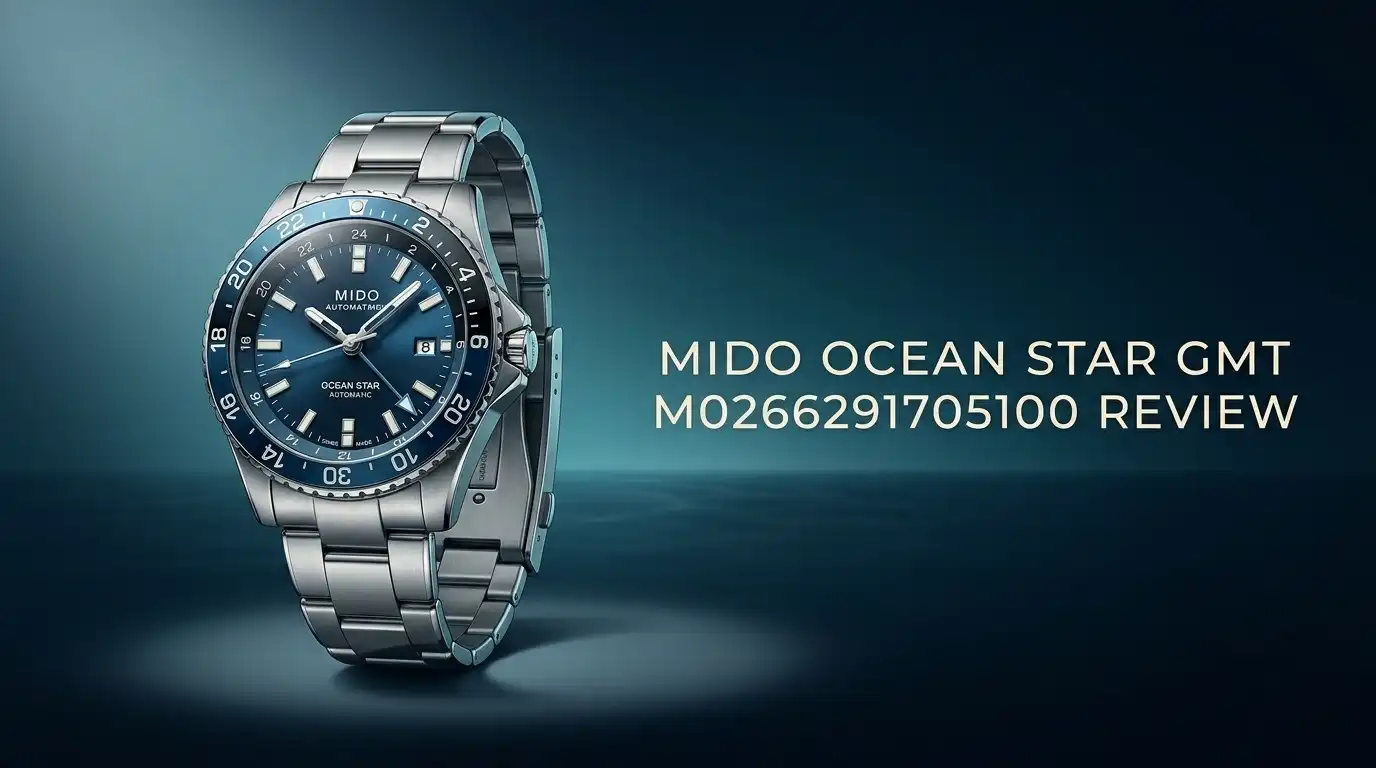
MIDO Ocean Star GMT M0266291705100 Review 2026: Worth Buying?
Swiss dive watches with a real traveler GMT hand used to cost a small fortune. The MIDO Ocean Star GMT changed that math.
This 44mm diver packs a flyer GMT movement, 200 meters of water resistance, and a ceramic bezel into a package that sells for far less than the famous names it borrows from.
I spent weeks with the black dial version on the blue fabric strap, reference M026.629.17.051.00. I wore it to work, in the shower, on a flight, and under a jacket sleeve that it barely cleared.
In a Nutshell:
- This is a true flyer GMT, not an office GMT. The 12 hour hand jumps independently in one hour steps. You change time zones without stopping the watch, and the date follows along. That feature normally lives in watches costing three times more.
- The MIDO Caliber 80 GMT delivers up to 80 hours of power reserve. Based on the ETA C07.661, it runs at 21,600 vibrations per hour. Leave it off your wrist Friday night and it still ticks Monday morning.
- The case measures 44mm wide and about 13.4mm thick, with 22mm lugs. It is a big watch. Wrists under 7 inches will feel it. On the steel bracelet the whole thing weighs roughly 205 grams.
- Water resistance hits 200 meters with a screw down crown. The unidirectional bezel uses a ceramic insert. This is a genuine dive watch, not a desk diver wearing a costume.
- Retail sits around $1,410 on the official MIDO site, but street prices run far lower. Grey market dealers often list it near $800 to $900. That gap is the real story of this watch.
- It is not perfect. The lume fades faster than Seiko lume, the 24 hour bezel scale crowds the dial, and the size blocks it from dress duty entirely.
First Impressions of the MIDO Ocean Star GMT


Last update on 2026-11-21 / Affiliate links / Images from Amazon Product Advertising API
The watch arrives looking serious. The black dial soaks up light, the orange GMT hand pops instantly, and the ceramic bezel throws a deep gloss that cheap aluminum inserts never match. My first reaction was simple surprise at the finishing quality.
MIDO alternates brushed and polished surfaces across the case. The lug tops are brushed. The chamfers are polished. The transition is clean and sharp under a loupe. This level of case work usually signals a higher price tag.
Then you pick it up. The heft registers immediately. This is a dense, substantial object that announces itself. Some people love that. Others put it down within a minute. Your reaction in the first ten seconds will probably predict how you feel after a year.
Unboxing the M026.629.17.051.00
The box is a sturdy cardboard outer sleeve covering a padded presentation case. Nothing extravagant. MIDO clearly spent the budget on the watch instead of the packaging, which I respect.
Inside you get the watch on its blue fabric strap, a warranty card, and the user manual for the Caliber GMT 80.661. Some retail channels also ship an extra rubber strap. Check your seller before you assume you get two.
The fabric strap is already fitted and sized, so you can wear the watch out of the box in under a minute. The pin buckle is signed. The strap smells faintly of fresh textile, which fades after a few days.
MIDO also runs a promotion through its own store offering a free watch winder with automatic purchases. That perk only applies to direct orders, not to third party sellers.
Dial Design and Legibility
The dial is layered more than most divers. You get applied stick markers, a date window at 3, a printed 24 hour track on the rehaut, and a long orange tipped GMT hand sweeping over all of it.
Legibility for local time is excellent. The hour and minute hands are wide, filled with lume, and clearly separated in length. Reading the time takes no effort at all.
Reading the second time zone takes slightly more work. The 24 hour scale uses small numerals in two tones. In dim light you may squint. This is the one spot where MIDO traded clarity for information density.
The Ocean Star logo and starfish motif sit under 12. MIDO keeps text minimal, which helps. The overall look reads sporty and purposeful rather than fussy.
Case Size, Thickness, and Wrist Feel
Here is the honest part. The case spans 44mm across, about 13.4mm thick, and roughly 51mm lug to lug. That is a large watch by any 2026 standard.
On my 7.25 inch wrist it sits flat and does not overhang, but it owns the whole wrist. Under a dress shirt cuff it catches constantly. Under a jacket sleeve it is a losing battle.
The lug curvature saves it. MIDO angled the lugs downward enough that the case hugs instead of teetering. Comfort is genuinely good once the strap is sized properly.
Weight is the other factor. On the steel bracelet you carry about 205 grams, which is a lot of metal. The fabric strap version drops that significantly and is the more comfortable daily option for most people.
Top 3 Alternative for MIDO Ocean Star GMT

Last update on 2026-11-21 / Affiliate links / Images from Amazon Product Advertising API
SEIKO SSK001 5 Sports GMT

Last update on 2026-11-21 / Affiliate links / Images from Amazon Product Advertising API
Certina DS Action GMT Powermatic 80

Last update on 2026-11-21 / Affiliate links / Images from Amazon Product Advertising API
Tissot Seastar 1000 Automatic 43mm
The Caliber 80 GMT Movement
The engine is the MIDO Caliber 80.661, built on the ETA C07.661 base. It measures 25.60mm wide and 5.77mm thick, carries 25 jewels, and beats at 21,600 vibrations per hour.
That beat rate is slower than the common 28,800. You see it in the seconds hand, which ticks six times per second instead of eight. Purists notice. Most owners never do.
The payoff is the power reserve. Up to 80 hours means you can rotate watches freely. Take it off Friday, pick it up Monday, and the time and date are still running.
The movement also uses a Nivachron balance spring in current production, which improves antimagnetic performance. For a watch at this price, the specification sheet punches above its weight.
True GMT vs Office GMT Explained
This distinction matters more than any other spec on the watch. An office GMT, sometimes called a caller GMT, has an independent 24 hour hand. You adjust the second time zone and leave the main time alone.
A true GMT, also called a flyer or traveler GMT, has an independent 12 hour hand. You land in a new country, pull the crown to the first position, and jump the hour hand forward or backward.
The seconds hand never stops, so you keep your accuracy. The date also flips correctly as the hour hand crosses midnight.
The MIDO Ocean Star GMT is a true flyer GMT. That puts it in the same functional category as watches costing several thousand dollars. If you actually travel, this is the single best reason to buy it.
Accuracy and Power Reserve in Daily Use
My sample ran about plus 6 seconds per day over two weeks of normal wear. That sits comfortably inside the typical ETA tolerance of minus 10 to plus 20 seconds.
Positional variance was mild. Dial up overnight pulled it closer to plus 3. Crown down pushed it to plus 9. Resting it dial up each night kept it near perfect across a month.
The power reserve claim held up. I set it down fully wound on a Sunday evening and it was still running Wednesday afternoon, roughly 68 hours later, before timekeeping drifted.
If you want tighter accuracy, a regulation service from a local watchmaker usually brings these movements inside plus or minus 3 seconds per day. That costs far less than buying a chronometer grade watch.
Bezel, Crystal, and Lume Performance
The unidirectional bezel uses a ceramic insert over a steel ring. The action is firm with 120 clicks. There is almost no back play, which is impressive at this price.
Turning it with wet hands works fine thanks to the deep coin edge grip. The ceramic has resisted scratches completely during my testing, including one unfortunate meeting with a door frame.
The crystal is sapphire with double sided antireflective treatment. Glare control is very good. You can read the dial in direct sun without tilting your wrist.
Lume is the weak point. The hands and markers charge fast and glow brightly for the first twenty minutes, then fade noticeably. By the middle of the night the dial is dim. Seiko and Citizen both do better here.
Strap, Bracelet, and Comfort Options
This reference ships on a blue fabric strap with a signed pin buckle. The textile is tightly woven, breathes well, and dries quickly after a swim. It is the main reason this version feels lighter than its siblings.
The 22mm lug width gives you endless aftermarket choice. Rubber, leather, NATO, and steel all work. A 22mm rubber strap transforms the watch into a summer piece for under forty dollars.
MIDO sells its own straps around $120, including blue rubber and grey options. They fit perfectly but cost more than third party equivalents.
If you buy the steel bracelet version instead, know that it uses pin and collar links. Resizing is doable at home but more annoying than screwed links. The clasp does include a dive extension.
Water Resistance and Real Dive Capability
Twenty bar means 200 meters, and MIDO backs that with a screw down crown and a screw down case back. This watch handles real water without drama.
I showered with it, swam laps with it, and took it into the ocean. No fogging, no moisture, no issues. The crown threads engage smoothly and lock down with a confident feel.
For recreational scuba the specification is more than adequate. The unidirectional bezel tracks elapsed bottom time exactly as a dive bezel should.
The case back carries engraved world time zone indications, which is a genuinely useful touch. Flip the watch over and you can check city references instead of pulling out your phone. It is a small detail that shows thought.
What This Watch Does Not Do Well
Honest reviews list the failures. Here they are. The size disqualifies it from formal wear. At 44mm wide and 13.4mm thick, it will never slide under a cuff gracefully.
The lume underperforms against Japanese competitors at half the price. If night legibility ranks high for you, look elsewhere.
The 24 hour bezel plus the 24 hour rehaut track creates visual clutter. Some owners find the dial busy, especially in the two tone colorways.
The weight on the bracelet tires some wrists during long days. The fabric strap solves it, but then you lose the steel look.
Finally, resale value is modest. MIDO does not hold value like Tudor or Omega. Buy this to wear it, not to flip it.
Pros and Cons
Pros
- True flyer GMT movement with an independently jumping 12 hour hand, a feature normally reserved for much pricier watches.
- Up to 80 hours of power reserve from the MIDO Caliber 80.661, so weekend rotation is effortless.
- 200 meters of water resistance with a screw down crown and genuine dive capability.
- Ceramic bezel insert with a firm 120 click action and strong scratch resistance.
- Sapphire crystal with double sided antireflective coating for excellent glare control.
- Engraved world time zone map on the case back adds real travel utility.
- Street prices often fall hundreds below the official retail figure.
Cons
- The 44mm case with 13.4mm thickness overwhelms smaller wrists and blocks dress use.
- Lume brightness fades faster than competing Japanese divers.
- The dial layout feels crowded because of the dual 24 hour scales.
- Bracelet version weighs around 205 grams, which is heavy for all day wear.
- Pin and collar bracelet links make resizing fiddly.
- Weak resale value compared with established luxury brands.
Price and Value in 2026
Last update on 2026-11-21 / Affiliate links / Images from Amazon Product Advertising API
Official MIDO pricing for this reference sits at $1,410. That is the number on the brand website. Almost nobody pays it.
Authorized dealers discount, and grey market sellers go further. Listings in the $800 to $950 range appear regularly from reputable online retailers. Preowned examples in mint condition trade lower still.
At $900 this watch is one of the strongest value propositions in Swiss watchmaking right now. You get a flyer GMT, ceramic, sapphire, 200 meters, and an 80 hour movement.
At full retail the case weakens, because the Certina DS Action GMT offers a similar movement in a smaller package. Shop the price before you shop the brand. The discount is where the value lives.
Who Should Buy This Watch
Buy it if you travel often and want a mechanical watch that tracks two time zones properly. The flyer function earns its keep every single trip.
Buy it if you have a wrist measuring 7 inches or larger and you like substantial watches. The size that bothers some owners is exactly what others want.
Buy it if you swim, dive, or work around water. The 200 meter rating and screw down crown handle anything short of saturation diving.
Skip it if you need one watch for everything, including suits and formal events. It simply will not work there. Skip it if you prize bright overnight lume. Skip it if you want a watch that holds resale value.
Final Verdict
The MIDO Ocean Star GMT M026.629.17.051.00 does one thing better than almost anything in its price class. It gives you a genuine traveler GMT in a capable Swiss dive watch for well under a thousand dollars on the street.
The compromises are real. It is big, it is heavy on steel, and the lume disappoints. None of those flaws touch the core function.
I rate it 4.3 out of 5. The score would be higher at 42mm with better lume. As it stands, it remains one of the smartest mechanical watch purchases available to travelers who like a bold wrist presence.
Frequently Asked Questions
Is the MIDO Ocean Star GMT a true GMT?
Yes. It uses the MIDO Caliber 80.661, which has an independently jumping 12 hour hand. You can change local time without stopping the movement, and the date advances correctly with it.
How big is the MIDO Ocean Star GMT on the wrist?
The case is 44mm wide, roughly 13.4mm thick, and about 51mm lug to lug with 22mm lug width. It suits wrists of 7 inches and above best.
What movement powers this watch?
The MIDO Caliber 80.661, based on the ETA C07.661. It runs at 21,600 vibrations per hour with 25 jewels and delivers up to 80 hours of power reserve.
Can you dive with the Ocean Star GMT?
Yes. It carries 200 meters of water resistance, a screw down crown, and a unidirectional bezel. That covers swimming, snorkeling, and recreational scuba diving.
How accurate is the MIDO Ocean Star GMT?
Expect roughly minus 10 to plus 20 seconds per day from the factory. My sample ran about plus 6 seconds daily. A regulation service can tighten that considerably.
Does the watch come with extra straps?
The M026.629.17.051.00 ships on a blue fabric strap. Some sellers and some special editions include a second strap, so confirm with your retailer before ordering.
Is it worth buying over a Seiko 5 Sports GMT?
The MIDO offers Swiss build, sapphire, ceramic, 200 meter water resistance, and a flyer GMT. The Seiko costs much less but uses a caller GMT and Hardlex crystal. Choose based on budget and travel needs.

Hi, I’m Lucy Jones, a dedicated watch enthusiast and reviewer. I spend my time hunting down, testing, and evaluating the most intriguing wristwatches on the market. My goal is to guide you through the overwhelming choices with honest, hands-on insights into every timepiece.