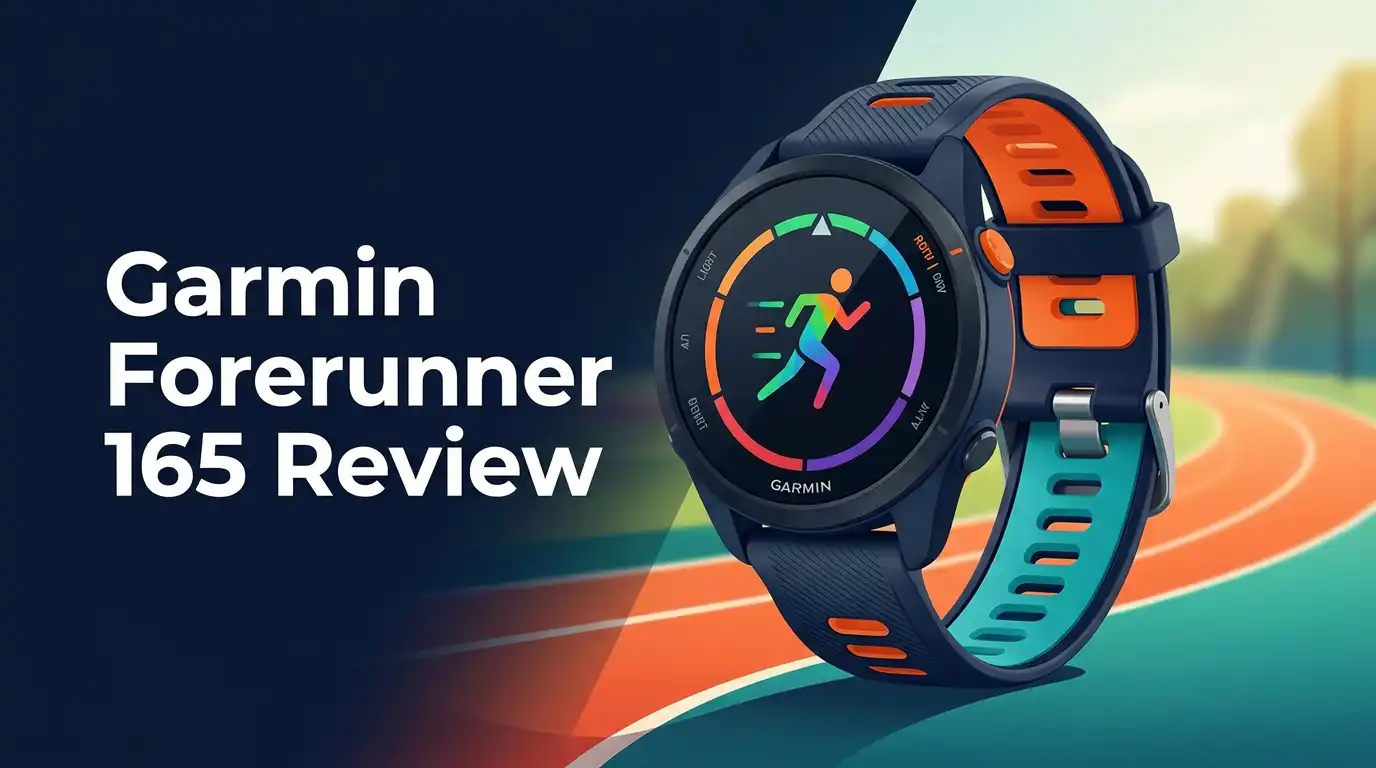
Garmin Forerunner 165 Review 2026: Still Worth It?
The Garmin Forerunner 165 arrived in February 2024 as the cheapest Forerunner with an AMOLED screen, and two years later it is still sitting in shopping carts everywhere. That says something.
Most budget running watches fade fast. This one kept selling because it does the main job well: it tracks your run accurately, it looks good doing it, and it does not ask you to pay for features you will never touch.
The question is whether the older model, now heavily discounted, beats the shiny new one at full price. I wore the 165 through long runs, treadmill sessions, bad sleep, and a few lazy weeks. Here is the honest answer.
In A Nutshell:
- The price is the whole story in 2026. The 165 launched at $249.99. It now regularly drops to around $199, and the Music edition has fallen from $299.99 to roughly $225. That makes it one of the best value running watches you can buy right now.
- The display punches far above the price. You get a 1.2 inch AMOLED touchscreen at 390 x 390 pixels. It is bright, sharp, and readable in direct sunlight. It also keeps five physical buttons, so you never have to touch the screen if you hate touchscreens.
- Battery life is honest, not inflated. Garmin claims up to 11 days in gesture mode and 19 hours of GPS. Real world testing lands close to that. Switch the display to always on and you drop to about 4 days.
- GPS accuracy is genuinely excellent. The 165 lacks multiband GPS, yet it matched watches that cost three times more in city street tests with tall buildings.
- It is missing real training analysis. No Training Status, no Training Load, no Training Readiness, and no triathlon mode. Serious data nerds will feel the gap within a month.
- The heart rate sensor is older tech. It uses Garmin Elevate V4, not V5, so there is no ECG and no wrist temperature sensing.
Garmin Forerunner 165: Quick Verdict


Last update on 2026-10-27 / Affiliate links / Images from Amazon Product Advertising API
The Forerunner 165 is a running watch first and a smartwatch second. Garmin built it for people who run three to five times a week and want clear data without a spreadsheet obsession. It weighs 39 grams, uses a standard 20mm strap, and includes Garmin Pay on every edition.
The core running experience is nearly identical to watches costing twice as much. During a run you get unlimited custom data pages, up to four data fields per page, running power, running dynamics, pace alerts, heart rate alerts, and structured workouts. Mid run, you honestly cannot tell this apart from a Forerunner 265.
Where it pulls back is after the run. The deeper training analytics stay locked behind pricier models. That is the trade. For most runners, it is a fair one.
Unboxing Experience: What Arrives In The Box
The box is small, flat, and recycled cardboard. Garmin stopped making unboxings feel premium years ago, and this one is no exception. Lift the lid and the watch sits face up in a paper tray, screen protected by a thin film with a pull tab.
Underneath you find three things: the charging cable, a tiny folded quick start guide, and a safety leaflet. That is it. No extra strap, no screen protector, no charging block. The cable uses Garmin’s standard four pin connector, so if you already own a Garmin, your old cable works fine.
First impression on the wrist is lightness. At 39 grams it feels like a plastic toy for about ten minutes, then you stop noticing it entirely. The screen wakes instantly and the colors pop. Setup through the Garmin Connect app takes roughly eight minutes.
Design And Build Quality: Plastic Done Right
The case is fiber reinforced polymer. The bezel is plastic. The screen is glass, not sapphire. Garmin made the cheap choices where you cannot see them and spent money where you can.
You get five buttons: three on the left for menu movement, two on the right for start, stop, lap, and back. Every single function works through buttons alone. You can disable the touchscreen completely and lose nothing. By default, touch switches off during activities so sweat and rain do not trigger random taps.
The 20mm quick release strap is the unsung hero here. You can swap it for any standard band, which means cheap replacements and endless style options. The silicone strap that ships with it is soft, breathable, and survives daily showers without stiffening. Water rating is 5 ATM.
Top 3 Alternatives For Garmin Forerunner 165

Last update on 2026-10-27 / Affiliate links / Images from Amazon Product Advertising API
Garmin Forerunner 265

Last update on 2026-10-27 / Affiliate links / Images from Amazon Product Advertising API
COROS PACE 3

Last update on 2026-10-27 / Affiliate links / Images from Amazon Product Advertising API
Garmin Forerunner 55
AMOLED Display Performance: The Big Upgrade
This screen is the reason the 165 exists. Garmin had been shipping memory in pixel displays on budget Forerunners for years, and they looked dated next to a $100 Fitbit. The 1.2 inch AMOLED fixes that completely.
Default behavior is gesture mode. The screen turns on when you raise your wrist and sleeps when you drop it. You can switch to always on, where the display dims instead of sleeping, at a heavy battery cost.
Night behavior deserves specific praise. The watch drops into a much dimmer sleep mode, so rolling over at 3am does not blast light into your face. Few watches handle this well.
There is also a flashlight with three white brightness levels and one red setting. It lives in the controls menu. Annoyingly, you cannot activate it with a double tap like pricier Garmins allow.
Battery Life: Real World Numbers
Garmin’s claimed figures hold up better than most brands, and the 165 is no exception. Here is what the official chart promises and what actually happens.
Smartwatch mode reaches up to 11 days with gesture display. Always on display cuts that to about 4 days, and testing with one to two hours of daily GPS confirmed that figure. Battery saver mode stretches to 20 days.
For activities, GPS only mode gives up to 19 hours. All systems GNSS mode gives 17 hours. Add music playback and it collapses to 7 hours on GPS only, or 6.5 hours with all systems.
Many owners report 6 to 7 days rather than 11. That is normal. Frequent notifications, pulse oximetry, and bright screen settings all drain it faster. Charging from empty takes roughly one hour.
GPS Accuracy: Better Than It Should Be
The 165 uses multi GNSS satellite tracking but not multiband, also called dual frequency. On paper that is a downgrade compared to rivals at the same price. In practice, it barely matters.
Independent testing in a downtown area with 30 story buildings put the 165 against a Forerunner 965, an Apple Watch Ultra 2, and a COROS PACE 3, all with multiband enabled. The 165 matched them. On one pass, the Apple Watch wandered off course while the 165 stayed correct.
On trails and switchbacks under tree cover, tracks looked virtually identical to a $1,500 Garmin Tactix. Corner cutting was minimal and the watch even kept the right side of the street on turns.
Satellite lock is quick outdoors. Some owners reported slow locks after certain firmware updates, which Garmin has generally patched.
Heart Rate Accuracy: Good, Not Perfect
The 165 carries Garmin’s Elevate V4 optical sensor. This is the same unit found in the Fenix 7, Epix, and Forerunner 255 and 265 series. It is proven, but it is also old.
Steady state running is where it shines. Long easy runs track within a beat or two of a chest strap for most of the session. Sharp intervals are where it stumbles. During 10 by 1 minute repeats, the sensor lagged on a couple of builds and recoveries, and the warm up period was messy.
Cold weather makes it worse. Starting a hard effort with zero warm up can take the sensor eight minutes to catch up.
Because it is V4 and not V5, there is no ECG app and no wrist temperature. If you want those, look at newer models. For intervals, pair a chest strap over ANT+ or Bluetooth.
Running Features And Garmin Coach
This is the strongest part of the watch. Garmin Coach gives you free adaptive training plans for 5K, 10K, and half marathon distances, written by real coaches, and the plan adjusts as your fitness changes.
Daily Suggested Workouts generate automatically based on a race goal on your calendar or just general improvement. Put a marathon in your calendar and the watch builds a balanced mix of base runs, intervals, and long runs. You pick which day your long run lands on.
You also get VO2 Max estimates and race predictors for 5K, 10K, half marathon, and marathon. Sport profiles cover running, trail running, ultra running, track run, treadmill, hiking, cycling, pool and open water swimming, strength, yoga, HIIT, pickleball, padel, and more.
Courses work as breadcrumb trails with off course warnings. There are no actual maps on the watch.
Sleep Tracking And Body Battery
Garmin’s health tracking is quietly one of the best reasons to buy this watch. Sleep tracking runs automatically and reports total sleep, sleep stages, movement, and a single Sleep Score.
Sleep times are reliable. Bedtime and wake time land accurately night after night. Sleep stage data is less trustworthy, but that is true of every wearable on the market.
Nap detection is a genuine standout feature. Lie on a bed or couch and the watch catches the nap to the minute. Fall asleep sitting upright in a chair and it usually misses it entirely.
HRV Status needs 19 nights before it produces a baseline. Body Battery combines HRV, stress, sleep, and activity into a 5 to 100 energy score. The Morning Report greets you with sleep data, HRV, weather, and your planned workout.
Garmin Forerunner 165 Music: Is It Worth The Extra?
Last update on 2026-10-27 / Affiliate links / Images from Amazon Product Advertising API
The Music edition adds two things: 4GB of onboard storage for offline playlists and WiFi syncing. It supports Spotify, Amazon Music, Deezer, and your own MP3 files.
Spotify Premium is required for offline Spotify downloads. Pair Bluetooth headphones and you can leave your phone at home completely.
The battery cost is steep. Music playback drops GPS runtime from 19 hours to around 7 hours. For a weekly 10K that is irrelevant. For a marathon, plan accordingly.
At launch the gap was $50. In 2026, the discounted prices have narrowed that to roughly $25 depending on the day. If you already run with your phone in a belt, skip it. If phone free running appeals to you, the upgrade is easy to justify at current prices.
What The Forerunner 165 Does Not Do Well
Authentic reviews need this section, so here it is plainly. The 165 has real gaps.
There is no Training Status, no Training Load, and no Training Readiness. You get Recovery Time and Training Effect, and that is all. Some owners report oddly inflated Recovery Time numbers compared to other Garmins.
There is no multisport or triathlon mode. If you swim, bike, and run in one session, this watch cannot do it. There are no skiing or snowboarding profiles either, despite the barometric altimeter being present.
Cycling power meters and smart trainers are unsupported. That rules it out for indoor cycling fans.
Other gaps: no onboard maps, no ECG, no wrist temperature, no widget folders, only one case size, and glass rather than sapphire. A few users also reported reboots and sensor glitches after specific firmware updates.
Pros And Cons
Pros
- Bright 1.2 inch AMOLED touchscreen at 390 x 390 pixels, the cheapest AMOLED Forerunner ever made
- GPS accuracy that matches watches costing three times more, even without multiband
- Honest battery life of up to 11 days smartwatch and 19 hours GPS
- Five physical buttons alongside the touchscreen, so both control styles work fully
- Free Garmin Coach adaptive plans, Daily Suggested Workouts, and race predictors
- Excellent sleep tracking with nap detection, Body Battery, HRV Status, and Morning Report
- Only 39 grams with a standard 20mm quick release strap
- Garmin Pay included on every edition
- Frequent discounts down to roughly $199
Cons
- No Training Status, Training Load, or Training Readiness
- No triathlon or multisport mode at all
- No cycling power meter or smart trainer support
- Older Elevate V4 sensor means no ECG and no wrist temperature
- No onboard maps, breadcrumb courses only
- Heart rate lags during sharp intervals and in cold weather
- Music playback slashes GPS battery to around 7 hours
- Single case size only, which suits small wrists poorly
Forerunner 165 vs Forerunner 170 In 2026
Garmin announced the Forerunner 70 and Forerunner 170 in May 2026, with availability starting May 15. The 170 directly replaces the 165 and keeps the same formula: a 1.2 inch AMOLED touchscreen, five buttons, and up to 10 days of battery life.
The 170 adds newer training features and improved sensors, and it retails around $299, with the Music version near $349.
That price gap is the entire argument for the 165. You can buy a Forerunner 165 Music for roughly $225 or a base 165 near $199. The 170 costs between $75 and $150 more.
If you want the newest sensor technology and fuller training metrics, buy the 170. If you want the best cost per feature in running watches right now, the 165 wins on math alone.
Who Should Buy The Garmin Forerunner 165
Buy this watch if you are a new or intermediate runner who wants accurate GPS, solid pace data, and a free training plan without spending $400. It is also strong for walkers, gym users, and anyone upgrading from a basic fitness band.
It suits people who want sleep and recovery insight without subscription fees. Garmin charges nothing for Body Battery, HRV Status, Sleep Score, or Garmin Coach.
Skip it if you are a triathlete, a cyclist with a power meter, or a data driven athlete who lives inside Training Load charts. Those runners should save for a Forerunner 265 or newer.
Also skip it if you need ECG, wrist temperature, or offline maps. Those features simply are not here, and no firmware update will add them.
Final Verdict: Still Worth It?
Yes, with one condition: buy it on discount. At $249.99 full price in 2026, the Forerunner 165 is outclassed by the newer Forerunner 170. At $199, it is one of the smartest purchases in running tech.
What you get is a watch that nails the fundamentals. GPS tracking is excellent. The screen is lovely. Battery life matches the claims. Garmin Coach is genuinely useful and completely free. Sleep and recovery data arrive every morning without you thinking about it.
What you give up is depth of analysis, not quality of basics. Your run will be recorded just as accurately as on a Forerunner 965. You just get less to chew on afterward.
For most runners, that is enough. Garmin built a watch that respects your wallet and your training. Two years on, it still delivers.
FAQs
Is the Garmin Forerunner 165 still worth buying in 2026?
Yes, provided you catch a discount near $199. The newer Forerunner 170 launched in May 2026 and offers more, but it also costs $299 or more. The 165 delivers the same core running accuracy for significantly less money.
Does the Forerunner 165 have multiband GPS?
No. It uses multi GNSS satellite tracking without dual frequency support. Despite that, real world accuracy testing shows it matching multiband watches in cities and under tree cover.
How long does the Forerunner 165 battery really last?
Expect 6 to 11 days in smartwatch mode depending on settings, about 4 days with the display always on, and 19 hours in GPS only activity mode. Music playback reduces GPS runtime to roughly 7 hours.
What is the difference between the Forerunner 165 and 165 Music?
The Music edition adds 4GB of storage for offline playlists from Spotify, Amazon Music, Deezer, or MP3 files, plus WiFi syncing. Everything else is identical.
Can the Forerunner 165 track triathlons?
No. There is no multisport or triathlon mode. You must record swim, bike, and run as separate activities. For true triathlon support, step up to the Forerunner 265 or higher.
Does the Forerunner 165 have maps?
No onboard maps. It supports breadcrumb style courses with off course alerts, which show a simple line to follow rather than a real map.
Is the heart rate monitor accurate on the Forerunner 165?
It is accurate for steady running and daily tracking. It struggles with short intervals and cold weather starts. Pair an external chest strap over ANT+ or Bluetooth for precise interval data.

Hi, I’m Lucy Jones, a dedicated watch enthusiast and reviewer. I spend my time hunting down, testing, and evaluating the most intriguing wristwatches on the market. My goal is to guide you through the overwhelming choices with honest, hands-on insights into every timepiece.