Garmin vivofit jr. 3 Review 2026: Worth Buying?
Parents want two things from a kids tracker. They want it to survive playground chaos. They want it to actually motivate their child. The Garmin vivofit jr. 3 promises both, and it has been sitting on kid wrists since 2020. That makes it old in tech years. It also makes it one of the most tested kids trackers you can buy right now.
I spent several months with this tracker on a seven year old. I watched the excitement of day one. I also watched what happened in month four, when the novelty faded.
This review covers the good, the frustrating, and the parts Garmin quietly gets wrong. By the end you will know if this tracker belongs on your child’s wrist in 2026, or if your money belongs somewhere else.
In a Nutshell:
- Battery life is the headline feature. The vivofit jr. 3 runs for roughly one year on a single CR2025 coin cell. You never plug it in. You never hear “my watch is dead” before school. For busy households, this single fact beats almost every other kids tracker on the market.
- It is a tracker, not a smartwatch. There is no GPS, no calling, no messaging, and no heart rate sensor. It counts steps, tracks sleep, times activities, and runs a timer. If you want location tracking, this is the wrong product.
- The app does the heavy lifting. The free Garmin Jr. app handles chores, rewards, step goals, and virtual coins. Parents assign tasks. Kids earn rewards. The watch itself is almost a dumb terminal for a very clever app.
- Build quality is genuinely tough. It survives pools, showers, sandboxes, and bike crashes with a 5 ATM water rating. The silicone band holds up better than most rivals.
- The screen is small and dim. A 0.7 inch color memory in pixel display looks great in sunlight and mediocre indoors. Expect your child to tilt their wrist a lot.
- Syncing is manual and mildly annoying. You need the watch near your phone with the app open. Forget for a week and data piles up.
What Is the Garmin vivofit jr. 3?

Last update on 2026-10-27 / Affiliate links / Images from Amazon Product Advertising API
The vivofit jr. 3 is a fitness tracker built for children aged four and up. Garmin designed it as the entry point to its kids lineup. It sits below the Bounce, which adds LTE calling and GPS at a higher price and with a monthly fee.
The device tracks steps, sleep, and active minutes. It includes a stopwatch, a timer, an alarm, and a chore timer. It pairs with the free Garmin Jr. app over Bluetooth. Parents manage everything from that app.
The real draw is the theme. Garmin sells versions with Disney Princess, Marvel, Star Wars, and plain patterns like Lilac Floral and Peach Leopard. Each theme unlocks a small in app adventure as your child hits step goals. That gamification is the engine behind the whole product.
The Unboxing Experience
The box is small, light, and refreshingly simple. Garmin ships it in a compact cardboard sleeve with a window showing the watch face. There is no plastic clamshell to fight with. A child can open it alone, which matters on a birthday morning.
Inside you get the tracker, a tiny quick start leaflet, and nothing else. There is no charging cable, because there is nothing to charge. The coin cell comes preinstalled with a pull tab you remove.
My son had it on his wrist in under ninety seconds. The band was already attached. The display lit up immediately with a smiling character. That instant gratification is worth more than any spec sheet. Setup through the app took about ten minutes, mostly spent creating a Garmin account and entering his birthday and height.
Design and Build Quality
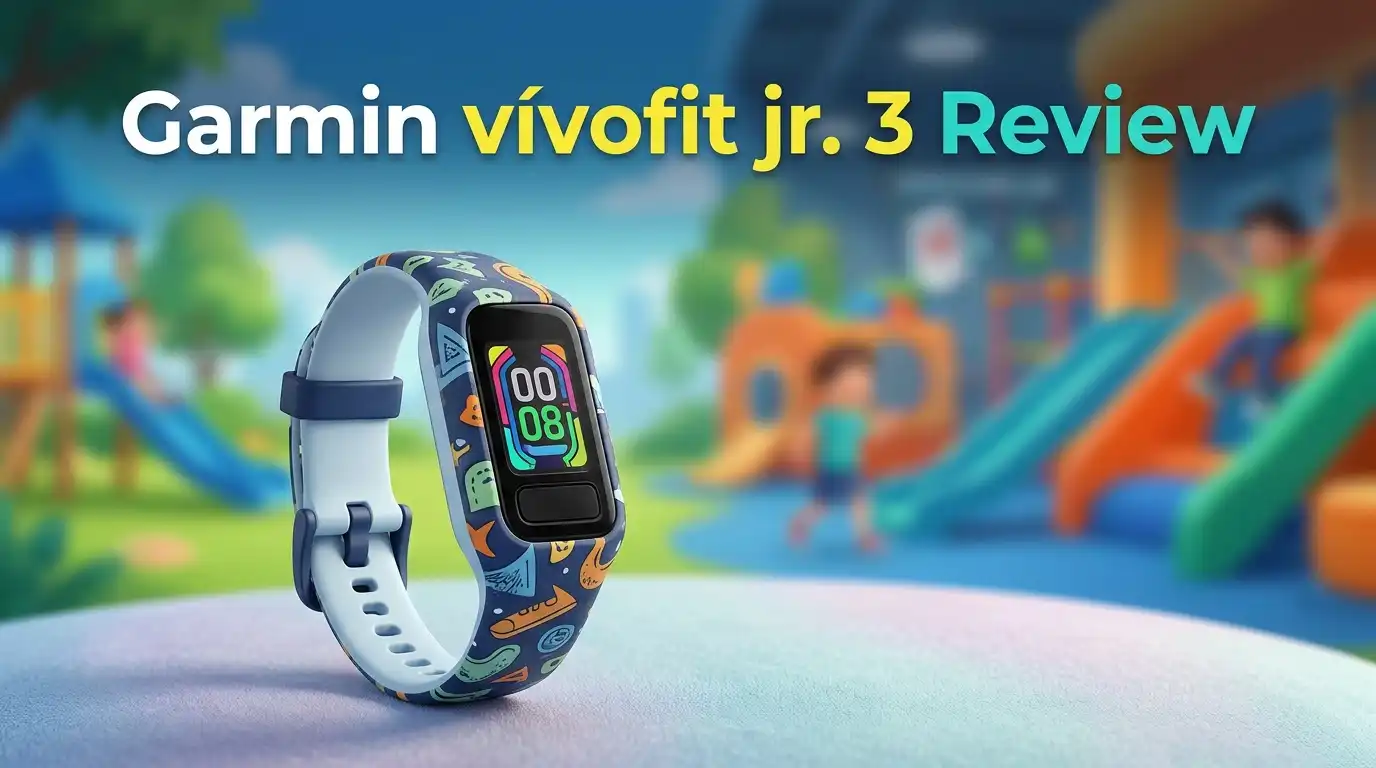
The vivofit jr. 3 looks like what a kid imagines a kids watch should look like. The case is chunky silicone. The single button sits on the right side. Themed versions carry printed graphics on the strap.
The band fits wrists from 130 mm to 175 mm, so it covers roughly ages four through ten. Garmin also sells a stretchy fabric band version for smaller wrists. The whole unit weighs about 25 grams, which is light enough that children forget they are wearing it.
Durability has been excellent. Ours went through a swimming pool, a muddy creek, and one scooter crash. No scratches on the lens, no cracks in the case. The one weak point is the strap buckle, which can loosen on very thin wrists during sleep.
Display and Daily Readability
The screen measures 0.7 inches with a 112 by 112 pixel memory in pixel panel. That technology sounds dated, and it is. It also happens to be the correct choice here, because it sips power.
Outdoors the display is bright and crisp. Sunlight makes it better, not worse. Kids playing in a park can read it without shading their eyes.
Indoors the story changes. The screen is dim and flat under household lighting. There is a backlight, activated by pressing the button, but it is weak. Reading step counts in a dark bedroom takes effort.
There is no touchscreen. Everything runs through one button and a short press or long press. Children learn the navigation quickly, usually within a day, but adults often find it clumsy at first.
Top 3 Alternative for Garmin vivofit jr. 3

Last update on 2026-10-27 / Affiliate links / Images from Amazon Product Advertising API
Garmin Bounce Kids Smartwatch

Last update on 2026-10-27 / Affiliate links / Images from Amazon Product Advertising API
Fitbit Ace LTE Kids Smartwatch

Last update on 2026-10-27 / Affiliate links / Images from Amazon Product Advertising API
BIGGERFIVE Vigor Kids Fitness Tracker
Battery Life That Actually Lasts a Year
This is where the vivofit jr. 3 embarrasses its competition. The device runs on a user replaceable CR2025 coin cell. Garmin rates it for up to one year of normal use.
Ours lasted close to eleven months before the low battery icon appeared. Replacement cells cost a couple of dollars and come in packs. You open the back with a coin or a small screwdriver and swap it in under two minutes.
Compare that to rechargeable rivals. The Fitbit Ace 3 needs charging every eight days. The Garmin Bounce needs charging every two days. Every charge cycle is a chance for the watch to end up dead in a drawer.
A tracker that is always on your child’s wrist beats a smarter tracker that is always on the dresser. That is the honest argument for this product.
Activity Tracking Accuracy
Step counting is the core function, and it performs well for a wrist worn device on a moving child. Across several test walks the vivofit jr. 3 landed within about five percent of a manual count.
The caveat is familiar. Kids swing their arms constantly. Drawing, playing with blocks, and riding in a car seat all generate phantom steps. Expect inflated numbers on days with lots of hand movement.
Garmin sets a default daily goal of 60 active minutes, which aligns with pediatric guidelines. The watch tracks that separately from raw steps, and that figure is more meaningful.
There is no heart rate sensor and no GPS. Distance is estimated from stride length. Treat the numbers as motivational, not medical. For a child, that is exactly the right level of precision.
Sleep Tracking and What It Tells You
The vivofit jr. 3 logs sleep automatically when it detects stillness. The app shows total sleep duration and a simple movement chart across the night.
Accuracy on bedtime and wake time was consistently good in our testing. It caught the 8:30 pm lights out and the 6:45 am wake up without fuss.
What it does not do is break sleep into stages. There is no deep, light, or REM breakdown, because there is no heart rate sensor to infer them. The data is basically a duration log with a restlessness graph.
That limitation bothered me less than I expected. For a child, total hours asleep is the number that matters. Parents can see whether a late soccer practice cost their kid an hour, and act on it.
The Garmin Jr. App for Parents
The free Garmin Jr. app is the brain of this system. Parents create a family account, add children, and manage everything from one dashboard. Multiple children can be linked to one parent phone.
From the app you set step goals, schedule chores, approve rewards, and view activity history. You can also adjust alarms and the watch face remotely, then push changes during the next sync.
The interface is colorful and reasonably intuitive. It is not as polished as the Fitbit app. Menus occasionally feel buried, and the first run setup asks for more information than it needs.
Syncing is the weak link. The watch must be within Bluetooth range with the app open. If a week passes without a sync, the watch stores the data, but chore approvals and rewards sit frozen until you connect.
The Chores and Rewards System
This feature sold me on the product more than the fitness tracking did. Parents assign chores in the app, such as making the bed or feeding the dog. Each chore carries a coin value you choose.
The chore appears on the child’s watch with a small icon. They complete it, mark it done, and the request goes to the parent for approval. Coins land in a virtual bank.
Kids then redeem coins for rewards you define. Screen time, a trip to the park, a small toy, anything you want. The system teaches earning and saving without a single real dollar changing hands.
The honest downside is enforcement. Children quickly learn to mark chores complete without doing them. The parental approval step exists for exactly this reason, and you will use it often.
Adventure Themes and Character Packs
Every vivofit jr. 3 ships with one themed app adventure. Marvel versions unlock Avengers storylines. Disney Princess versions unlock castle quests. Non licensed versions get a jungle or space adventure.
Here is how it works. Hitting the daily 60 minute activity goal unlocks the next chapter of the story in the app. Kids read or watch a short segment and collect a reward icon.
The motivation is real but temporary. My son chased unlocks aggressively for about six weeks. After the story ran out, the pull weakened noticeably.
Garmin lets you purchase additional adventure packs inside the app for a few dollars. This is a small but genuine ongoing cost that reviews rarely mention. Budget for one or two extra packs if you want the motivation to last past the first season.
Water Resistance and Swimming
The vivofit jr. 3 carries a 5 ATM rating. That means it handles pressure equivalent to 50 meters of water. In practice your child can shower, bathe, swim, and jump into pools without removing it.
We tested it through an entire summer of pool days and a week at the beach. No water intrusion. No fogging under the lens. The button still works normally when wet.
One important detail. There is no swim tracking mode. The watch survives water, but it does not count laps or measure swim distance. Steps recorded while swimming are essentially random arm movement.
Rinse the band with fresh water after pool or ocean use. Chlorine and salt both degrade silicone over time, and a thirty second rinse adds months to the strap life.
What the vivofit jr. 3 Does Not Do Well
Honest reviews list failures, so here they are. There is no GPS and no location tracking of any kind. If your main worry is knowing where your child is, this device cannot help you. Buy the Bounce instead.
There is no calling, no messaging, and no speaker. Communication is not part of the design.
The screen is small and dim indoors. Children with any vision difficulty will struggle with it.
Syncing requires parent effort every few days, and the app can be slow to connect.
The themed adventures run out of content. Motivation drops once a child finishes the story.
Finally, the hardware is old. Garmin launched this in 2020 and has not refreshed it. At the full retail price it feels overdue for a successor.
Pros and Cons
Pros
- Up to one year of battery life from a cheap replaceable coin cell, with no charging cable to lose.
- Genuinely tough build with a 5 ATM rating that handles pools, showers, and sandboxes.
- The chore and reward system teaches responsibility and money concepts in a way kids enjoy.
- Lightweight 25 gram design that children forget they are wearing.
- Free Garmin Jr. app with no subscription fee, unlike most connected kids watches.
- Fun themed versions including Marvel, Star Wars, and Disney Princess.
- Toe to Toe step challenges let parents compete directly against their kids.
Cons
- No GPS, no location tracking, and no messaging of any kind.
- Dim 0.7 inch screen that is hard to read in indoor lighting.
- No heart rate sensor, so sleep data lacks stages and intensity.
- Manual Bluetooth syncing is easy to forget and sometimes slow.
- Adventure content runs out, and extra packs cost money.
- Hardware dates back to 2020 with no refresh since.
- Step counts inflate during drawing, playing, and car rides.
Price and Value in 2026
The vivofit jr. 3 launched at 89.99 dollars. In 2026 you can usually find it between 60 and 80 dollars, with themed versions occasionally dipping lower during sales. Licensed Marvel and Disney models tend to cost a few dollars more.
At 60 dollars this is a strong buy. At full retail it feels expensive for 2020 hardware.
Compare the ongoing costs. The Garmin Bounce costs more upfront plus roughly 10 dollars monthly for LTE. The Fitbit Ace LTE carries a similar subscription. The vivofit jr. 3 has zero recurring fees beyond the occasional coin cell and optional adventure pack.
Over three years, the total cost of ownership is dramatically lower than any connected kids watch. For families who only want activity tracking and chores, that math is hard to argue with.
Who Should Buy the Garmin vivofit jr. 3?
Last update on 2026-10-27 / Affiliate links / Images from Amazon Product Advertising API
Buy this if your child is between four and nine years old and you want a first tracker with no monthly fee. It suits families who value simplicity and hate charging cables.
It fits well for parents who want a structured chore and reward system. The app genuinely helps build routines around bedtime, screen time, and daily tasks.
It also suits active kids who swim, bike, and play outdoors, because the build survives all of it.
Skip it if you need to know your child’s location. Skip it if your child is over ten, since the band and the cartoon interface will feel babyish. Skip it if you want heart rate data or detailed sleep stages.
For everyone else, it remains one of the most practical kids trackers available.
Final Verdict
The Garmin vivofit jr. 3 is not the most advanced kids tracker in 2026. It is arguably the most sensible one.
It does a narrow set of jobs very well. It counts steps reliably. It survives everything a child throws at it. It runs for a year without charging. It turns chores into a game that children voluntarily play.
It also fails clearly in places. No GPS. No messaging. A dim screen. Aging hardware that Garmin has left alone for too long.
My rating is 4 out of 5 for the right age group. If your child is four to nine and you want a tracker that quietly works in the background of family life, this is the one to buy. If you need to reach or locate your child, spend more and get the Bounce.
Frequently Asked Questions
Does the Garmin vivofit jr. 3 have GPS?
No. The vivofit jr. 3 contains no GPS chip and no location tracking. Distance figures come from estimated stride length, not satellites. Parents who need location awareness should look at the Garmin Bounce or the Fitbit Ace LTE, both of which include GPS and require a monthly subscription.
How long does the battery really last?
Garmin rates it at up to one year. Real world results usually land between ten and twelve months, depending on how often your child uses the backlight, stopwatch, and timer. The CR2025 coin cell is user replaceable, costs about two dollars, and takes two minutes to swap using a coin or small screwdriver.
Can my child wear it swimming?
Yes. The 5 ATM rating covers swimming, showering, and bathing. There is no dedicated swim tracking mode, so laps and swim distance are not recorded. Rinse the band with fresh water after chlorine or salt exposure to keep the silicone in good condition.
What age is the vivofit jr. 3 best for?
Garmin markets it for ages four and up. In practice it works best from four to nine. The band fits wrists from 130 mm to 175 mm. Children aged ten and older usually find the interface and themed graphics too young, and they often want messaging features this device lacks.
Is there a monthly subscription fee?
No. The Garmin Jr. app is free and includes chores, rewards, step goals, sleep logs, and Toe to Toe challenges. The only optional cost is additional adventure packs, which run a few dollars each inside the app. There is no LTE plan and no recurring charge.
Does it track heart rate?
No. The vivofit jr. 3 has no optical heart rate sensor. It tracks steps, active minutes, and sleep duration only. Sleep data shows total hours and restlessness but no deep, light, or REM stages. Garmin left the sensor out partly to achieve the one year battery life.

Hi, I’m Lucy Jones, a dedicated watch enthusiast and reviewer. I spend my time hunting down, testing, and evaluating the most intriguing wristwatches on the market. My goal is to guide you through the overwhelming choices with honest, hands-on insights into every timepiece.