How to Resize a Mesh Milanese Watch Bracelet the Right Way?
You just got a stunning Milanese mesh watch bracelet, and it looks amazing. There is just one problem. It does not fit your wrist properly.
The bracelet slides around, sits too loose, or pinches too tight. Sound familiar? You are not alone. Thousands of watch owners face this exact issue every single day.
The good news is that resizing a mesh Milanese watch bracelet is one of the easiest adjustments you can make at home. Unlike traditional link bracelets that require pin removal and special tools, most Milanese mesh bands use a simple sliding clasp system.
Key Takeaways
- Most Milanese mesh bracelets use a sliding clasp that moves freely along the woven mesh surface. This makes sizing adjustments fast and reversible. You can tighten or loosen the bracelet in under five minutes without removing any material from the band.
- You only need basic tools to resize a mesh bracelet. A small flathead screwdriver, a spring bar tool, or even a butter knife can do the job. Many watch brands include a small adjustment tool inside the box, so check your packaging before buying anything new.
- Always measure your wrist before adjusting the bracelet. Use a flexible measuring tape or a piece of string wrapped around your wrist. Add about 5mm to 10mm of extra space for comfort. This prevents over tightening and ensures good blood circulation.
- The clasp must align with the grooves on the back of the mesh band. If the clasp does not lock into a groove, it will not close properly. Take your time sliding it into the correct position so it snaps shut with a firm click.
- Magnetic Milanese loops work differently from traditional clasps. These bands use a magnetic closure that sticks to any point along the mesh. They require no tools at all and offer infinite adjustability, but they can shift during wear if the magnet weakens.
- Permanent trimming should be your last resort. Some older or premium mesh bands require cutting to shorten. Once you cut mesh, you cannot reverse it. Always try clasp adjustment first before committing to a permanent change.
Understanding the Milanese Mesh Bracelet Design
The Milanese mesh bracelet has a rich history that dates back to Milan, Italy. Craftsmen originally created this style of woven metal band in the late 1800s. The design features hundreds of tiny interlocking metal loops woven together to form a flat, flexible surface.
This weave pattern gives the bracelet a smooth texture that sits comfortably against your skin. Unlike solid link bracelets, mesh bands distribute pressure evenly across your wrist. They also allow airflow, which reduces sweat buildup during warm weather.
Modern Milanese mesh bracelets come in stainless steel, titanium, and gold plated options. The weave can be tight or loose depending on the manufacturer.
Tighter weaves feel more premium and hold their shape better over time. Understanding this construction helps you handle the bracelet with care during adjustment, since pulling too hard can stretch or damage the delicate mesh pattern.
Identifying Your Clasp Type Before You Start
Before you grab any tools, you need to figure out what type of clasp your Milanese bracelet uses. This single step determines your entire adjustment method. Getting this wrong can lead to frustration or even damage to your bracelet.
The most common type is the sliding fold over clasp. This clasp hooks into the grooves on the underside of the mesh band. You pry it open with a small tool, slide it to a new position, and snap it shut. Most affordable and mid range Milanese bracelets use this system.
The second type is the magnetic closure, made famous by certain smartwatch brands. This clasp uses a strong magnet that grips the mesh at any point. It offers the easiest adjustment but can sometimes come loose during physical activity.
The third type is the hook and tuck clasp found on some vintage and high end mesh bands. This style uses a thin metal hook that tucks under the mesh. Each clasp type requires a slightly different approach, so identify yours before moving forward.
Tools You Will Need for the Job
One of the best things about resizing a Milanese mesh bracelet is that you do not need expensive or specialized equipment. Most people already have what they need at home or received a tool with their watch purchase.
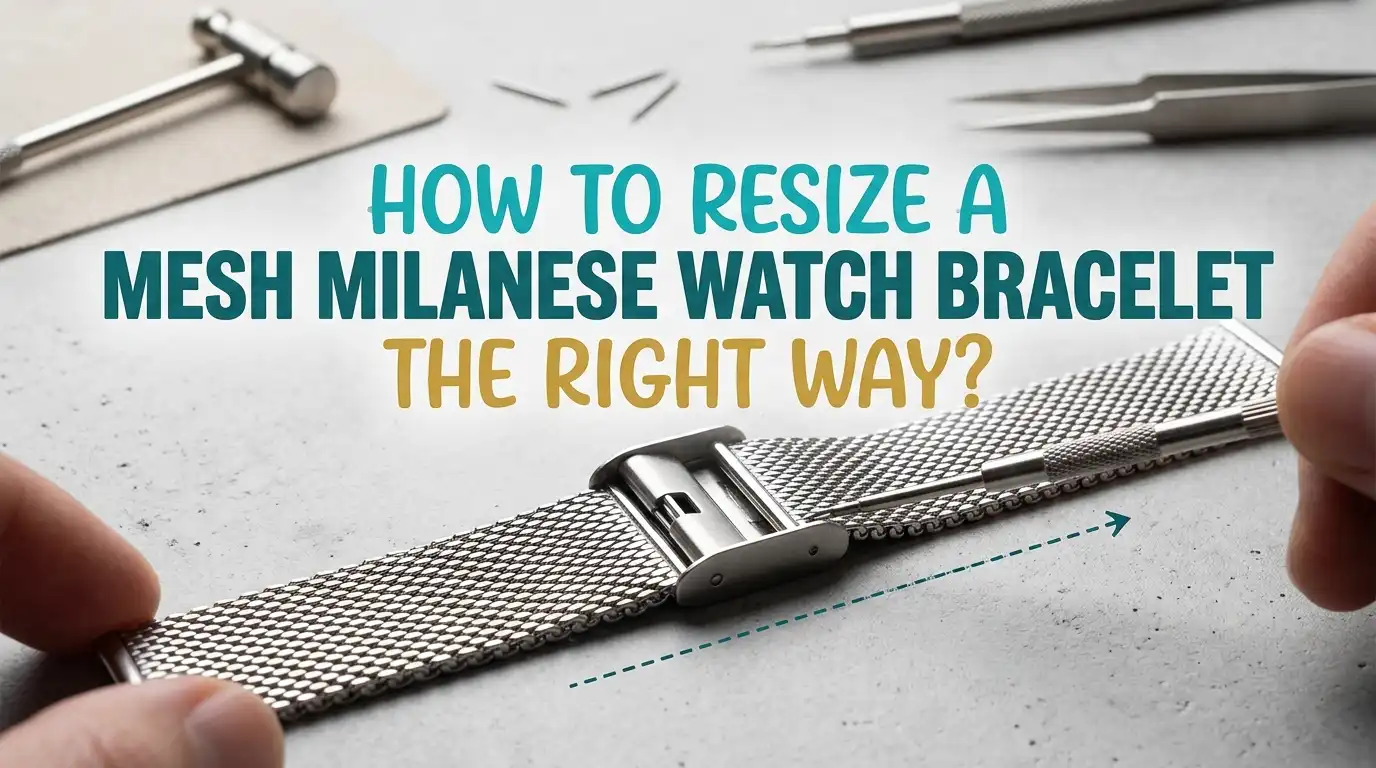
The primary tool is a small flathead screwdriver or a spring bar tool. The screwdriver tip should be thin enough to fit into the small notch on the clasp. Many watch brands include a dedicated tool inside the watch box. Check your packaging because it might be tucked under the cushion or inside a small pouch.
You will also want a soft cloth or microfiber towel to place under the watch while you work. This protects the case and bracelet from scratches on hard surfaces. A piece of felt or a mouse pad works just as well.
If you do not have a spring bar tool, a thin butter knife, a SIM card ejector pin, or even a sturdy toothpick can work in a pinch. Just be gentle to avoid scratching the clasp. Avoid using sharp knives or pointed objects that could slip and damage the mesh weave.
Pros of DIY adjustment: Free, fast, no appointment needed, and completely reversible.
Cons of DIY adjustment: Risk of minor scratches if you use the wrong tool, and it takes a few tries to find the perfect fit.
How to Measure Your Wrist Correctly
Getting an accurate wrist measurement is the foundation of a proper fit. Skipping this step is the number one reason people end up adjusting their bracelet multiple times before getting it right.
Wrap a flexible measuring tape around your wrist at the point where you normally wear your watch. Keep the tape snug but not tight. Write down the measurement in millimeters. If you do not have a measuring tape, use a piece of string or a thin strip of paper. Wrap it around your wrist, mark where it overlaps, and then measure that length against a ruler.
Add 5mm to 10mm to your measurement for a comfortable fit. This extra space allows your wrist to breathe and accounts for natural swelling that happens throughout the day. Your wrist is typically larger in the afternoon and evening compared to the morning because of heat and activity.
Also note that the watch case itself takes up some of the bracelet length. Subtract the case width from your total bracelet length to figure out how much band you need on each side. This calculation prevents the watch from sitting off center on your wrist.
Step by Step Guide to Adjusting a Sliding Clasp
This method works for the majority of Milanese mesh bracelets on the market. Follow these steps carefully, and you will have a perfect fit within minutes.
Step 1: Place your watch face up on a soft cloth on a flat surface. This gives you a stable working area and protects the watch from scratches.
Step 2: Open the fold over clasp as you would when removing the watch from your wrist. You should see a small notch or hole in the center of the clasp mechanism.
Step 3: Insert your spring bar tool or small flathead screwdriver into the notch. Use the tool as a lever and gently pry the inner clasp mechanism upward. You will feel it release from the groove on the mesh.
Step 4: Once the clasp lifts free, slide it along the mesh band to your desired position. Move it closer to the watch head to tighten the bracelet. Move it away from the watch head to loosen it.
Step 5: Align the clasp with one of the grooves on the underside of the mesh. Press the clasp firmly down until you hear a satisfying click. This confirms the clasp has locked into place.
Step 6: Put the watch on your wrist and test the fit. You should be able to fit one finger between the bracelet and your skin. If it feels wrong, repeat the process.
How to Adjust a Magnetic Milanese Loop
Magnetic Milanese loops are the simplest watch bands to resize. There is no clasp to pry open and no grooves to align. The entire process takes about ten seconds.
Simply place the watch on your wrist and pull the free end of the mesh band through the magnetic closure. The magnet will grab onto the mesh wherever you stop. Wrap the excess band underneath so it sits flat against the bracelet. That is it.
The beauty of this system is its infinite adjustability. You are not limited to preset groove positions. You can fine tune the fit down to a fraction of a millimeter. This makes magnetic loops ideal for people whose wrist size changes throughout the day.
However, magnetic closures do have a downside. The magnet can weaken over time, especially if the watch is exposed to strong magnetic fields from electronics or other magnets.
If you notice your band coming loose during normal wear, the magnet may have lost some strength. Additionally, magnetic closures can interfere with certain credit cards or electronic devices if they come into close contact.
Pros of magnetic closure: No tools required, infinite sizing, quick to adjust, impossible to break the clasp.
Cons of magnetic closure: Can slip during vigorous activity, magnet may weaken, potential interference with electronics.
Permanent Trimming for Non Adjustable Mesh Bands
Some older, vintage, or high end mesh bracelets do not have a sliding clasp. These bands require permanent trimming to shorten the length. This is a serious step because you cannot reverse it once done.
A certified watchmaker is the safest option for this job. They use a flexible shaft machine with a separating disc to cut through the mesh cleanly. This method produces the smoothest and most precise cut without crushing or fraying the mesh edges.
If a machine is not available, heavy duty wire nippers can also cut mesh. The downside is that nippers tend to crush the edges, which then need to be filed smooth. Always cut a small amount at a time. You can always remove more material, but you can never add it back.
One important detail is how you distribute the cut. Do not remove all the excess from one end. Remove slightly more than half from the 12 o’clock end and slightly less than half from the 6 o’clock end. This accounts for the natural shape of your wrist, where the inner side is shorter than the outer side, and keeps the watch centered on top.
Pros of permanent trimming: Creates a clean, custom fit for bands without sliding clasps.
Cons of permanent trimming: Irreversible, requires professional tools, risk of damage if done incorrectly.
Common Mistakes to Avoid During Resizing
Even though resizing a Milanese mesh bracelet is straightforward, a few common errors can turn a simple job into a frustrating experience. Knowing these pitfalls saves you time and protects your bracelet.
The first mistake is using too much force when prying the clasp open. The clasp mechanism is delicate. Excessive pressure can bend or break the hinge, which is expensive to repair. Use slow, steady leverage instead of a quick jab.
The second mistake is failing to align the clasp with a groove before closing it. If the clasp does not sit in a groove, it will not lock and will pop open during wear. Always check the alignment before pressing it shut.
The third mistake is adjusting the bracelet while wearing it. Always work on a flat surface for better control and visibility. Trying to adjust the band on your wrist leads to slipping tools and potential scratches.
The fourth mistake is overtightening the bracelet. A watch that sits too tight restricts blood flow and causes discomfort. Remember the one finger rule: you should always be able to slide a finger between the band and your skin.
When to Visit a Professional Watchmaker
There are situations where a trip to a professional is the smartest choice. Knowing when to ask for help can save your bracelet from accidental damage.
If your mesh band requires permanent cutting, a watchmaker has the right tools to make a clean, precise cut. They use separating discs and professional nippers that produce much better results than household scissors or wire cutters. The cost of a professional resize is usually between $10 and $30, which is far less than replacing a damaged bracelet.
You should also see a professional if your clasp mechanism is stuck, bent, or broken. Forcing a damaged clasp can cause further harm to the mesh weave. A watchmaker can repair or replace the clasp without affecting the rest of the band.
Finally, if your mesh bracelet is made from gold or another precious metal, professional handling is strongly recommended. Precious metals scratch easily, and any damage affects the value of the piece. A certified master watchmaker knows how to handle these materials with the care they deserve.
Tips for Maintaining the Perfect Fit Over Time
Getting the right fit once is great, but keeping that fit requires a little ongoing attention. Mesh bracelets can shift or loosen over time due to regular wear and environmental factors.
Check your clasp every few weeks to make sure it is still locked in its groove. Daily wear, bumps, and vibrations can gradually work the clasp out of position. A quick inspection takes only a few seconds and prevents the bracelet from becoming too loose unexpectedly.
Clean your mesh bracelet regularly with warm water and mild soap. Dirt and oils from your skin can build up in the tiny gaps of the mesh weave. This buildup can actually affect how the clasp grips the mesh surface and may cause it to slide over time.
Avoid exposing your bracelet to saltwater, chlorine, or harsh chemicals. These substances corrode stainless steel and weaken gold plating. If your watch gets wet in a pool or the ocean, rinse it with fresh water immediately. Dry the mesh thoroughly with a soft cloth to prevent water spots and mineral deposits.
Store your watch on a cushion or in a watch box when you are not wearing it. Letting it sit on hard surfaces or tangle with jewelry can stretch the mesh and damage the clasp.
Choosing the Right Milanese Mesh Band Width
If you are replacing your mesh bracelet entirely, picking the correct width is critical for both comfort and appearance. A band that is too narrow looks awkward on a large case, while an oversized band overwhelms a smaller watch.
Measure the lug width of your watch case. This is the distance in millimeters between the two lugs where the bracelet connects. Common lug widths are 18mm, 20mm, and 22mm. Your new mesh band must match this measurement exactly or it will not attach properly.
Width also affects how the bracelet drapes on your wrist. Wider bands sit flatter and distribute weight more evenly. Narrower bands tend to feel lighter and allow more wrist movement. Most people find that a band matching their exact lug width provides the best balance of comfort and style.
Consider the thickness of the mesh as well. Thicker, tighter weaves feel more solid and last longer. Thinner weaves are more flexible but can stretch over time. A good quality mesh band should feel smooth on both sides with no rough edges or loose wires.
Quick Troubleshooting for Common Fit Issues
Sometimes even after proper adjustment, your bracelet might still not feel quite right. Here are fast fixes for the most common problems.
The bracelet keeps sliding on your wrist: This usually means it is still too loose. Tighten the clasp by one groove position. If it is a magnetic loop, pull the band slightly tighter before letting the magnet grip.
The clasp will not stay closed: The clasp is likely not aligned with a groove. Open it, reposition carefully, and make sure you hear a firm click when closing. If the clasp still pops open, the spring mechanism inside may be worn out and need replacement.
The bracelet pinches your skin: Mesh bracelets sometimes catch arm hair. Wearing the watch slightly higher on your wrist can help. Also, make sure no part of the mesh is folded or bent, as this creates sharp edges that cause pinching.
The watch sits off center: The band lengths on each side of the case are uneven. If possible, adjust the clasp to center the watch head. On permanently trimmed bands, a watchmaker can help rebalance the length.
Final Thoughts on Getting the Perfect Milanese Fit
Resizing a Milanese mesh watch bracelet is a simple task that makes a huge difference in comfort and appearance. Most people can do it at home in under five minutes with basic tools. The sliding clasp system found on most modern Milanese bands is designed for easy, reversible adjustment.
Remember to always identify your clasp type first, measure your wrist accurately, and work on a padded surface. Take your time with each adjustment and test the fit after every change. A well fitting watch should feel snug enough to stay in place but loose enough to breathe.
For vintage or high end mesh bands that require trimming, trust the job to a professional watchmaker. The small cost is worth the peace of mind. No matter which method you use, a properly fitted Milanese mesh bracelet transforms the way your watch looks and feels on your wrist.
Frequently Asked Questions
Can I resize a Milanese mesh bracelet without any tools?
Yes, if your bracelet has a magnetic closure, you do not need any tools at all. Simply pull the strap to your desired tightness and let the magnet lock it in place. For sliding clasp models, you will need at least a small flathead screwdriver or spring bar tool to pry the clasp open. Some people use a SIM card ejector pin or a thin coin edge as a substitute.
How tight should a Milanese mesh bracelet fit on my wrist?
A properly fitted bracelet should allow you to slide one finger between the band and your skin. It should feel snug enough that the watch does not spin or slide around, but loose enough that it does not leave marks or restrict circulation. Your wrist swells slightly during the day, so adjust the fit in the afternoon for the most accurate result.
Will adjusting the clasp damage my mesh bracelet?
No, sliding the clasp along the mesh will not damage a quality bracelet. The grooves on the underside of the mesh are specifically designed for clasp repositioning. Just be careful not to use excessive force when prying the clasp open, and always use a proper tool instead of sharp objects that could scratch the surface.
How often should I readjust my Milanese mesh band?
Most people adjust their bracelet once and leave it. However, seasonal changes can affect your wrist size. Your wrist tends to swell in summer heat and shrink in winter cold. If you notice your watch fitting differently between seasons, a quick clasp adjustment takes only a minute. Weight changes can also require resizing.
Can a jeweler shorten a Milanese mesh bracelet that is too long?
Yes, a professional watchmaker or jeweler can permanently shorten a mesh bracelet by cutting away excess material. This process uses a separating disc or nippers to trim the mesh cleanly. This is an irreversible change, so make sure you have tried all other adjustment methods first. The typical cost ranges from $10 to $30 depending on the material and your location.
Is a Milanese mesh bracelet suitable for everyday wear?
Absolutely. Milanese mesh bracelets are made from durable stainless steel or titanium and handle daily wear very well. They resist stretching better than expansion bands and provide excellent comfort thanks to their flexible weave. Regular cleaning and occasional clasp checks will keep your mesh bracelet in great condition for years of daily use.

Hi, I’m Lucy Jones, a dedicated watch enthusiast and reviewer. I spend my time hunting down, testing, and evaluating the most intriguing wristwatches on the market. My goal is to guide you through the overwhelming choices with honest, hands-on insights into every timepiece.