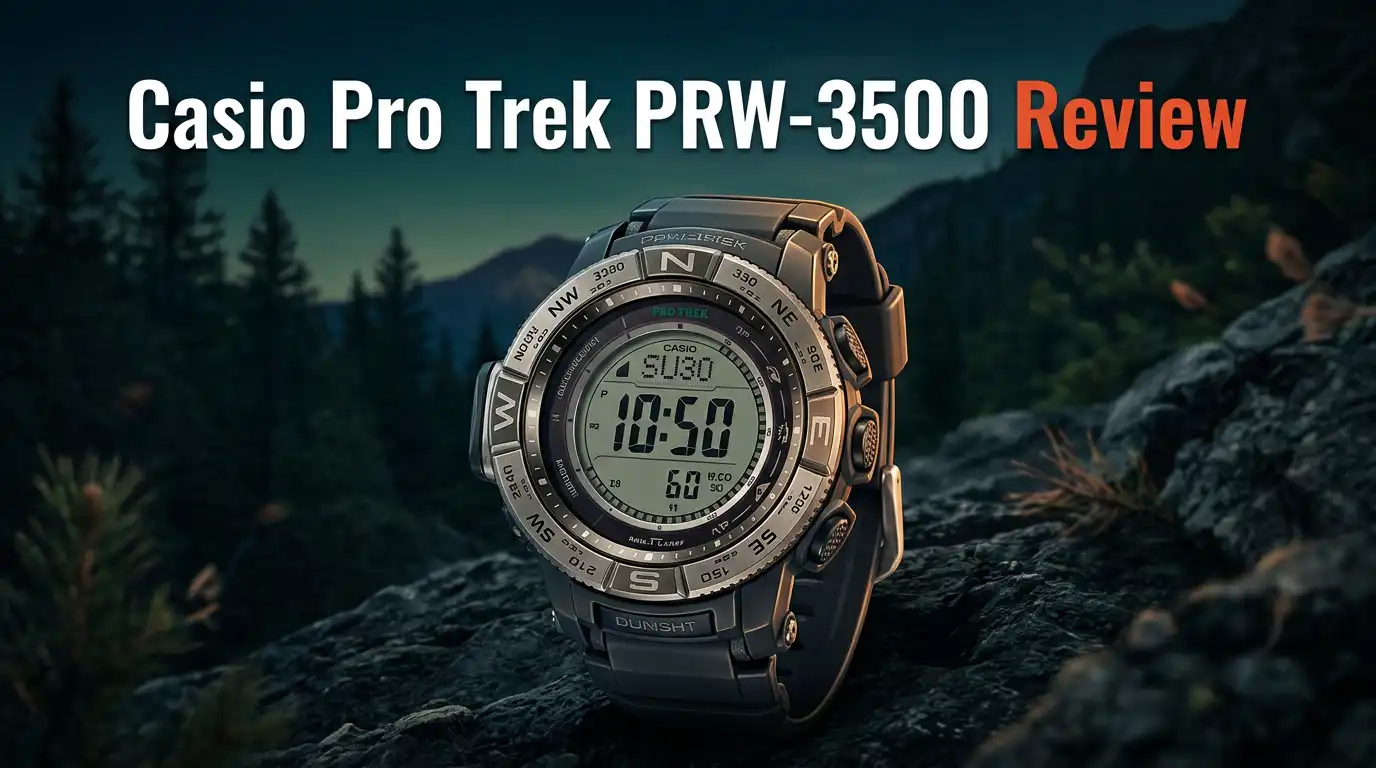
Casio Pro Trek PRW-3500 Review 2026: Still Relevant?
The Casio Pro Trek PRW-3500 is one of those watches that refuses to fade away. Casio launched it back in 2015, yet hikers, arborists, electricians, and weekend campers still buy it in 2026.
That says something. Most gadgets from 2015 sit forgotten in a drawer. This one keeps showing up on wrists in forests, on job sites, and on mountain trails.
This review covers the unboxing, the sensors, the solar system, the comfort, and the honest weak spots. I will tell you exactly where this watch disappoints, because no watch is perfect, and reviews that skip the negatives help nobody.
In A Nutshell:
- The Triple Sensor Version 3 module is the heart of this watch. It gives you a digital compass, an altimeter, a barometer, and a thermometer at the push of a side button. Casio’s third generation sensor draws less power and reads faster than older Pro Trek sensors.
- Tough Solar plus Multi Band 6 means you forget about maintenance. Light charges the cell, and the radio receiver corrects the time automatically in six regions. You never set this watch manually and you never change a battery.
- 200 meters of water resistance sets the PRW-3500 apart from the PRW-3000 that came before it, which managed only 100 meters. Swimming, snorkeling, rain, and pressure washing are all fine.
- The case is large. Casio lists it at roughly 53.4mm wide, 56.9mm long, and 14.5mm thick, yet the resin strap version weighs around 89 grams. It wears lighter than the numbers suggest, but small wrists will notice the width.
- The weak points are real. The thermometer reads your body heat, the altimeter needs frequent calibration, there is no GPS, there is no app, and the resin bezel insert scratches.
- Value in 2026 is strong. Street prices often sit well below the original $300 launch price for the strap model, which makes this an easy recommendation for outdoor use.
Casio Pro Trek PRW-3500 Overview


Last update on 2026-10-26 / Affiliate links / Images from Amazon Product Advertising API
The PRW-3500 belongs to Casio’s Multifield Line, the branch of Pro Trek built for mixed terrain rather than one specialist activity. Casio released it in 2015 as a chunkier companion to the slimmer PRW-3000.
The design brief was clear. Keep the modern Triple Sensor Version 3 module, bring back the wide rotating navigational bezel, and raise water resistance to the traditional Pro Trek standard of 200 meters.
The case mixes resin and stainless steel, which adds a little extra toughness over the resin and aluminium build of the PRW-3000. The result is a watch that feels purpose built rather than fashionable.
You get a compass, altimeter, barometer, thermometer, sunrise and sunset data, world time, five alarms, a 1000 hour stopwatch, and a countdown timer. What you do not get are the exotic extras like tide graphs or moon phase, which live on other Pro Trek and G Shock models.
The Unboxing Experience
Casio does not treat this watch like a luxury product, and that honesty is refreshing. The watch arrives in a simple rounded tin or a plain card box depending on the region and seller.
Inside you find the watch wrapped around a plastic cushion, a thick multilingual instruction booklet, and a warranty card. That is it. No charger, no cable, no pairing card, no app QR code.
The first thing you notice is the weight, or the lack of it. You lift it expecting a brick and you get something closer to a padded plastic cuff. The second thing you notice is that the watch is already running and already showing the correct time, because the solar cell charged under the warehouse lights.
That moment sells the whole concept. You put it on, you spin the bezel once because you cannot resist, and you start using it immediately.
Design And Build Quality
The PRW-3500 looks like a tool. The wide rotating bezel dominates the face, the four side buttons sit under protective guards, and the case back is screwed down with a steel plate.
Casio uses mineral glass rather than sapphire, which is the expected compromise at this price. Mineral glass resists shattering well but picks up fine scratches over years of brushing against doorframes and rock.
The resin feels dense and slightly matte. The bezel insert and the printed markings are the parts that age fastest, so expect scuffs on the raised edges within a few months of real work. The stainless steel elements around the case add rigidity and stop the shell from flexing when you tighten the strap hard.
Fit and finish are tidy rather than beautiful. Button travel is firm with a positive click, which matters a lot when you press them wearing gloves.
Casio Pro Trek PRW-3500T Titanium Version

Last update on 2026-10-26 / Affiliate links / Images from Amazon Product Advertising API
Casio also sells the PRW-3500T, the top version of the family, with a titanium bracelet and a titanium coloured case. It launched at $450 against $300 for the strap models, and that gap still shows up in 2026 pricing.
The titanium bracelet changes the character of the watch completely. It turns a trail watch into something you can wear with a collared shirt.
Titanium keeps the weight reasonable, resists corrosion, and avoids the hot and cold shock of stainless steel against skin. The bracelet also solves the sweat problem that resin straps create in humid weather.
The trade off is practical. A bracelet traps grit, it is slower to adjust, and it is harder to clean after a muddy hike. Serious hikers often buy the resin version and keep the titanium model for travel and office days. Both share the identical module and identical sensor performance.
Top 3 Alternative For Casio Pro Trek PRW-3500

Last update on 2026-10-26 / Affiliate links / Images from Amazon Product Advertising API
Casio Pro Trek PRG-270-1

Last update on 2026-10-26 / Affiliate links / Images from Amazon Product Advertising API
Casio Pro Trek PRW-6600Y

Last update on 2026-10-26 / Affiliate links / Images from Amazon Product Advertising API
Casio Pro Trek PRG-340
Triple Sensor Version 3 Performance
The sensor package is the reason people buy a Pro Trek, so it deserves close attention. The digital compass holds a bearing for 20 seconds per press and shows both a bearing number and a graphic pointer. It needs a flat hold and a magnetic declination setting to be trustworthy. Calibrate it away from your car and your phone or the readings will wander.
The barometer plots pressure changes on a small graph and flags sudden drops with an arrow. This is the feature that quietly earns its keep, because a falling trend on the graph gives you an hour or two of warning before weather turns ugly.
The altimeter reads from roughly 700 meters below sea level to 10,000 meters, which covers every trail on earth. It is a pressure altimeter, so weather affects it. Set a reference point at a known elevation and it stays close.
Tough Solar Power And Battery Life
Tough Solar is the feature that makes this watch feel different from everything else on your charging shelf. A thin solar panel sits under the display and feeds a rechargeable cell. Normal indoor light tops it up slowly. An hour of direct sun fills it quickly. In practice you charge it by living your life.
Casio quotes long reserve times when the watch sits in the dark, helped by a power saving mode that blanks the display and keeps timekeeping running. I have never seen the indicator drop below the second level during normal wear, and that includes winter weeks with short daylight.
The honest caveat is that the rechargeable cell is not immortal. After roughly ten to fifteen years it holds less charge and needs replacing by a service centre. That is cheap maintenance for a decade of use.
Multi Band 6 Atomic Timekeeping
Multi Band 6 lets the watch pull a radio time signal from six transmitters covering North America, Japan, China, and parts of Europe. The watch listens at night without being asked. You wake up with the correct time, the correct date, and automatic daylight saving handling in supported regions.
This feature works best if you sleep near a window. Radio signals struggle inside steel buildings and basements, so place the watch display up on a sill overnight if syncing fails.
Outside the six coverage zones the feature does nothing useful. If you live in South America, Africa, Australia, or most of Asia, you will set the time by hand once and rely on the quartz accuracy instead. That accuracy is around fifteen seconds per month, which is fine but not remarkable. Travellers should know this before paying extra for the radio model.
Display Readability And Backlight
The display is a large negative or positive LCD depending on the colourway, split into a main time row, a secondary data row, and a mode indicator. The positive display versions are far easier to read in bright sun. The black and blue PRW-3500Y-1 looks sharper in photos, yet the light faced PRW-3500T-7 wins outdoors.
Full Auto LED illumination lights the whole screen when you tilt your wrist, and it works in the dark without hunting for a button. This matters more than any other small feature during a night hike or an early start.
Readability is where the watch beats smartwatches outright. There is no wake delay, no dimmed always on mode, and no screen timeout. The information sits there, permanently visible, in rain, glare, and dust.
Comfort And Everyday Wear
On paper this watch sounds enormous. On the wrist it behaves. The lugs curve down sharply, the case back is flat and smooth, and the resin strap is soft enough to conform within a day of wear. At around 89 grams on the strap it feels lighter than many smaller steel watches.
The width is still the limiting factor. On a wrist under 17cm the bezel overhangs, and the watch catches on sleeve cuffs. Try it before committing if you have slim wrists.
Hot weather is the strap’s weakness. Resin traps sweat against the skin, so the underside gets damp on long summer days. Rinsing the strap under a tap fixes the smell and takes thirty seconds. The strap also takes standard aftermarket replacements, including nylon straps that breathe better.
Water Resistance And Real Durability
The jump to 200 meters of water resistance is the headline upgrade over the PRW-3000 and the reason many buyers chose this generation.
You can swim, snorkel, kayak, and shower without a second thought. Just avoid pressing the sensor buttons underwater, since the barometer port and button seals are not designed for pressure while depressed.
Low temperature resistance down to 10 degrees below zero Celsius keeps the display alive in winter conditions where other LCDs go sluggish.
Owner reports back this up. People who climb and trim trees for a living report years of hard use with nothing worse than cosmetic scarring on the bezel. The module survives impact well because the resin case absorbs shock around the steel core. It is not a G Shock, but it is closer than the slim profile suggests.
What The PRW-3500 Does Not Do Well
Honest reviews list the failures, so here they are. The thermometer is nearly useless on the wrist. Body heat soaks into the case and inflates the reading by several degrees. You must take the watch off and wait fifteen to thirty minutes for a true air temperature.
The altimeter drifts with weather. Pressure based altitude is not GPS altitude, and a passing front can shift your reading by fifty meters overnight.
There is no GPS, no step counting, no heart rate, no Bluetooth, and no app. Casio never built smart features into this generation, so route tracking and activity logging are impossible.
The mineral glass scratches. The resin bezel insert scuffs. The menu system buries settings behind long button holds, and most owners keep the manual bookmarked for the first month.
Pros And Cons
Pros
- Triple Sensor Version 3 delivers quick and accurate compass, barometer, and altitude readings with low power draw, which keeps the solar system comfortably ahead of demand.
- Tough Solar removes charging from your life completely. Ambient light is enough for daily use, and a power saving mode protects the reserve during storage.
- 200 meters of water resistance covers swimming and watersports, a genuine upgrade over the 100 meter PRW-3000 it replaced.
- Full Auto LED illumination lights the entire display with a wrist tilt, which makes night use effortless and glove friendly.
- Comfortable at roughly 89 grams with soft resin strap that breaks in fast.
- Multi Band 6 keeps time correct automatically in six supported radio regions with no user input.
Cons
- The thermometer reads body heat, not air temperature, unless you remove the watch and wait.
- The pressure altimeter drifts as weather shifts and needs regular reference calibration.
- No GPS, no app, no fitness tracking of any kind, so route recording is impossible.
- The 53.4mm case width overwhelms slim wrists and catches on sleeves.
- Mineral glass and resin bezel pick up visible scratches with regular outdoor use.
- Negative display versions lose contrast in direct sunlight compared with light faced models.
Price And Value In 2026
The PRW-3500 launched at $300 on a resin strap and $450 on the titanium bracelet. Eleven years later the strap models frequently sell well below that figure, and the titanium version appears in sales regularly. That discount is the strongest argument for buying one now.
You are paying mature product prices for hardware that Casio has never needed to fix. The module is proven, the parts are available, and service centres know it well.
Compare that with a smartwatch at the same price. The smartwatch does more, then dies after three years of battery cycling and software support ending. The Pro Trek will still be running in 2040 with one cell replacement. For outdoor buyers who want information rather than notifications, the value case is clear and still convincing.
Who Should Buy The PRW-3500
Buy this watch if you spend real time outside and want data without maintenance. Hikers, campers, sailors, arborists, farmers, field engineers, and tradespeople get the most from it. The combination of solar power, radio sync, and 200 meter water resistance means it simply works on days when charging is impossible.
It also suits travellers who hate setting watches and anyone who wants a backup timepiece that never needs attention.
Skip it if you want route navigation, training metrics, or phone notifications. A GPS watch serves those needs far better. Skip it too if you have a small wrist and dislike bulky watches, because the width is not negotiable. Buyers who prize scratch free looks should also look at sapphire crystal alternatives instead.
Final Verdict
The Casio Pro Trek PRW-3500 remains relevant in 2026 because it solves a problem that smartwatches still have not solved. It tells you what you need outdoors, forever, without a cable. The Triple Sensor, Tough Solar, Multi Band 6, and 200 meter rating form a package that ages gracefully.
It is not flawless. The thermometer disappoints, the altimeter needs babysitting, the case is wide, and the glass scratches. Those faults are honest and predictable, and owners work around them easily.
If you want a watch that disappears into your routine and never asks for anything, this is still one of the best buys Casio makes. I score it a confident recommendation for outdoor users, and a firm pass for anyone shopping for fitness features. Buy the light faced version if you can, because the display readability gain is worth it.
Frequently Asked Questions
Is the Casio PRW-3500 still worth buying in 2026?
Yes, for outdoor use. The sensors, solar charging, and water resistance still match current Pro Trek models, and the price is lower than it was at launch. You lose GPS and app features, which this generation never had.
Does the PRW-3500 need a battery change?
Not often. The rechargeable solar cell lasts roughly ten to fifteen years before capacity fades. A Casio service centre replaces it cheaply, and normal daylight keeps it charged in the meantime.
How accurate is the altimeter?
It reads altitude from air pressure across a range of about 700 meters below sea level to 10,000 meters. Accuracy depends on weather. Set a reference altitude at a known point and readings stay close for that day.
Can I swim with the PRW-3500?
Yes. It carries 200 meters of water resistance, which covers swimming, snorkeling, and watersports. Avoid pressing the side buttons while submerged to protect the seals.
What is the difference between the PRW-3500 and the PRW-3000?
The PRW-3500 uses a larger case with a wide rotating bezel, a resin and steel build, and 200 meters of water resistance. The PRW-3000 is slimmer, uses resin and aluminium, and offers 100 meters.
Why does the thermometer read too high?
Body heat transfers from your wrist into the case. Remove the watch and leave it in shade for fifteen to thirty minutes for a true air temperature reading.

Hi, I’m Lucy Jones, a dedicated watch enthusiast and reviewer. I spend my time hunting down, testing, and evaluating the most intriguing wristwatches on the market. My goal is to guide you through the overwhelming choices with honest, hands-on insights into every timepiece.