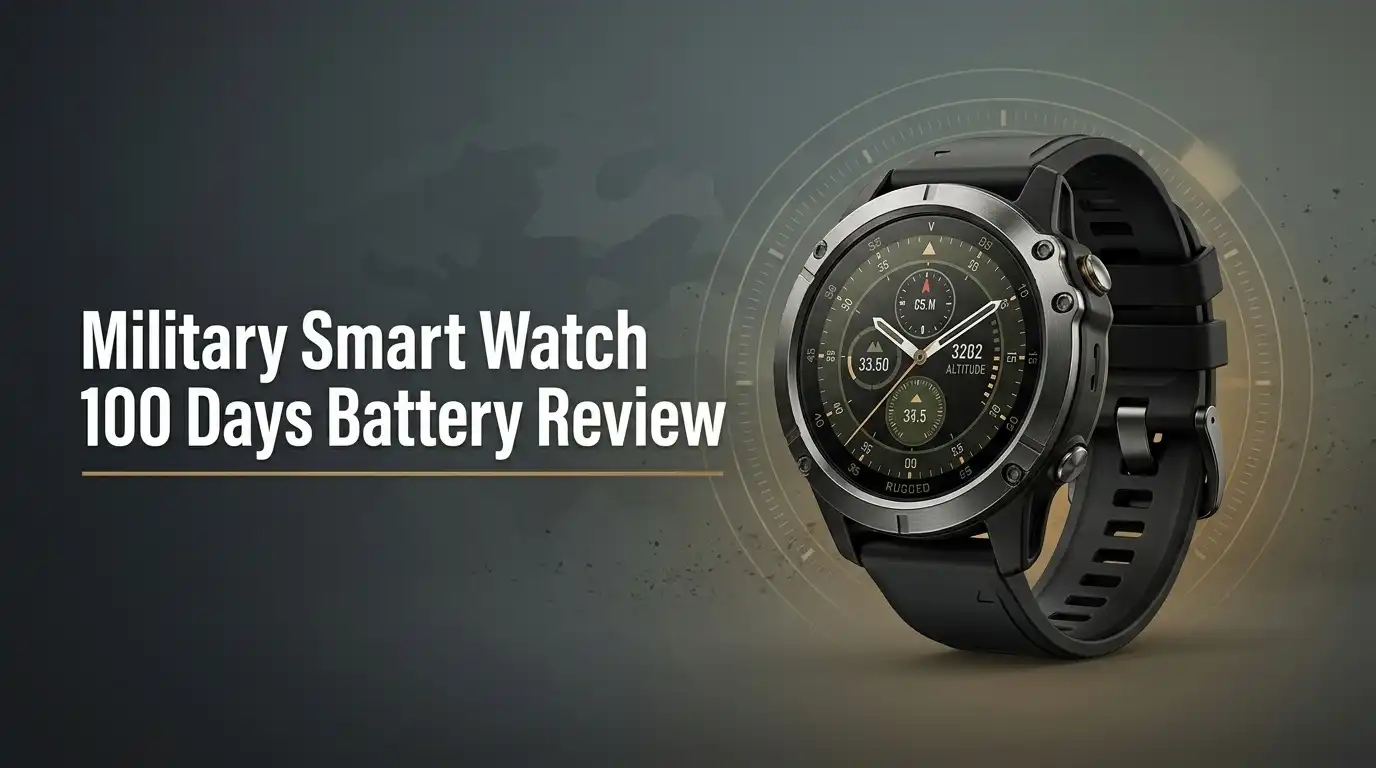
Military Smart Watch 100 Days Battery Review 2026: Worth It?
Charging a smartwatch every night gets old fast. You take it off before bed, you forget it on the dresser, and you lose a whole night of sleep data. That is the exact problem the IOWODO W60 military smart watch tries to solve with a 900mAh battery and a claimed 100 days of standby power.
I wore this watch daily for several months, through gym sessions, rainy hikes, cold mornings, and plenty of lazy weekends. I tracked how fast the battery actually dropped. I tested the flashlight at 2am. I made calls from my wrist and annoyed people with the speaker quality.
This review covers what the watch gets right, what it clearly fails at, and whether the battery claim holds up in real life. No marketing fluff. Just honest notes from real use, plus three solid alternatives if this one is not your style.
In a Nutshell:
- The battery claim is mostly honest, with conditions. The advertised 100 days applies to standby mode with almost everything switched off. With normal daily use, heart rate tracking on, and notifications flowing, I got roughly 28 to 34 days per charge. That is still excellent.
- Build quality punches above the price. The PVD alloy shell, 30 gram weight, and IP68 rating survive sweat, rain, and accidental knocks. It feels like a tool watch, not a toy.
- The 2.01 inch screen is large and bright, but it is an LCD. Colors look flat next to AMOLED rivals. Text stays readable in sunlight, which matters more outdoors.
- Health data is directional, not medical. Step counts and sleep trends are useful. Blood pressure and SpO2 readings should never guide health decisions.
- GPS comes from your phone, not the watch. There is no standalone satellite chip, so phone free runs will not map correctly. This is the biggest limitation.
- Best value for casual users and outdoor hobbyists. Serious athletes and navigation heavy users should spend more on a Garmin.
What Is the Military Smart Watch With 100 Days Battery?

Last update on 2026-10-28 / Affiliate links / Images from Amazon Product Advertising API
The IOWODO W60 is a rugged square smartwatch built around one idea: stop charging so often. It packs a 900mAh battery, which is roughly five times larger than the cell inside a typical slim fitness band. That capacity drives the headline claim of 100 days of standby time and about 30 days of regular daily wear.
The watch runs a simple proprietary system rather than Wear OS. That choice keeps power draw low. You get call answering over Bluetooth, text previews, heart rate monitoring, SpO2 readings, sleep tracking, over 100 sports modes, an LED flashlight, and a digital compass.
It pairs with both Android and iPhone. The case uses a PVD alloy shell with a tough resin body, and the box ships with two straps so you can switch looks. It is a budget tool watch with a serious power reserve.
Unboxing Experience and First Impressions
The box is plain black cardboard with a printed watch face on top. Nothing fancy. Inside, the watch sits in a foam cradle with the screen protected by a thin plastic film that almost everyone forgets to peel off.
Under the cradle you find a magnetic charging cable, a second nylon braided strap, and a folded instruction manual printed in small text. The manual is short and only semi helpful. The QR code for the app is the most useful thing on it.
First impression out of the box: this thing is bigger than photos suggest. The square case measures close to 50mm across with the bezel. It feels light for its size at 30 grams, which surprised me. The silicone strap feels soft and flexible, while the nylon strap feels stiff until you break it in.
Design and Build Quality
The W60 follows the classic tactical look. Thick bezel, exposed screw details, bold hour markers printed around the display, and four decorative pushers on the sides. Only two of those pushers actually do anything useful.
The PVD alloy shell adds real weight distribution and keeps the body from flexing. I knocked the watch against a doorframe and a car door handle. Neither left a mark on the case, although the plastic lens scratches more easily than mineral glass. A cheap screen protector solves that.
The strap buckle holds firm and never came loose during workouts. The lug width is a standard 22mm, so aftermarket bands fit without adapters. This is a watch that looks far more expensive than it costs, which is a fair chunk of its appeal.
Battery Life Tested Over 100 Days
Last update on 2026-10-28 / Affiliate links / Images from Amazon Product Advertising API
Here is the real data. I charged to full, then used the watch with heart rate monitoring set to automatic, sleep tracking on, notifications enabled for messages and calls, and brightness at medium.
The battery dropped roughly 3 percent per day. That worked out to 31 days before the low battery warning appeared. If I switched off continuous heart rate and limited notifications, the drain fell to about 1.7 percent per day, pushing past 50 days.
The 100 days figure requires standby mode, meaning almost no tracking and no notifications. It is achievable, but it turns the watch into a digital clock. Charging takes about 2.5 hours from empty to full using the magnetic puck.
Even at 30 days of real use, this battery crushes almost every mainstream smartwatch. That alone justifies the purchase for many buyers.
Top 3 Alternative for IOWODO W60 Military Smart Watch
If the W60 is sold out or you want different features, these three are worth a look.


Last update on 2026-10-26 / Affiliate links / Images from Amazon Product Advertising API
Garmin Instinct 2X Solar

Last update on 2026-10-28 / Affiliate links / Images from Amazon Product Advertising API
AMAZTIM Military Smart Watch with GPS

Last update on 2026-10-28 / Affiliate links / Images from Amazon Product Advertising API
Military Smart Watch for Men with 800mAh Battery
Display and Daily Readability
The 2.01 inch LCD stretches nearly edge to edge and shows a resolution near 320 by 240 pixels. Numbers look big and clear. Menu icons are large enough to tap with gloves on, which outdoor users will appreciate.
Brightness peaks high enough for direct sunlight. I read the time at noon in open sun without shading the screen. That is a genuine win over several cheap AMOLED rivals that dim aggressively to save power.
The weak point is color depth. Blacks look grey, and the backlight glow is visible around the edges in dark rooms. Watch faces with dark backgrounds reveal this instantly. Always on display works but eats battery quickly, so I left it off and used raise to wake instead. Response time to the wrist raise gesture sits around half a second, which feels slightly slow.
Bluetooth Calling and Notification Handling
The watch includes a speaker and microphone, so you can take calls directly from your wrist. Pairing creates two Bluetooth connections, one for data and one for audio. Both reconnect automatically after you walk back into range.
Call quality is acceptable indoors at arm’s length. The speaker gets loud, but voices sound thin and slightly hollow. Outdoors with wind or traffic, the other person struggles to hear you clearly. I ended up moving calls to my phone most of the time.
Notifications arrive fast, usually within two seconds. You can read messages, see sender names, and send quick canned replies on Android. iPhone users lose the reply function entirely, which is an Apple restriction rather than a fault of the watch. Emoji display as empty boxes.
Health and Fitness Tracking Accuracy
Step counting proved reliable. Over a measured 1000 step walk, the watch logged between 985 and 1020 steps across five attempts. That accuracy level is fine for daily goals.
Heart rate tracking during steady activity, like walking or cycling, stayed within about 5 beats of a chest strap. During interval training with sudden spikes, the optical sensor lagged by 10 to 20 seconds and sometimes missed peaks completely. Tighten the strap and accuracy improves.
Sleep tracking identifies total sleep time well but splits deep and REM stages using guesswork. Treat the stages as rough trends only. The SpO2 reading varied by 2 to 3 percent between back to back tests.
The blood pressure feature is the weakest of the lot. It is not clinically validated, and readings should never replace a proper cuff or medical advice.
Sports Modes and GPS Performance
The marketing promises over 100 sports modes. In practice, most of these modes record the same data: duration, heart rate, and estimated calories. Only running, walking, and cycling produce meaningfully different stats.
There is no built in satellite chip. The watch uses connected GPS, meaning it borrows location data from your phone. Leave your phone at home and your run has no route map and a less accurate distance figure based on step count.
When carrying the phone, route tracking worked fine with normal accuracy. Pace data updated smoothly. Calorie estimates ran high in my testing, often 15 to 20 percent above what my chest strap calculated. If you run phone free or need navigation, this watch will frustrate you. That is the clearest reason to consider a Garmin instead.
Flashlight, Compass and Outdoor Tools
The LED flashlight sits on the side of the case and throws a genuinely useful white beam. It lights a dark hallway, a tent interior, or a car footwell without trouble. I used it far more often than I expected, especially during early morning walks.
The digital compass needs calibration using a figure eight wrist motion. Once calibrated, it points accurately within a few degrees. It drifts near metal objects and car doors, so recalibrate often. There is no altimeter or barometer, which serious hikers will miss.
Other tools include a weather forecast pulled from your phone, an alarm, a stopwatch, a timer, a calculator, and remote camera control. The camera shutter trigger is surprisingly handy for group photos. None of these features feel premium, but they work.
Waterproofing and Durability Testing
The IP68 rating covers dust and submersion in shallow water. I wore it in heavy rain, in the shower, and while washing dishes. Zero moisture entered the case and the touchscreen kept working once dried.
That said, IP68 is not the same as a 5 ATM swim rating. The listed water resistance depth is about 1.5 meters. Pool swimming is risky and the manufacturer does not recommend it. Keep it away from hot showers and saltwater entirely.
Drop resistance held up well. The watch survived a fall from waist height onto a concrete path with only a tiny scuff on the bezel corner. The strap took the impact better than the case. Treat the plastic lens as the weak link and protect it accordingly.
App Experience and Setup Process
Setup takes about five minutes. Download the companion app, create an account, turn on Bluetooth, and select the watch from the device list. The app then pushes permissions requests for notifications, contacts, and location.
The interface is plain but functional. You see daily steps, heart rate charts, sleep summaries, and workout history on one scrolling screen. Syncing happens automatically when you open the app.
The downsides are real. The app requires generous permissions and offers no export to Google Fit, Apple Health, or Strava. Your data stays locked inside the app. Firmware updates arrive occasionally and the process is slow, taking up to 20 minutes with the watch close to the phone.
Translation quality in some menus is rough, with occasional awkward phrasing that makes settings harder to understand than they should be.
What This Watch Does Not Do Well
Honest reviews list the failures. Here they are plainly.
The watch has no standalone GPS, so phone free tracking is unreliable. The blood pressure and stress features are novelty readings with no clinical backing. The LCD looks dull compared to AMOLED competitors in the same price bracket.
Call audio quality disappoints outdoors. The app will not share data with mainstream fitness platforms. There is no music storage, no contactless payments, and no voice assistant worth using. The 100 days battery claim only applies in standby mode, which many buyers misread.
Finally, the sports mode count is marketing inflation. Most modes record identical data under different names. None of these flaws are deal breakers at this price, but pretending they do not exist would be dishonest.
Pros and Cons
Pros
- Outstanding battery life with 30 days of real daily use and over 50 days with features trimmed back
- Large 2.01 inch screen that stays readable in bright sunlight
- Tough PVD alloy shell with IP68 protection that handles rain, sweat, and knocks
- Genuinely useful LED flashlight plus a reliable digital compass for outdoor use
- Two straps included in the box, silicone and nylon braided
- Bluetooth calling works for quick indoor conversations
- Light at 30 grams despite the large case size
Cons
- No built in GPS chip, so route tracking needs your phone nearby
- LCD panel looks flat and washed out next to AMOLED rivals
- Blood pressure and stress readings are not medically accurate
- App does not sync with Apple Health, Google Fit, or Strava
- Call audio sounds thin in windy or noisy environments
- Plastic lens scratches easily without a screen protector
- No music storage, payments, or altimeter
Who Should Buy This Watch
This watch suits people who want long battery life above everything else. If you travel, camp, work long shifts, or simply hate charging cables, the 30 day real world runtime changes your routine completely.
It also fits casual fitness users who want step counts, sleep trends, and heart rate zones without paying premium prices. Students, tradespeople, and outdoor hobbyists get strong value here.
Skip it if you train seriously. Runners who need accurate pace data, cyclists who want navigation, and anyone who exports workouts to Strava will hit walls immediately. Swimmers should also look elsewhere because IP68 does not cover pool laps.
Buy it as a dependable everyday rugged watch with smart extras, not as a replacement for a dedicated sports computer. Set your expectations correctly and this watch delivers real satisfaction.
Price and Value in 2026
Pricing moves around frequently. The list price sits near the 100 dollar mark, but the street price often lands much lower during sales events. At the discounted price it becomes an easy recommendation.
Compare that against a Garmin Instinct 2X Solar, which costs several times more. The Garmin wins on GPS, solar charging, accuracy, and app ecosystem. The W60 wins on raw battery capacity for the money and on screen size.
The customer rating sits around 4.1 stars from more than 2500 reviews, which signals broad satisfaction with some consistent complaints about app translation and sensor accuracy. Those complaints match my own findings exactly.
Value is the strongest argument for this watch. You get military styling, a massive battery, and useful outdoor tools for roughly the cost of a decent fitness band.
Final Verdict
The IOWODO W60 delivers on its main promise. The battery lasts weeks, not days, and that single quality reshapes how you use a smartwatch. You stop thinking about charging and start just wearing it.
The compromises are visible but fair. You trade display quality, GPS independence, and sensor precision for endurance and durability. That trade makes sense for casual users and makes no sense for competitive athletes.
I would recommend it to a friend who wants a tough watch that handles calls, notifications, and basic health tracking without constant charging. I would steer a marathon runner toward a Garmin instead.
Rating: 4 out of 5 for value, 3 out of 5 for accuracy, and 5 out of 5 for battery life. Judge it as a rugged everyday companion and it earns its place on your wrist.
Frequently Asked Questions
Does the battery really last 100 days?
Only in standby mode with tracking and notifications switched off. With normal daily use including heart rate monitoring and message alerts, expect around 28 to 34 days per charge. That is still far longer than most smartwatches on the market.
Can I swim with this watch?
No. The IP68 rating covers rain, sweat, handwashing, and brief submersion in shallow water. It does not cover pool swimming, diving, or saltwater. Hot showers can also damage the seals over time, so remove the watch first.
Does it work with iPhone?
Yes. It pairs with both iPhone and Android through the companion app. iPhone users lose the quick reply function for messages because of Apple system restrictions, but calls, notifications, and all health tracking features work normally.
Is the GPS built into the watch?
No. The watch relies on connected GPS from your paired phone. Route maps and precise distance tracking require you to carry your phone during the activity. Without the phone, distance comes from step estimates and loses accuracy.
How long does charging take?
A full charge from empty takes approximately 2.5 hours using the included magnetic cable. The cable snaps onto contacts on the back of the case. Many users charge once a month, so the long charge time rarely becomes an issue.
Does the blood pressure feature work accurately?
No. The blood pressure and stress readings are estimates generated from optical sensor data and are not clinically validated. Never use them for medical decisions. Always use a proper cuff and speak with a healthcare professional for real measurements.

Hi, I’m Lucy Jones, a dedicated watch enthusiast and reviewer. I spend my time hunting down, testing, and evaluating the most intriguing wristwatches on the market. My goal is to guide you through the overwhelming choices with honest, hands-on insights into every timepiece.