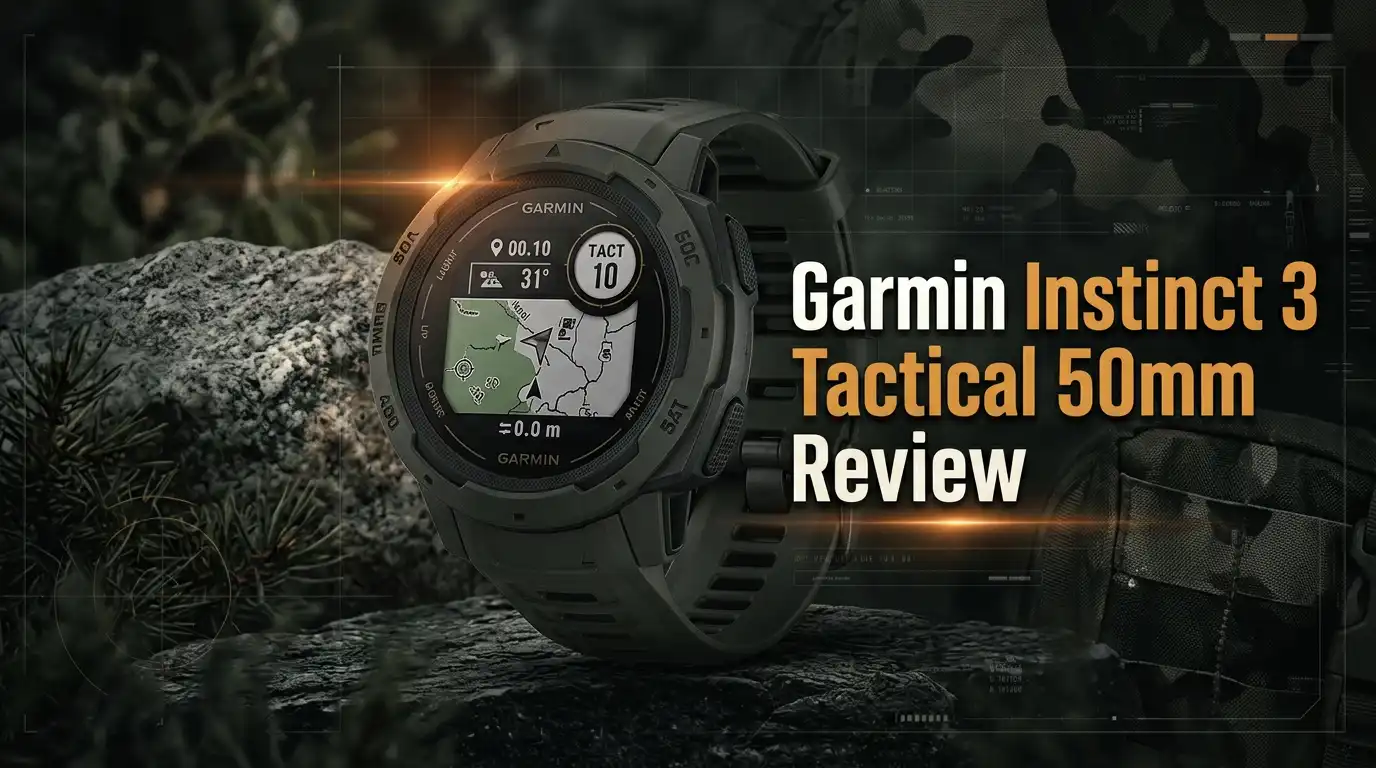
Garmin Instinct 3 Tactical 50mm Review 2026: Worth Buying?
The Garmin Instinct 3 Tactical 50mm looks like a watch that belongs on a ruck strap, not a charging dock. It promises weeks of battery, a green flashlight, night vision friendly screens, and a kill switch that wipes your data.
That mix sounds dramatic. The real question is simple. Does this watch earn its price in 2026, or are you paying extra for features you will never touch?
I spent weeks with this watch on trails, in the gym, during night walks, and on normal workdays. This review covers the unboxing, the honest weak spots, the battery numbers you can expect, and who should skip it. No marketing fluff. Just what the watch does, and what it fails to do.
In A Nutshell:
- Battery life is the headline feature. The AMOLED 50mm model runs roughly 22 to 24 days in smartwatch mode, and the Solar version pushes far longer with real sun exposure. You stop thinking about charging.
- Tactical extras are real but narrow. You get night vision mode, stealth mode, a kill switch, Jumpmaster, rucking, and a green flashlight. Most civilians will use two of those six.
- The $100 premium is the sticking point. The Tactical 50mm costs about $599 for AMOLED and $549 for Solar, while base Instinct 3 models sit $100 lower with nearly identical hardware.
- No offline maps. This is the biggest miss. You can follow a route, but you see a breadcrumb line, not a map. Cheaper watches from rivals include full mapping.
- The build quality is excellent. A metal reinforced bezel, 100 meter water rating, and a case that shrugs off doorframes and rock scrapes.
- The ballistics solver is not free. Applied Ballistics sits on the watch but stays locked until you pay $100 or $300 extra.
Garmin Instinct 3 Tactical 50mm: Quick Verdict


Last update on 2026-10-26 / Affiliate links / Images from Amazon Product Advertising API
This watch is a very good rugged GPS smartwatch wearing a tactical costume. The core hardware matches the standard Instinct 3 almost exactly. Same case, same optical heart rate sensor, same multiband GNSS, same 100 meter water resistance. The differences come from software and a reworked flashlight.
If you serve, hunt, or train in low light, the night vision mode and green LED genuinely help. The stealth mode and kill switch add peace of mind on deployment. If you just want a tough watch with huge battery life, the base Instinct 3 gives you 95 percent of this watch for $100 less.
The 50mm size suits bigger wrists. It feels purposeful, not delicate. Buy it for the tactical toolkit, not for the looks.
Unboxing Experience And First Impressions
The box is small, plain, and recyclable cardboard. Garmin stopped shipping fancy packaging years ago, and that is fine. Inside you find the watch, a short USB A to proprietary charging cable, and a thin folded quick start guide. That is the entire contents. No wall plug, no extra band, no screen protector.
The watch feels lighter than it looks. Pick it up and the fiber reinforced polymer case surprises you. It reads heavy duty on the eye and feather light on the wrist. The silicone band arrives slightly stiff and softens after a few days of wear.
First power on took about two minutes. Pairing with Garmin Connect took five. The screen lit up bright enough that I turned the brightness down immediately. It feels like gear, not jewelry.
Top 3 Alternative for Garmin Instinct 3 Tactical 50mm

Last update on 2026-10-26 / Affiliate links / Images from Amazon Product Advertising API
Garmin Instinct 3 Solar 50mm

Last update on 2026-10-26 / Affiliate links / Images from Amazon Product Advertising API
Garmin Instinct 2X Solar Tactical 50mm

Last update on 2026-10-26 / Affiliate links / Images from Amazon Product Advertising API
Garmin tactix 8 AMOLED 51mm
Design, Build Quality And Comfort
The 50mm case is thick and unapologetic. Garmin added a metal ring inside the bezel as reinforcement, which helps the watch survive knocks against rock and door frames. The lens resisted scratches across my test period, including one solid hit on a concrete wall.
Five physical buttons handle everything. No touchscreen. That sounds old fashioned until you wear gloves, and then it feels brilliant. Button presses stay firm and clicky, with no mush.
Comfort depends on your wrist. On a 7.5 inch wrist it sits flat and stable. On smaller wrists it overhangs. The band holes are generous, and the keeper loop actually stays put. Water resistance is rated to 100 meters, so swimming and heavy rain cause no concern at all. The all black finish hides scuffs well.
AMOLED Versus Solar: Which Display Wins
Garmin sells two display types in the Tactical line. The 50mm AMOLED gives you a bright 1.3 inch panel with deep blacks and sharp text. The Solar version uses a monochrome memory in pixel screen with a secondary display window and a solar charging lens.
The AMOLED looks modern. The Solar looks tactical. In direct sunlight, the Solar screen stays perfectly readable with zero backlight. The AMOLED needs brightness turned up, which drains battery.
For night operations, the AMOLED wins because its green night vision mode looks cleaner through optics. For raw endurance, the Solar wins by a mile. Pick AMOLED for daily readability and sharp data screens. Pick Solar if you treat charging as a chore you want to forget. Both share the same case and sensors.
Battery Life In Real World Use
Garmin rates the 50mm AMOLED at about 24 days in smartwatch mode with wrist gesture, dropping to roughly nine days with always on display. Amazon listings quote 22 days. My own results landed near 18 days with daily notifications, sleep tracking, and three GPS workouts per week.
Turn on always on display and that number falls hard. Pulse oximetry at night is the other battery killer. Leave it off unless you need it.
GPS endurance reached around 30 hours in standard mode. Multiband GNSS cuts that figure by roughly a third. The Solar 50mm stretches to 40 days of typical use, and in strong sun it can run effectively without a charger. Charging from empty takes about 90 minutes. Battery performance is the single best reason to own this watch.
Tactical Features That Actually Matter
Four exclusive features define the Tactical badge. Night vision mode dims the display into a green only state that works with night observation devices. Stealth mode disables Bluetooth and GPS so the watch broadcasts nothing. Kill switch deletes stored user data in seconds. Jumpmaster plans HAHO, HALO, and static line jumps with drop altitude and wind inputs.
Here is the honest part. Stealth mode will not satisfy a secure facility, since anyone can switch it back on. The kill switch removes files but leaves folder structures behind, so it will not defeat a serious forensic recovery attempt.
Dual grid coordinates, the tactical sport profile, and Xero sight integration are often listed as exclusives. They are not. The standard Instinct 3 already includes all three.
Night Vision Mode And The Green Flashlight
The Tactical model swaps the standard white and red LED flashlight for a white and green combination. Green causes less glare through night vision optics and reads more cleanly at low brightness than red. The flashlight is genuinely bright for its size and sits right on the top button.
I used it constantly. Finding a dropped key, checking a tent peg, reading a trail sign. It is the most useful feature on the watch, tactical or not.
Night vision mode has one catch worth knowing. If your optic focuses at five or ten meters, your wrist falls outside that focal plane and the screen blurs. You would need to adjust the diopter to read it. Garmin did its part, but physics still applies.
GPS Accuracy And Navigation Performance
Multiband GNSS comes standard, and accuracy impressed me. Tree cover, canyon walls, and tall buildings caused minor wobble at worst. Garmin SatIQ automatically switches between satellite modes to protect battery, and it works well enough that I stopped overriding it.
TracBack routing retraces your path reliably. The compass holds calibration. The barometric altimeter tracked elevation within a few meters of known markers.
Then comes the frustration. There are no offline maps. You can load a course and follow a thin breadcrumb line with distance and direction, but you see no terrain, no trails, and no roads around you. Competing watches at half this price include full mapping. For a watch marketed at navigation heavy users, this omission stings more than any other shortcoming.
Health, Fitness And Sleep Tracking
Garmin’s Gen 4 optical heart rate sensor sits on the back. Resting heart rate, Body Battery, stress, and respiration all track accurately against a chest strap in steady state activity. Interval work shows the usual wrist sensor lag, so pair a strap for serious training.
Sleep tracking improved a lot. Nap detection and Sleep Coach both arrived with the Instinct 3 generation, and the sleep score matched how I actually felt most mornings.
You get over 170 sport modes, training load focus, training load ratio, and multisport auto transition. That feature list used to belong to pricier Forerunner watches. The gap worth noting is ECG. The Instinct 3 line uses an older sensor, so no ECG and no irregular rhythm alerts. Health tracking is strong, just not cutting edge.
What This Watch Does Not Do Well
Authentic reviews name the flaws, so here they are. No offline mapping is the headline failure. No ECG function. No WiFi, which means music and software updates rely on your phone connection. No onboard music storage, so you cannot leave your phone behind on a run.
The Applied Ballistics solver sits locked on the device and costs $100 or $300 to unlock. Paying $599 for a watch and then paying again for its flagship shooting feature feels rough.
The 50mm case overwhelms small wrists. The AMOLED version loses the handy secondary display window that Solar keeps. Stealth mode and the kill switch are convenience features, not security grade tools. And the $100 tactical premium buys software, not better hardware.
Pros And Cons
Pros
- Outstanding battery life, with 18 to 24 days realistic on AMOLED and effectively unlimited on Solar in good sun
- Tough case with a metal reinforced bezel and 100 meter water resistance
- Green and white flashlight that is bright, fast to reach, and genuinely useful
- Accurate multiband GNSS with SatIQ battery management
- Five physical buttons that work perfectly with gloves and wet hands
- Deep fitness suite with 170 plus sport modes, rucking, and training load tools
- Night vision mode that works well with observation devices
Cons
- No offline maps, only breadcrumb route following
- Applied Ballistics solver requires a paid unlock
- $100 premium over base Instinct 3 for software only differences
- No ECG, no WiFi, and no onboard music storage
- Kill switch and stealth mode are not security grade
- 50mm size is too large for smaller wrists
- AMOLED model drops the secondary display window
Who Should Buy The Instinct 3 Tactical 50mm
Buy it if you are military, law enforcement, a hunter, or a serious long range shooter. The Jumpmaster planner, night vision mode, and green flashlight exist for you, and no cheaper Garmin offers them together.
Buy it if you want one watch that lasts three weeks between charges and survives abuse without complaint.
Skip it if you are a hiker, runner, or gym user drawn in by the tactical look. The base Instinct 3 gives you identical hardware, identical battery, and identical fitness tracking for $100 less. You lose a green flashlight and features you will never open.
Skip it if you need maps on your wrist. Look at Garmin’s Fenix or Tactix lines instead, or accept carrying a phone for navigation.
Price And Value In 2026
The Tactical 50mm AMOLED launched at $599.99, with the Solar 50mm at $549.99 and the Solar 45mm at $499.99. Street prices have softened since release, and discounts near $495 have appeared on the AMOLED model.
At full price, the value argument is thin. At a 15 to 20 percent discount, it becomes reasonable. The base Instinct 3 remains the smarter buy for most people at $499 and $449 respectively.
Garmin has supported this platform with steady software updates, and no feature here hides behind a Garmin Connect Plus subscription. That matters. You own what you buy, except the ballistics solver. Watch the price history and buy on a dip rather than at launch pricing.
Frequently Asked Questions
Is the Garmin Instinct 3 Tactical waterproof?
Yes. The watch carries a 100 meter water resistance rating, which covers swimming, snorkeling, and heavy rain. It is not built for scuba diving.
Does the Instinct 3 Tactical have maps?
No. It follows loaded courses as a breadcrumb line with turn prompts, but it shows no topographic or street maps. This is the watch’s largest weakness.
Is the ballistics calculator included?
The Applied Ballistics software ships on the watch but stays locked. Unlocking costs $100 for the Ultralight tier or $300 for the Elite tier.
AMOLED or Solar for tactical use?
Choose Solar for maximum battery and sunlight readability. Choose AMOLED for a sharper screen and a cleaner green night vision display.
How long does the battery really last?
Expect 18 to 24 days on AMOLED with normal use, or 40 days and beyond on Solar models with regular sun exposure.
Does it work with iPhone and Android?
Yes. Garmin Connect supports both platforms, and notifications, Garmin Pay, and Garmin Messenger all function on each.
Is the 50mm too big?
On wrists above roughly seven inches it fits well. Below that, the 45mm Solar Tactical is the better choice.

Hi, I’m Lucy Jones, a dedicated watch enthusiast and reviewer. I spend my time hunting down, testing, and evaluating the most intriguing wristwatches on the market. My goal is to guide you through the overwhelming choices with honest, hands-on insights into every timepiece.